Understanding the Epic: Why Did Draupadi Have Five Husbands?
The Mahabharata is a cornerstone of Indian mythology, filled with complex characters, intricate dharma, and divine interventions. Among its many mysteries, readers frequently ask why did draupadi have five husbands. This unique marital arrangement, known as polyandry, holds deep karmic, historical, and spiritual significance.
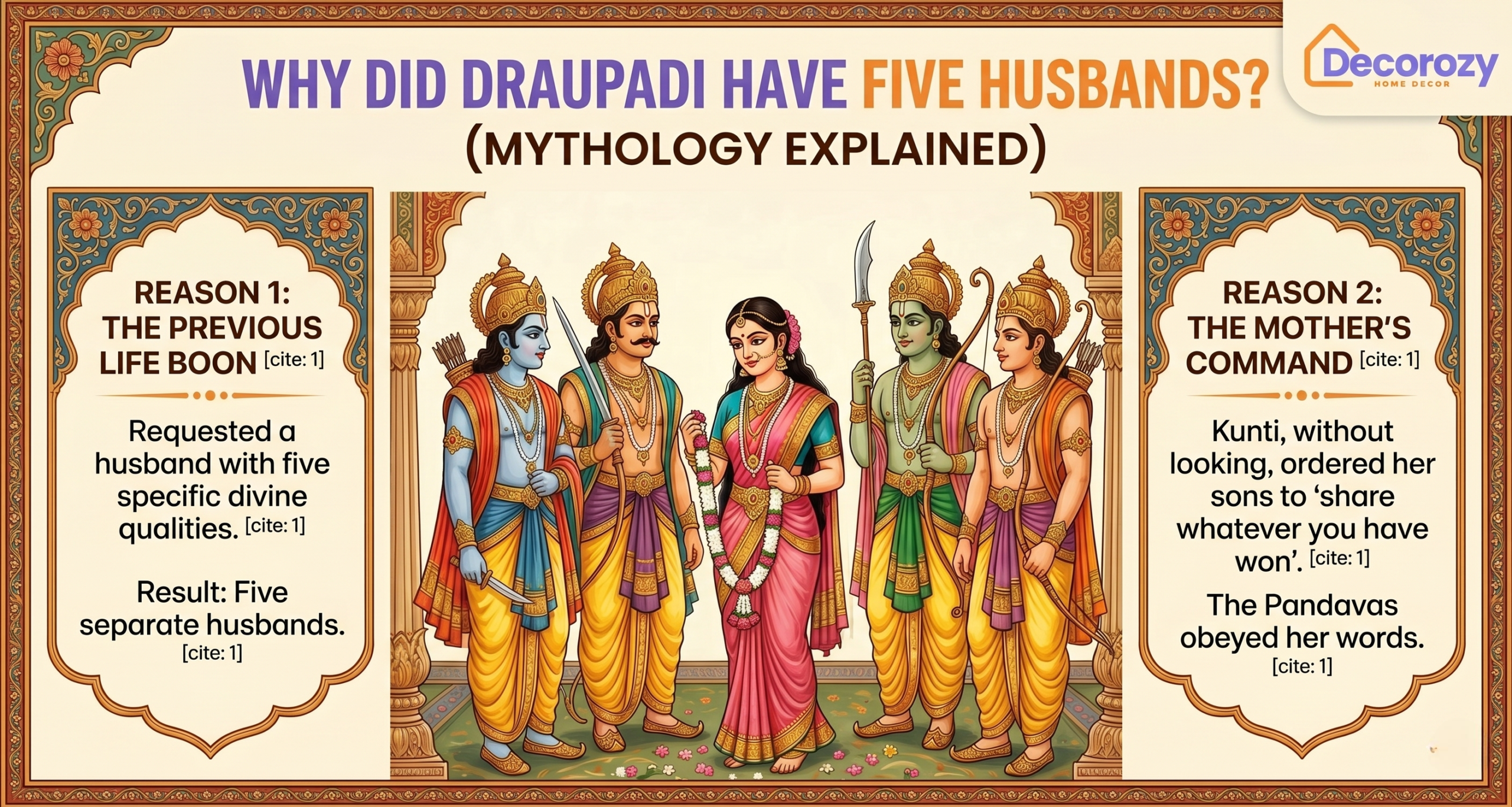
Quick Answer: Draupadi had five husbands due to a misunderstanding by Kunti, who unknowingly told her sons to share their “alms” equally. Additionally, Lord Shiva granted Draupadi a boon in her past life, decreeing she would marry five men possessing distinct divine qualities.
The Divine Boon: Why Did Draupadi Have Five Husbands in Past Lives?
According to ancient Vedic texts, Draupadi’s destiny was sealed long before her birth. In a previous life, she was a devout ascetic named Nalayani.
Nalayani performed rigorous, unwavering penance to please Lord Shiva. When the deity finally appeared, she was overwhelmed with emotion and devotion.
In her excitement, she asked for a husband endowed with fourteen distinct, perfect qualities. She anxiously repeated this request five separate times.
Lord Shiva granted her wish but explained that no single mortal could possess all these traits. Therefore, she was fated to marry five different men in her next life.
The Earthly Misunderstanding: How the Pandavas Became Her Spouses
In her earthly incarnation, Arjuna won Draupadi’s hand in a highly complex archery tournament. This event was known as her Swayamvara.
Arjuna brought his beautiful new bride home to his mother, Queen Kunti. From outside, he announced he had brought a wondrous “gift.”
Without looking, Kunti instructed her sons to equally share whatever they had brought home. In this era, a mother’s word was considered the ultimate, unbreakable law.
To honor Kunti’s unintended command and uphold absolute familial unity, the five Pandavas agreed to marry Draupadi together.
PREMIUM COLLECTIONS
Elevate Your Home with Timeless Elegance
Discover handcrafted God idols, luxury home décor, wooden handicrafts, and pooja essentials designed to create a peaceful and beautiful living space.
🏡
Premium Home Décor Store
Browse our complete collection of premium décor products and handcrafted designs.
Visit
🛕
God Idols Collection
Premium handcrafted idols for home temples, offices, and gifting.
Explore
🌸
Lakshmi Idol Guide
Discover elegant Lakshmi idols symbolizing prosperity and abundance.
Read
💪
Hanuman Idol Guide
Premium Hanuman idols representing strength, courage, and devotion.
Discover
🎨
Animal Décor
Unique decorative figurines crafted to enhance modern interiors.
Browse
🎁
Exclusive Best Deals
Enjoy special discounts on bestselling home décor collections.
Save Now
👜
Handcrafted Bags
Stylish handmade bags designed for everyday elegance.
Shop
Bring Beauty & Positivity to Every Corner
Explore India’s finest handcrafted God idols, traditional décor, and premium home accessories—all carefully curated for your home.
Shop Premium Collection →
The Deeper Symbolism: Why Did Draupadi Have Five Husbands Spiritually?
Beyond the literal storyline, this marital arrangement symbolizes the unity of the five elements and human senses. Each Pandava brother represented a different core virtue.
Yudhishthira was justice, Bhima was strength, Arjuna was skill, and the twins Nakula and Sahadeva represented beauty and wisdom.
Draupadi acts as the central grounding energy, or ‘Shakti,’ uniting these diverse and powerful forces into one unstoppable unit.
This impenetrable bond was ultimately crucial to their victory in the great Kurukshetra war. It kept the brothers from dividing their kingdom or their loyalties.
The tale of Draupadi is a fascinating blend of divine boons, human error, and cosmic purpose. Understanding this story enriches our appreciation of historical epics and cultural narratives. For more insights into cultural heritage and lifestyle inspiration, keep exploring Decorozy.com.
FAQ Schema
- Question 1: Who was Draupadi in her past life?
- Answer: In her past life, Draupadi was a pious ascetic named Nalayani. She prayed fervently to Lord Shiva for a perfect husband, which resulted in her unique divine boon.
- Question 2: Did Draupadi love all five husbands equally?
- Answer: While Draupadi respected and fulfilled her marital duties to all five Pandavas, the epic texts suggest she held a special, unspoken partiality for Arjuna, who originally won her hand in the Swayamvara.
- Question 3: What does polyandry mean in the context of the Mahabharata?
- Answer: Polyandry is the rare practice of a woman having more than one husband. In the Mahabharata, it serves a specific divine and moral purpose to keep the five Pandava brothers united against their enemies.