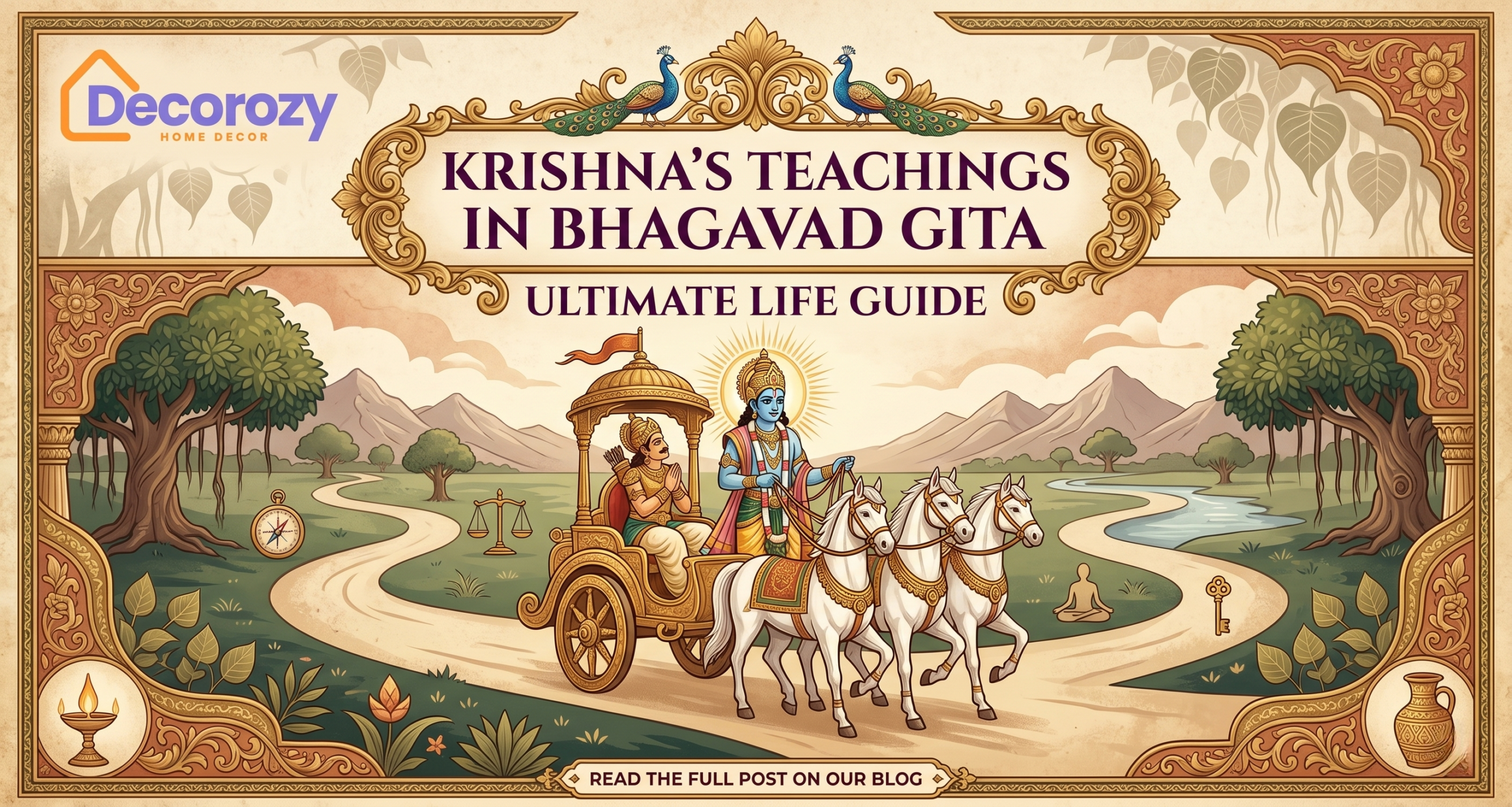
Understanding Krishna’s Teachings in Bhagavad Gita
The ancient wisdom of India holds timeless solutions for our modern struggles and daily anxieties. At the heart of this spiritual heritage lies a profound philosophical dialogue on the battlefield of Kurukshetra. Exploring Krishna’s teachings in Bhagavad Gita offers unparalleled clarity for navigating life’s ultimate challenges.
Quick Answer: Krishna’s teachings in Bhagavad Gita center on fulfilling righteous duty (Dharma) through selfless action (Karma Yoga), spiritual knowledge (Jnana Yoga), and devotion (Bhakti Yoga). He instructs Arjuna to act without attachment to the results, guiding humanity toward spiritual enlightenment, resilience, and lasting inner peace.
Core Concepts of Krishna’s Teachings in Bhagavad Gita
The foundation of these timeless lessons rests on the vital concept of Dharma. Dharma translates to righteous duty, cosmic order, or moral obligation in life.
Lord Krishna explains that every individual has a unique, inherent path to follow. Embracing this personal path without hesitation is crucial for long-term spiritual growth.
Another central pillar is the eternal, indestructible nature of the human soul (Atman). The physical body is temporary, but the inner spirit remains unaffected by time.
Understanding this separation helps individuals conquer their fear of mortality. It empowers us to face immense adversity with profound courage and mental stability.
The Importance of Krishna’s Teachings in Bhagavad Gita Today
Modern life is heavily saturated with stress, anxiety, and endless digital distractions. This makes the ancient wisdom of the Mahabharata more relevant today than ever before.
Practicing detached action frees us from the constant, paralyzing fear of failure. We learn to focus exclusively on our efforts, rather than obsessing over the final outcome.
This psychological shift dramatically reduces mental burnout and emotional exhaustion in the workplace. It allows professionals to achieve peak performance while maintaining a calm, focused mind.
Furthermore, these principles teach emotional resilience in the face of inevitable change. By grounding ourselves in spiritual wisdom, we navigate modern complexities with absolute grace.
Detailed Analysis: The Three Paths to Realization
The Gita introduces three primary, interconnected paths to achieve self-realization and ultimate liberation. These paths are designed to accommodate different human temperaments and lifestyle preferences.
The Path of Action: Karma Yoga
Karma Yoga is the dedicated path of selfless, intentional action. It requires performing our daily duties without any selfish desire for the resulting rewards.
By offering our daily tasks as a service to the divine, ordinary work transforms into worship. This practice eliminates the ego and fosters a deep sense of humility.
The Path of Knowledge: Jnana Yoga
Jnana Yoga represents the rigorous pursuit of ultimate truth and supreme spiritual wisdom. It involves intense self-inquiry and profound philosophical contemplation.
Practitioners learn to distinguish the eternal reality from the temporary illusions of the material world. This path develops powerful discernment and a razor-sharp intellect.
The Path of Devotion: Bhakti Yoga
Finally, Bhakti Yoga outlines the beautiful path of pure, unadulterated devotion. Unconditional love for the Supreme provides a direct, accessible route to inner peace.
Lord Krishna assures that total surrender to the divine guarantees protection and spiritual salvation. It is considered the most accessible path for humanity in the current age.
Overcoming Inner Conflict and Doubt
Arjuna’s initial paralysis on the battlefield mirrors our own moments of profound self-doubt. We often face moral dilemmas where the “right” choice seems impossible to identify.
Krishna’s teachings in Bhagavad Gita provide a systematic framework for breaking through this paralysis. The text encourages objective analysis over emotional impulsivity.
By stepping back and viewing our problems through a lens of universal duty, clarity emerges. We transition from emotional victims of circumstance to empowered architects of our destiny.
In conclusion, mastering these divine instructions provides a foolproof blueprint for a deeply fulfilling life. By aligning your daily actions with higher spiritual principles, true serenity is always within your reach.
Ready to transform both your physical and spiritual space for ultimate harmony? Explore more lifestyle insights, home optimization tips, and create your perfect sanctuary at Decorozy.com today!
FAQ Schema
- Question 1: What is the main message of the Bhagavad Gita?
- Answer: The primary message is to perform your righteous duty (Dharma) flawlessly without attachment to the final results. It emphasizes achieving self-realization and inner peace through the balanced practice of Karma, Jnana, and Bhakti Yoga.
- Question 2: Who was Lord Krishna speaking to in the Gita?
- Answer: Lord Krishna delivered his profound spiritual teachings directly to the warrior prince Arjuna. This transformative dialogue took place on the battlefield of Kurukshetra right before the beginning of the great Mahabharata war.
- Question 3: How can I apply the Bhagavad Gita in my daily life?
- Answer: You can apply these teachings by focusing intensely on your daily work without stressing over the future outcomes. Practice daily mindfulness, embrace your personal responsibilities, and maintain inner calm during unexpected life challenges.
CUSTOMERS ALSO EXPLORED
Discover More Beautiful Collections
Explore premium handcrafted décor, divine idols, traditional pooja collections, and exclusive decorative products loved by customers across India.
🌸
Durga Maa Idols
Elegant Durga Maa statues crafted with fine detailing.
View Products →
🦚
Radha Krishna Idols
Graceful Radha Krishna idols symbolizing eternal love.
Shop Now →
🐄
Kamdhenu Cow Idol
Premium Kamdhenu Cow with Calf decorative idol.
View Details →
🛕
God Idols Collection
Discover our complete collection of premium God idols.
Explore More →
🔥
Today’s Best Deals
Save more on bestselling décor and spiritual collections.
Grab Offers →
Looking for Premium Home Décor?
Shop handcrafted God idols, elegant home décor, traditional handicrafts, and exclusive collections designed to enhance every space.
Visit Decorozy →