The Ultimate Guide to the Bhagavad Gita Summary and Meaning
Ancient texts often hold the keys to modern tranquility and success. If you are seeking spiritual clarity or personal growth, understanding the Bhagavad Gita summary and meaning is a transformative first step.
This sacred scripture offers timeless wisdom on duty, action, and the human mind. By exploring its verses, we uncover profound truths that remain surprisingly relevant in our fast-paced, modern world.
Quick Answer: The Bhagavad Gita is a 700-verse Hindu scripture that forms part of the ancient Indian epic, the Mahabharata. It is a philosophical dialogue between Prince Arjuna and Lord Krishna, exploring profound concepts like duty (Dharma), righteous action (Karma), and the paths to spiritual liberation (Moksha).
Understanding the Bhagavad Gita Summary and Meaning
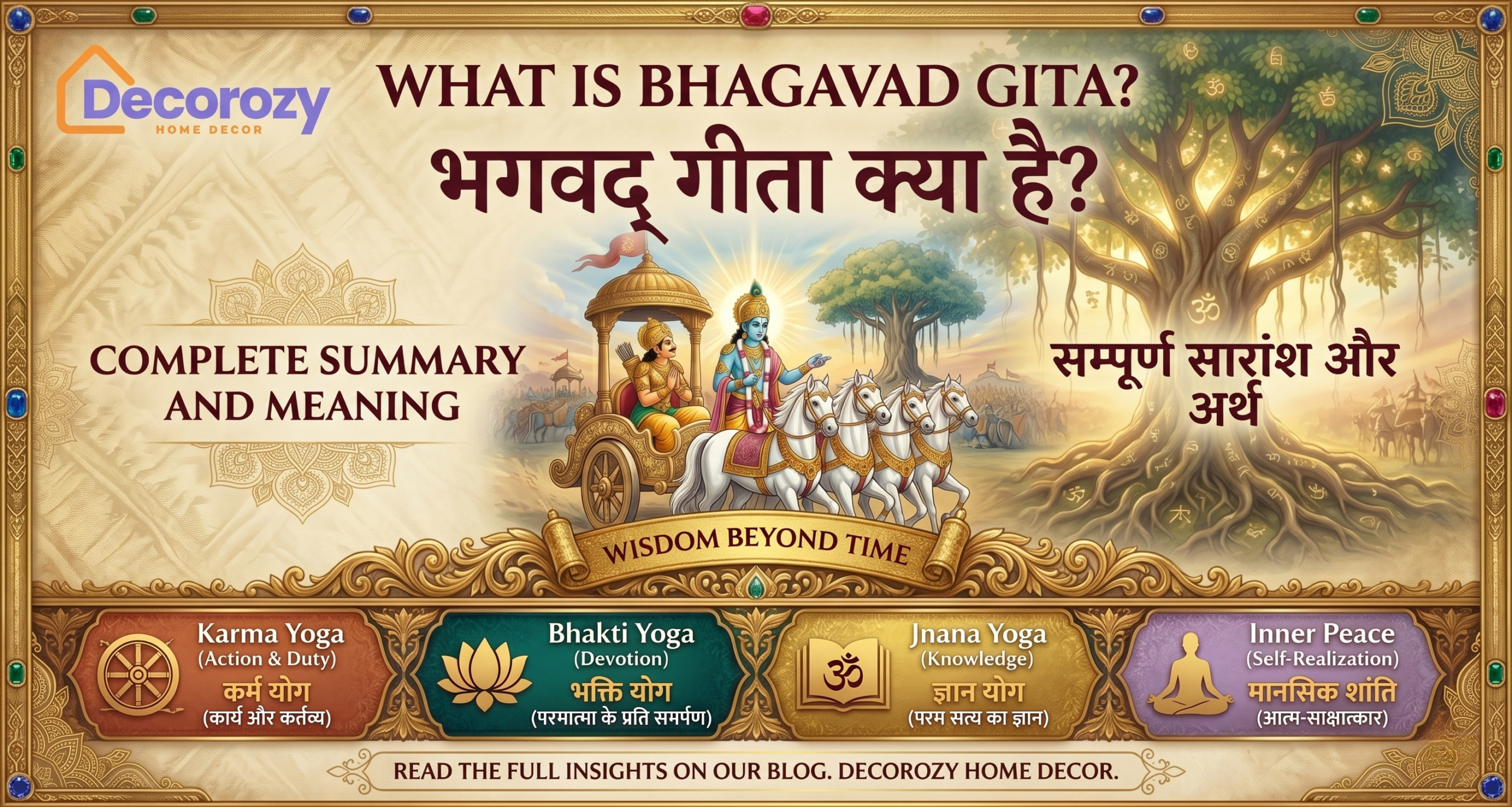
The Bhagavad Gita, often referred to simply as “the Gita,” is set on the battlefield of Kurukshetra. It takes place just moments before a massive and devastating war.
Prince Arjuna, a mighty warrior, looks across the battlefield and sees his own relatives, teachers, and friends. Overcome with deep moral despair and sorrow, he drops his weapons and refuses to fight.
At this critical moment, his charioteer, Lord Krishna, steps in to guide him. Krishna is not just a driver; he is an avatar of the Supreme Deity, offering ultimate divine wisdom.
The dialogue that follows is the core of the Gita. Krishna explains that Arjuna must fight to uphold justice and righteousness, effectively defining his moral duty.
Through this conversation, the text shifts from a literal battlefield to a metaphorical one. It represents the internal struggle between good and evil that every human being faces.
Key Lessons from the Bhagavad Gita Summary and Meaning
To fully grasp the Bhagavad Gita summary and meaning, we must look at its core teachings. The text outlines three distinct paths to achieve spiritual liberation.
The first path is Karma Yoga, the yoga of selfless action. It teaches us to perform our duties with supreme dedication, but without any attachment to the final results.
You are entitled to your labor, but not to the fruits of your labor. This mindset reduces anxiety and allows for pure, focused work in any professional or personal endeavor.
The second path is Jnana Yoga, the yoga of knowledge and wisdom. This path requires intense study, meditation, and deep intellectual inquiry.
Through Jnana Yoga, a seeker learns to distinguish between the temporary physical body and the eternal soul. It is the pursuit of ultimate truth and self-realization.
The third path is Bhakti Yoga, the yoga of loving devotion. Krishna states that this is the most direct and accessible path for the modern spiritual seeker.
By surrendering entirely to the Divine with pure love, an individual is freed from the cycle of birth and death. Devotion transcends all intellectual and physical limitations.
The Concept of Dharma and Righteousness
A central pillar in the Bhagavad Gita is the concept of “Dharma.” Dharma loosely translates to duty, righteousness, or moral law.
Every individual has a unique cosmic duty based on their nature and position in life. For Arjuna, his Dharma was to protect society as a righteous warrior.
Avoiding one’s Dharma leads to spiritual stagnation and societal chaos. The text emphasizes that it is better to do your own duty imperfectly than to perfectly copy someone else’s.
By following our own unique path, we align ourselves with the natural order of the universe. This brings deep inner peace and ultimate life satisfaction.
Overcoming the Mind and Senses
Another crucial theme in the Gita is the mastery of the human mind. Krishna describes the mind as restless, turbulent, and exceptionally difficult to control.
However, an uncontrolled mind acts as a person’s greatest enemy. It leads to endless desires, anger, and eventual self-destruction.
Through regular meditation and detachment, the mind can be tamed. A controlled mind becomes your greatest friend, acting as a serene vehicle for higher consciousness.
This ancient psychological insight is incredibly relevant today. In an era of constant digital distraction, the Gita offers a clear roadmap to mental focus and clarity.
Applying the Gita’s Wisdom Today
You do not need to be a monk to apply these ancient teachings. The Bhagavad Gita is specifically designed for the active person living in the real world.
When facing tough career choices or family conflicts, ask yourself what your true duty is. Act with integrity and let go of the obsessive need for a specific outcome.
By viewing life’s challenges as your own personal Kurukshetra, you can fight your daily battles with grace. The wisdom of Krishna serves as an eternal internal compass.
We hope this deep dive into the Gita brings value to your journey. For more insights on lifestyle, balance, and mindful living, continue exploring our expert guides right here on Decorozy.com!
FAQ Schema
- Question 1: Who wrote the Bhagavad Gita?
- Answer: Traditionally, the Bhagavad Gita is attributed to the ancient sage Vyasa. He is the revered author who compiled the Mahabharata, the epic poem that contains the Gita within its Bhishma Parva section.
- Question 2: What are the three main paths of Yoga in the Gita?
- Answer: The three primary paths to spiritual liberation are Karma Yoga (the path of selfless action), Jnana Yoga (the path of knowledge and self-realization), and Bhakti Yoga (the path of loving devotion to the Divine).
- Question 3: What is the central message of the Bhagavad Gita?
- Answer: The core message is to perform your righteous duty (Dharma) with complete dedication, while remaining unattached to the outcomes of your actions. It teaches mental discipline, devotion, and the realization of the eternal soul.
CUSTOMERS ALSO EXPLORED
Discover More Beautiful Collections
Explore premium handcrafted décor, divine idols, traditional pooja collections, and exclusive decorative products loved by customers across India.
🌸
Durga Maa Idols
Elegant Durga Maa statues crafted with fine detailing.
View Products →
🦚
Radha Krishna Idols
Graceful Radha Krishna idols symbolizing eternal love.
Shop Now →
🐄
Kamdhenu Cow Idol
Premium Kamdhenu Cow with Calf decorative idol.
View Details →
🛕
God Idols Collection
Discover our complete collection of premium God idols.
Explore More →
🔥
Today’s Best Deals
Save more on bestselling décor and spiritual collections.
Grab Offers →
Looking for Premium Home Décor?
Shop handcrafted God idols, elegant home décor, traditional handicrafts, and exclusive collections designed to enhance every space.
Visit Decorozy →