The Epic Life of Sita Explained: A Comprehensive Guide
Understanding ancient mythology requires looking past simple narratives to uncover profound human truths. Having the life of Sita explained reveals a story not just of a devoted wife, but of remarkable resilience, divine strength, and enduring grace. As a central figure in the Hindu epic, the Ramayana, Devi Sita’s journey continues to shape cultural values across the globe.
Quick Answer: The life of Sita represents a journey of divine resilience. Born from the earth, she married Lord Rama, endured a 14-year forest exile, and survived abduction by Ravana. Ultimately, her story highlights unwavering devotion, purity through the Agni Pariksha, and a final return to Mother Earth.
The Early Life of Sita Explained: Origins in Mithila
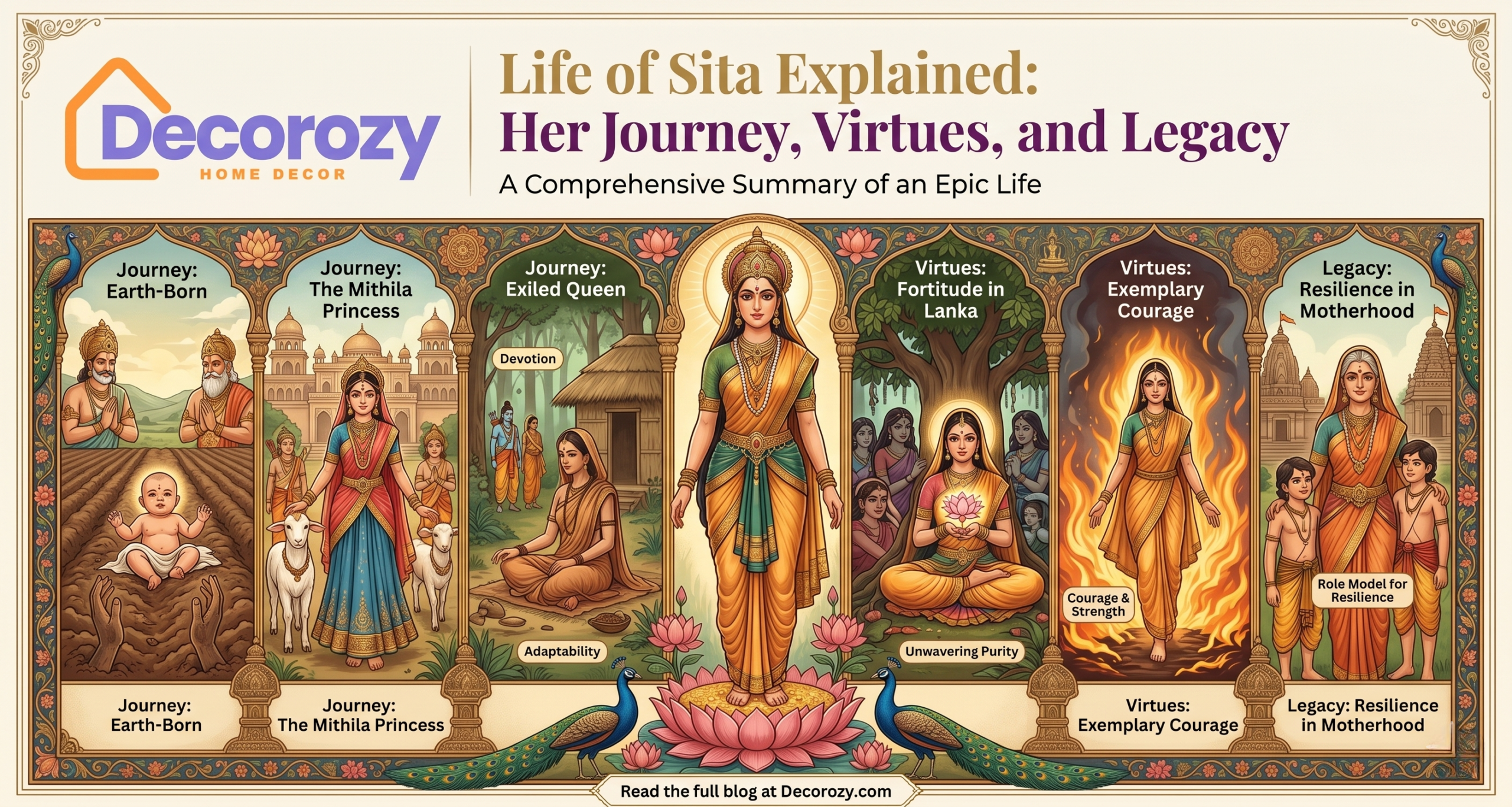
Sita’s origins are famously rooted in the divine rather than the mortal realm. King Janaka of Mithila discovered her in a furrow while ritually plowing a field to appease the gods. This miraculous birth earned her the name Bhumija, or daughter of the earth.
Growing up in the culturally rich kingdom of Mithila, she was educated in philosophy, duty, and statecraft. Her intellect and grace made her a respected princess long before her eventual marriage.
Her wedding to Lord Rama was secured through a legendary feat of strength. Rama successfully strung the divine Shiva Dhanush (bow of Shiva), winning her hand and forging a union that would shape ancient history.
The Life of Sita Explained: Exile, Abduction, and Resilience
The royal couple’s life was abruptly disrupted when Rama was banished from Ayodhya. Choosing loyalty and duty over palace comforts, Sita insisted on accompanying Rama into a grueling 14-year forest exile.
During their time in the Dandaka forest, the demon king Ravana orchestrated a deceitful plot. Using a golden deer as a distraction, Ravana breached their magical protections and abducted Sita, taking her to the island kingdom of Lanka.
Held captive in the Ashoka Vatika, Sita faced immense psychological pressure and daily threats. Despite Ravana’s attempts to woo or terrify her, she maintained absolute faith in Rama, demonstrating unparalleled emotional fortitude.
The Epic Rescue and the Trial of Agni Pariksha
The epic war of Lanka culminated in Rama defeating Ravana and dismantling his tyrannical empire. However, Sita’s liberation was immediately followed by one of the most controversial moments in the Ramayana.
To prove her purity to the world after months of captivity, Sita was asked to undergo the Agni Pariksha, a trial by fire. Guided by unshakeable truth, she walked through the blazing flames completely unscathed.
The fire god, Agni, personally testified to her absolute purity and unwavering devotion. This event restored her honor in the eyes of the public and allowed the couple to triumphantly return to Ayodhya.
The Second Exile and the Birth of Lava and Kusha
Despite her proven innocence, societal rumors in Ayodhya cast shadows on her reputation. Prioritizing his duties as a king over his personal happiness, Rama made the agonizing decision to banish a pregnant Sita.
She found sanctuary in the tranquil ashram of the sage Valmiki. It was here that she gave birth to twin sons, Lava and Kusha, raising them as formidable warriors and scholars.
Sita independently managed her life as a single mother in the wilderness. She ensured her sons memorized the epic poem of the Ramayana, eventually leading them to reunite with their father.
The Enduring Legacy and Cultural Impact of Devi Sita
Sita’s narrative concludes with a powerful assertion of her autonomy and divine origin. When asked to prove her purity once more before the court, she called upon Mother Earth to embrace her.
The ground split open, and Sita descended back into the earth, ending her mortal journey on her own terms. This dramatic exit solidified her status as a deity of immense power and self-respect.
Today, she remains a global symbol of strength, purity, and feminine resolve. For more insightful analyses of cultural history, spiritual decor, and mythology, continue exploring our expert resources here on Decorozy.com.
FAQ Schema
- Question 1: How was Sita born according to the Ramayana?
- Answer: Sita was not born from a mortal womb. King Janaka of Mithila discovered her as a baby in a furrow while ritually plowing a field, making her the spiritual daughter of Bhumi, the Earth Goddess.
- Question 2: Why did Sita undergo the Agni Pariksha?
- Answer: Following her rescue from Ravana in Lanka, Sita underwent the Agni Pariksha (trial by fire) to publicly prove her purity and unwavering loyalty to Lord Rama, silencing societal doubts regarding her captivity.
- Question 3: How did Sita die in the Ramayana?
- Answer: Sita did not experience a mortal death. When asked to prove her innocence a second time in Ayodhya, she prayed to Mother Earth to take her back. The earth opened up, and she descended into the ground.
CUSTOMERS ALSO EXPLORED
Discover More Beautiful Collections
Explore premium handcrafted décor, divine idols, traditional pooja collections, and exclusive decorative products loved by customers across India.
🌸
Durga Maa Idols
Elegant Durga Maa statues crafted with fine detailing.
View Products →
🦚
Radha Krishna Idols
Graceful Radha Krishna idols symbolizing eternal love.
Shop Now →
🐄
Kamdhenu Cow Idol
Premium Kamdhenu Cow with Calf decorative idol.
View Details →
🛕
God Idols Collection
Discover our complete collection of premium God idols.
Explore More →
🔥
Today’s Best Deals
Save more on bestselling décor and spiritual collections.
Grab Offers →
Looking for Premium Home Décor?
Shop handcrafted God idols, elegant home décor, traditional handicrafts, and exclusive collections designed to enhance every space.
Visit Decorozy →