8 Surprising and Interesting Facts About Ravan You Didn’t Know
The epic Ramayana paints a vivid picture of its primary antagonist, but there is far more to this complex figure than mere villainy. For history enthusiasts and mythology scholars alike, uncovering interesting facts about Ravan reveals a highly intelligent, multifaceted ruler. By looking past the traditional narratives, we find a character deeply rooted in scholarly pursuits, astrological mastery, and profound devotion.
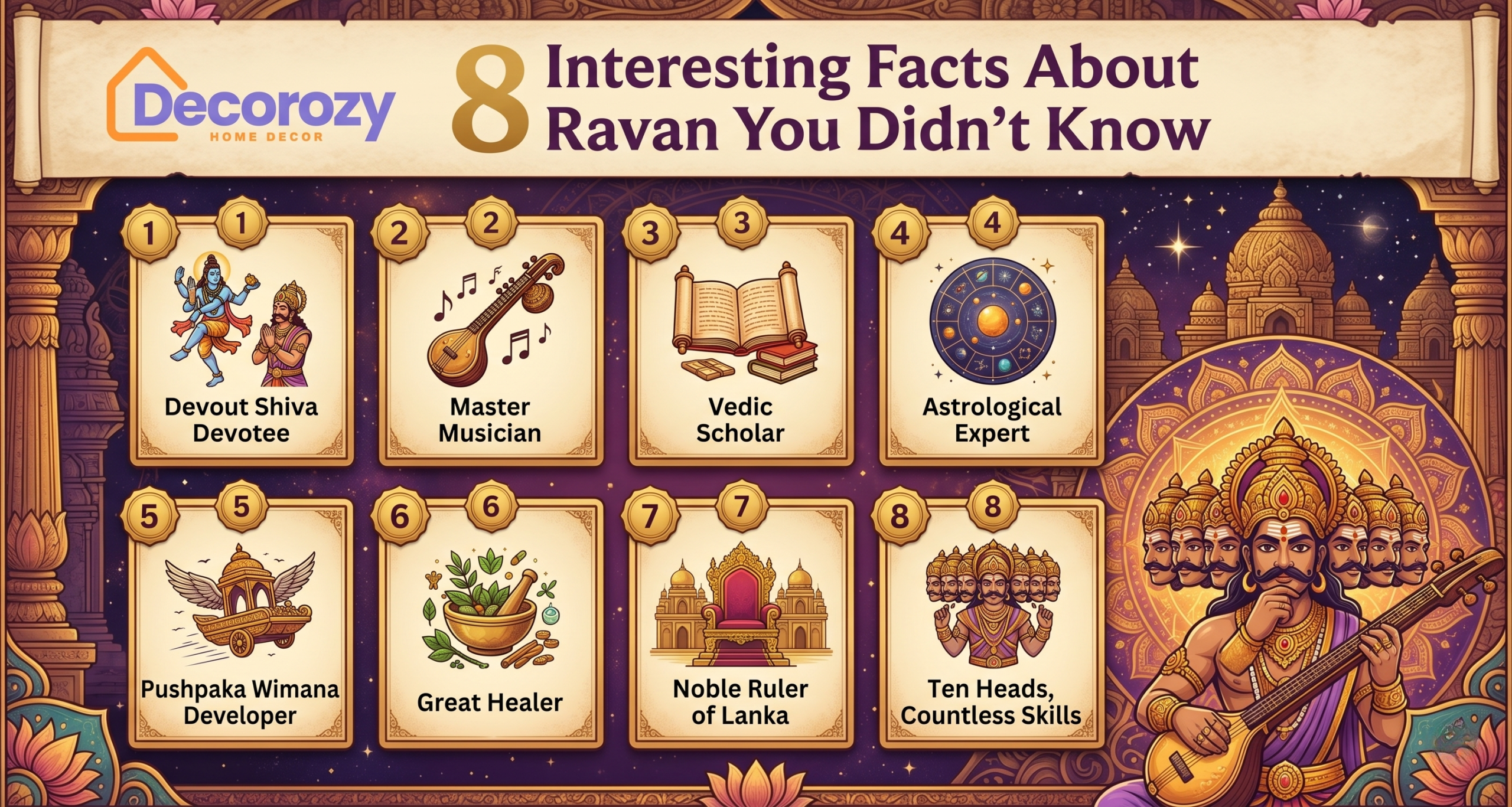
Quick Answer: The most interesting facts about Ravan include his lineage as Lord Brahma’s great-grandson and his mastery of astrology, where he reportedly altered planetary alignments. Furthermore, he was a maestro of the Veena, authored the Shiva Tandava Stotram, and imparted diplomatic wisdom to Lakshmana.
Beyond Mythology: Interesting Facts About Ravan’s Lineage
One of the most overlooked details in ancient texts is his direct connection to the creator of the universe. Ravan was actually the great-grandson of Lord Brahma, making his lineage highly prestigious.
His father was the famous sage Visravas, who was the son of Prajapati Pulastya. Pulastya was renowned as one of Lord Brahma’s ten “mind-born” sons. This elite Brahmanical lineage granted Ravan extraordinary intellectual capabilities and unparalleled access to ancient Vedic scriptures.
Despite his demonic characterization in popular culture, his biological roots commanded immense respect among sages. His half-Brahmin, half-demon (Daitya) parentage created a unique duality that defined his entire rule over Lanka.
Astrological Mastery: Interesting Facts About Ravan and the Planets
Among the most interesting facts about Ravan is his astonishing control over cosmic and planetary forces. Ancient scriptures suggest his power was so absolute that he could literally dictate the movement of celestial bodies.
During the birth of his son, Meghnad, Ravan wanted to guarantee the child’s immortality and invincibility. To achieve this, he instructed all the planets to align perfectly in the 11th house of his son’s astrological chart.
However, Saturn (Shani Dev) refused to comply, moving instead to the 12th house to disrupt the ritual. Enraged by this defiance, Ravan attacked Shani with his mace and imprisoned the deity. This legendary astrological intervention highlights the sheer magnitude of his authoritative power.
The Scholar and Musician: Hidden Talents of the Demon King
Far from being a mindless conqueror, Ravan was considered one of the most learned scholars to have ever lived. He possessed an encyclopedic knowledge of the four Vedas and six Upanishads, symbolizing his ten heads.
His intellectual depth extended to the arts, specifically as a maestro of classical music. He was an exceptionally skilled Veena player, and ancient depictions frequently show him carrying this classical stringed instrument.
His devotion to Lord Shiva inspired him to compose the “Shiva Tandava Stotram,” a highly complex and revered Sanskrit hymn. His musical prowess was so captivating that it is said to have moved Lord Shiva himself, cementing Ravan’s legacy as a divine artist.
Unexpected Alliances and Lesser-Known Defeats
While his final battle with Lord Ram is legendary, Ravan actually faced multiple crushing defeats earlier in his life. He was severely humbled by King Bali, who trapped him in a stable for months.
He was also defeated by Sahastrabahu Arjuna, a king with a thousand arms who washed Ravan’s army away by redirecting the Narmada River. Even Lord Shiva pinned Ravan under Mount Kailash when the arrogant king attempted to uproot the sacred mountain.
Ironically, Ravan also performed a sacred Yagya (fire ritual) for Lord Ram before the construction of the bridge to Lanka. Because Ravan was the most knowledgeable Brahmin in the region, he honorably officiated the ritual, essentially blessing Ram’s expedition against him.
Ultimately, his profound wisdom was utilized by Lord Ram, who sent his brother Lakshmana to sit at dying Ravan’s feet. In his final moments, the King of Lanka delivered a masterclass on statecraft, diplomacy, and the importance of never underestimating an enemy.
Discover more fascinating deep dives into history, mythology, and ancient architecture right here on Decorozy.com. Elevate your knowledge and explore the hidden stories that shape our world!
FAQ Schema
- Question 1: Who defeated Ravan before Lord Ram?
- Answer: Before his final battle with Lord Ram, Ravan was defeated by King Bali, Sahastrabahu Arjuna, and Lord Shiva. Bali physically trapped him, Sahastrabahu washed his army away, and Shiva crushed his hands under Mount Kailash.
- Question 2: Was Ravan related to Lord Brahma?
- Answer: Yes, Ravan was the great-grandson of Lord Brahma. His father was the sage Visravas, who was the son of Prajapati Pulastya, one of Lord Brahma’s ten original mind-born sons.
- Question 3: What did Ravan teach Lakshman before dying?
- Answer: On his deathbed, Ravan taught Lakshman critical lessons in statecraft and diplomacy. He emphasized the importance of never underestimating your enemy, trusting critical ministers, and maintaining good relations with your inner circle.
CUSTOMERS ALSO EXPLORED
Discover More Beautiful Collections
Explore premium handcrafted décor, divine idols, traditional pooja collections, and exclusive decorative products loved by customers across India.
🌸
Durga Maa Idols
Elegant Durga Maa statues crafted with fine detailing.
View Products →
🦚
Radha Krishna Idols
Graceful Radha Krishna idols symbolizing eternal love.
Shop Now →
🐄
Kamdhenu Cow Idol
Premium Kamdhenu Cow with Calf decorative idol.
View Details →
🛕
God Idols Collection
Discover our complete collection of premium God idols.
Explore More →
🔥
Today’s Best Deals
Save more on bestselling décor and spiritual collections.
Grab Offers →
Looking for Premium Home Décor?
Shop handcrafted God idols, elegant home décor, traditional handicrafts, and exclusive collections designed to enhance every space.
Visit Decorozy →