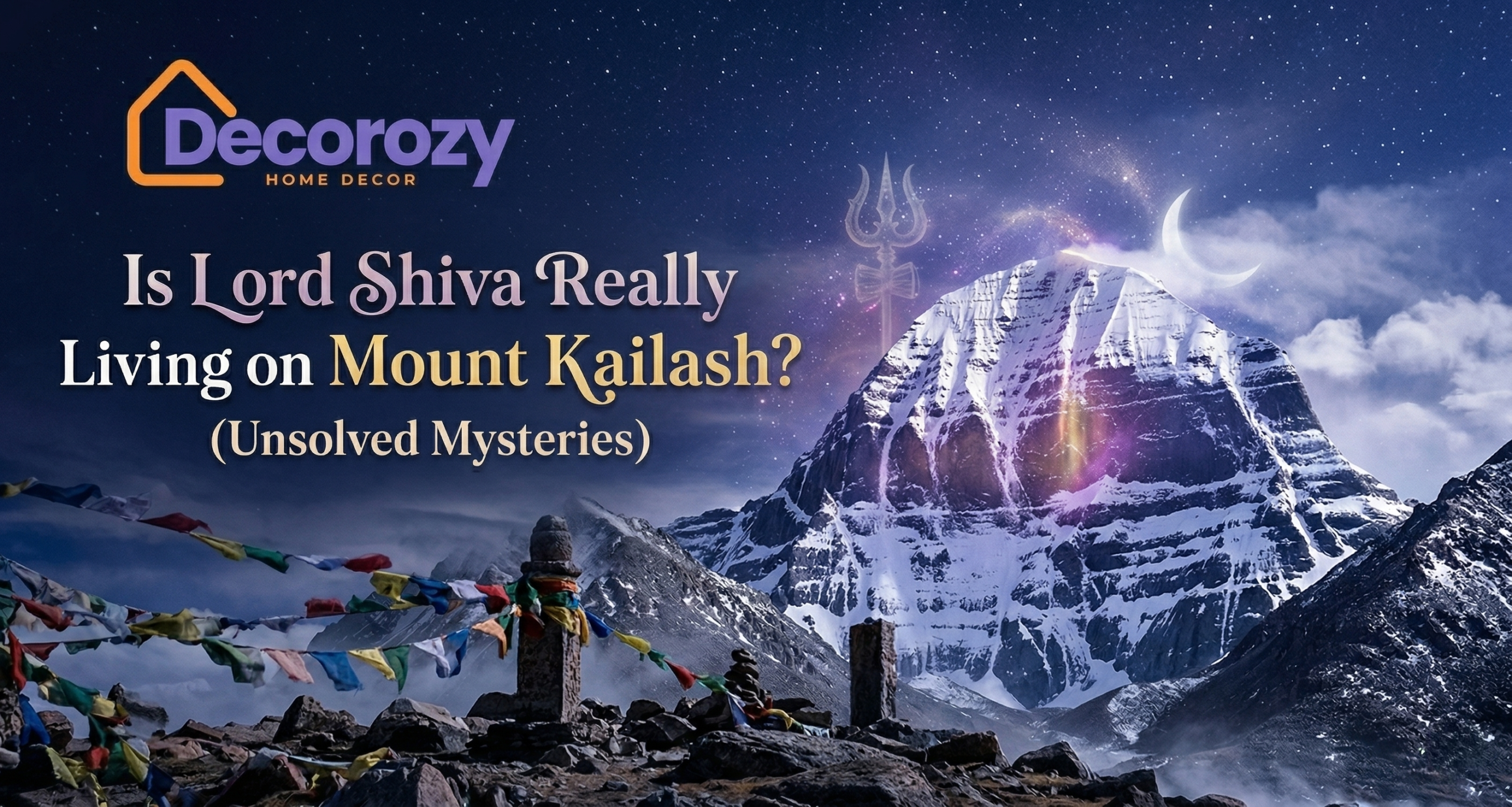
Rising majestically to 6,638 meters in the remote Transhimalayan range of Tibet stands a peak like no other. For centuries, spiritual seekers, scientists, and explorers have debated a profound question: is Lord Shiva really living on Mount Kailash? This enigmatic mountain remains completely unclimbed, surrounded by bizarre scientific anomalies and ancient legends.
Whether you view it through the lens of strict geographical science or deep religious faith, Mount Kailash commands undeniable reverence. It is not just a geographical wonder; it is the spiritual epicenter for billions of people across four major world religions. Let us dive deep into the facts, the myths, and the supernatural phenomena surrounding this sacred summit.
Quick Answer: While modern science views Mount Kailash as a unique geological formation, billions of Hindus believe it is the literal and spiritual abode where Lord Shiva resides in eternal meditation. There is no scientific proof of a physical entity living there, but its legally protected, unclimbed status preserves this ancient divine mystery.
The Core Concept: Is Lord Shiva Really Living on Mount Kailash?
To understand the immense gravity of this mountain, we must look at the ancient scriptures. In Hindu mythology, Mount Kailash is recognized as the ultimate physical and energetic abode of Lord Shiva. He is believed to sit in a state of perpetual meditation at the summit, alongside his consort, Goddess Parvati.
For devout Hindus, the mountain is not just a symbol; it is a massive, radiating energy center. The scriptures describe Kailash as the pillar of the world, where the divine vibrations of the universe are generated and maintained. Asking “is Lord Shiva really living on Mount Kailash” is, for believers, a question of experiencing this profound cosmic energy rather than seeking physical proof.
Interestingly, this reverence is not exclusive to Hinduism. For Tibetan Buddhists, the mountain is the earthly manifestation of Mount Meru, the cosmic center of the universe. Jains believe it is the site where their first Tirthankara attained spiritual liberation. The indigenous Bon religion of Tibet also regards it as the sacred nine-story swastika mountain, the seat of all spiritual power.
FEATURED COLLECTIONS
Discover Handcrafted Indian Home Décor
Explore beautifully crafted God idols, spiritual décor, handmade artifacts, and exclusive collections designed to enhance every corner of your home.
🛕
God Idols
Premium handcrafted idols for temples, homes, and gifting.
Explore →
🪷
Durga Maa Idols
Elegant Durga Maa idols crafted with exceptional artistry.
View Collection →
🧘
Buddha Idols
Peaceful Buddha statues for meditation and interior décor.
Shop Now →
🎨
Madhubani Paintings
Traditional Indian artwork that adds elegance to your walls.
Browse →
🐘
Animal Décor
Decorative figurines inspired by wildlife and nature.
Explore →
🪔
Pooja Essentials
Everything you need for traditional rituals and festivals.
View Products →
Don’t Miss Our Best Offers
Save more on premium home décor, handcrafted idols, wooden handicrafts, and decorative collections with our latest exclusive discounts.
View Best Deals →
Scientific Anomalies: Is Lord Shiva Really Living on Mount Kailash?
Beyond religious texts, Mount Kailash is a hotspot for unexplained physical phenomena that baffle modern researchers. One of the most documented mysteries is the accelerated aging experienced by pilgrims and trekkers near the base. Visitors frequently report that their hair and nails grow at an unusually rapid pace during the short trek.
Scientists hypothesize that this could be due to unique atmospheric pressures or highly concentrated magnetic energy fields. However, no definitive scientific consensus has been reached. Spiritual leaders argue that this time anomaly is direct evidence of divine presence, reinforcing the belief that the mountain operates on a higher vibrational frequency.
Furthermore, satellite imagery and geological surveys have revealed that the mountain bears an uncanny resemblance to a perfectly symmetrical pyramid. Russian scientists have even proposed the controversial theory that Mount Kailash is not a natural mountain at all. They suggest it could be a colossal, ancient, man-made pyramid built by an advanced civilization.
The Mystery of the Twin Lakes
At the foot of Mount Kailash lie two massive lakes that present another geographical paradox. Lake Mansarovar is a perfectly round, freshwater lake that remains incredibly calm, even in harsh weather. It is considered the lake of light and purity, created in the mind of Lord Brahma.
Right next to it is Rakshas Tal, a crescent-shaped saltwater lake that is perpetually stormy and turbulent. It is known as the lake of demons, lacking any aquatic plant or animal life. The stark contrast between these two adjacent bodies of water—one representing light and the other darkness—defies standard geological explanation.
The Divine Resonance of “Om”
Another fascinating anomaly reported by thousands of pilgrims is the acoustic environment surrounding the peak. When the wind howls through the jagged rocks and ice caves of Kailash, it reportedly creates a continuous, deep humming sound.
Many visitors and audio researchers have compared this frequency to the sacred syllable “Om.” Additionally, during the winter months, the snow sets into the mountain’s crevices in a way that physically resembles the “Om” symbol. For devotees, this acoustic and visual manifestation is clear proof of Lord Shiva’s eternal presence.
The Unclimbed Peak: Why Human Footsteps Never Reach the Top
You might wonder, with modern mountaineering technology successfully conquering Mount Everest, why has no one scaled Kailash? The answer lies in a combination of absolute spiritual reverence and strict legal prohibition. Climbing Mount Kailash is considered the ultimate act of sacrilege across multiple religions.
To step foot on the slopes is believed to be an intrusion into the divine realm of the gods. Recognizing this profound global sentiment, the Chinese government, which administers the Tibet Autonomous Region, has permanently banned all climbing expeditions. The mountain is officially protected as a pristine, untouchable sanctuary.
The Legend of Milarepa
According to ancient Tibetan folklore, only one person has ever successfully reached the summit of Mount Kailash. His name was Milarepa, an 11th-century Tibetan Buddhist mystic and poet. Legend states that he did not physically climb the mountain, but rather rode to the peak on a ray of sunlight.
Upon his return, Milarepa reportedly warned humanity never to attempt the ascent. He cautioned that the spiritual energy at the summit was too overwhelming for ordinary mortals. Since then, his warning has been respected, and no legitimate religious figure has ever sanctioned an expedition to the top.
Modern Expeditions and Mystical Deterrents
Before the strict governmental ban was enforced, a few Western and Russian teams allegedly attempted to map or climb the lower ridges. These expeditions were universally met with disaster. Climbers reported sudden, violent shifts in weather, failing navigational equipment, and a disorienting loss of direction.
Some accounts even claim that climbers experienced severe psychological breakdowns, forcing them to abandon their missions immediately. Whether these failures were caused by the brutal Transhimalayan weather or a protective divine force, they have only solidified the mountain’s untouchable reputation.
The Anatomy of the Kailash Mansarovar Yatra
For those seeking to connect with the divine, the ultimate pilgrimage is the Kailash Mansarovar Yatra. Since scaling the peak is forbidden, devotees instead perform a “Kora,” or circumambulation, around the base of the mountain. This arduous 52-kilometer trek is considered one of the most physically and spiritually demanding journeys on Earth.
Pilgrims endure freezing temperatures, extreme altitudes, and rugged terrain to complete the loop. Hindus believe that completing just one Kora will wash away the sins of a lifetime. Completing 108 Koras is said to guarantee instant Moksha, or liberation from the cycle of rebirth.
The Physical and Mental Challenge
The trek typically takes three days to complete, starting from the small outpost of Darchen. Pilgrims must cross the perilous Dolma La Pass, which sits at a breath-stealing altitude of 5,645 meters. Altitude sickness, severe fatigue, and harsh winds are constant companions on this sacred trail.
Despite the grueling conditions, thousands of people from all walks of life undertake this journey every year. They are driven by an unbreakable faith and the desire to feel the divine vibrations of Lord Shiva. The yatra is not merely a physical hike; it is a profound internal journey of self-discovery and spiritual awakening.
Conclusion
So, is Lord Shiva really living on Mount Kailash? Science may never provide a definitive answer that satisfies the analytical mind. However, the geographical anomalies, the unclimbed majesty of the peak, and the transformative experiences of millions of pilgrims speak volumes. Mount Kailash remains a powerful axis of spiritual energy, demanding respect and awe from all who look upon it.
If you are fascinated by the hidden mysteries of the world and want to bring a touch of that divine energy into your own space, explore our exclusive spiritual decor collections. Visit Decorozy.com today to elevate your home with artifacts inspired by the universe’s greatest wonders!
FAQ Schema
- Question 1: Has anyone ever climbed Mount Kailash?
- Answer: No modern mountaineer has ever climbed Mount Kailash. It is legally banned by the government to respect the religious beliefs of Hindus, Buddhists, and Jains. According to ancient Tibetan legends, only the 11th-century Buddhist mystic Milarepa has ever reached the summit.
- Question 2: Why does time supposedly move faster near Mount Kailash?
- Answer: Many pilgrims and explorers report that their hair and nails grow at an accelerated rate while visiting Mount Kailash. While scientists theorize this could be due to extreme altitude, unique atmospheric pressure, or localized magnetic fields, believers consider it a supernatural phenomenon of divine energy.
- Question 3: Is Mount Kailash actually a man-made pyramid?
- Answer: A controversial theory proposed by some Russian researchers suggests that Mount Kailash’s perfectly symmetrical shape makes it an ancient, colossal pyramid rather than a natural mountain. However, mainstream geologists maintain that the peak is a natural geological formation shaped by millions of years of glacial erosion.