CBSE vs ICSE vs State Board: The Ultimate Full Comparison Guide
Choosing the right educational path for your child is a crucial decision for any parent.
If you are caught in the “cbse vs icse vs state board” debate, you are certainly not alone in this complex journey.
This comprehensive guide will break down the core differences, helping you make an informed and confident choice.
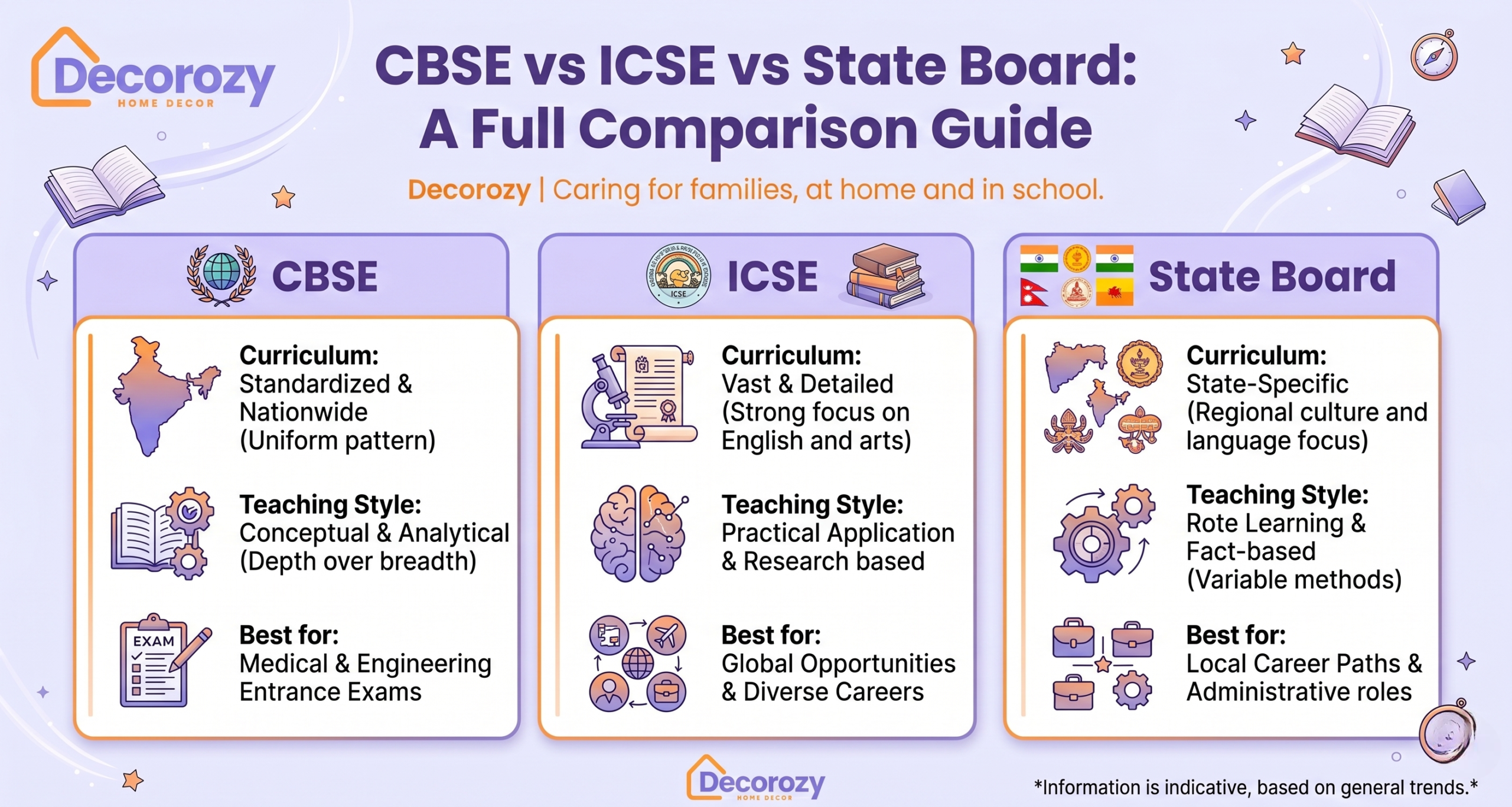
Quick Answer: The CBSE focuses on science and math, making it ideal for national entrance exams like JEE and NEET. ICSE offers a comprehensive, English-heavy curriculum prioritizing analytical skills. State boards emphasize regional language and local culture, offering a more localized educational approach.
Understanding the Basics of CBSE vs ICSE vs State Board
The Central Board of Secondary Education (CBSE) is a recognized national board overseen by the Union Government of India.
It follows a standardized curriculum across the country, making it highly preferred by families with transferable government or corporate jobs.
The Indian Certificate of Secondary Education (ICSE) is a prestigious private, non-governmental educational board.
It is renowned for its vast, detailed syllabus and strong emphasis on the English language, arts, and humanities.
State boards are managed independently by individual state governments across India.
Each state designs its own curriculum, meaning educational standards and syllabi can vary significantly depending on the specific region.
PREMIUM COLLECTIONS
Elevate Your Home with Timeless Elegance
Discover handcrafted God idols, luxury home décor, wooden handicrafts, and pooja essentials designed to create a peaceful and beautiful living space.
🏡
Premium Home Décor Store
Browse our complete collection of premium décor products and handcrafted designs.
Visit
🛕
God Idols Collection
Premium handcrafted idols for home temples, offices, and gifting.
Explore
🌸
Lakshmi Idol Guide
Discover elegant Lakshmi idols symbolizing prosperity and abundance.
Read
💪
Hanuman Idol Guide
Premium Hanuman idols representing strength, courage, and devotion.
Discover
🎨
Animal Décor
Unique decorative figurines crafted to enhance modern interiors.
Browse
🎁
Exclusive Best Deals
Enjoy special discounts on bestselling home décor collections.
Save Now
👜
Handcrafted Bags
Stylish handmade bags designed for everyday elegance.
Shop
Bring Beauty & Positivity to Every Corner
Explore India’s finest handcrafted God idols, traditional décor, and
PREMIUM COLLECTIONS
Elevate Your Home with Timeless Elegance
Discover handcrafted God idols, luxury home décor, wooden handicrafts, and pooja essentials designed to create a peaceful and beautiful living space.
🏡
Premium Home Décor Store
Browse our complete collection of premium décor products and handcrafted designs.
Visit
🛕
God Idols Collection
Premium handcrafted idols for home temples, offices, and gifting.
Explore
🌸
Lakshmi Idol Guide
Discover elegant Lakshmi idols symbolizing prosperity and abundance.
Read
💪
Hanuman Idol Guide
Premium Hanuman idols representing strength, courage, and devotion.
Discover
🎨
Animal Décor
Unique decorative figurines crafted to enhance modern interiors.
Browse
🎁
Exclusive Best Deals
Enjoy special discounts on bestselling home décor collections.
Save Now
👜
Handcrafted Bags
Stylish handmade bags designed for everyday elegance.
Shop
Bring Beauty & Positivity to Every Corner
Explore India’s finest handcrafted God idols, traditional décor, and premium home accessories—all carefully curated for your home.
Shop Premium Collection →
premium home accessories—all carefully curated for your home.
Shop Premium Collection →
Key Benefits: Evaluating CBSE vs ICSE vs State Board Curriculums
When comparing cbse vs icse vs state board, the primary benefit of CBSE is its alignment with major competitive exams.
Students often find it easier to prepare for medical and engineering tests due to the highly structured NCERT-based syllabus.
ICSE stands out for its holistic development and rigorous internal assessments.
Students from this board often excel in global language proficiency, literature, and management studies later in life.
State boards offer the distinct advantage of cultural relevance and regional language mastery.
They are highly beneficial for students aiming for state-level competitive exams, local universities, and regional civil services.
Detailed Analysis: Grading Systems, Pedagogy, and Future Scope
The CBSE grading system utilizes a 9-point scale, aiming to reduce student stress by replacing exact marks with grades.
Its pedagogy is highly structured, focusing heavily on conceptual understanding in core subjects like mathematics and physical sciences.
Conversely, ICSE provides detailed scoring and places equal weight on all subjects, including arts and physical education.
Its project-heavy pedagogy encourages critical thinking, deep research skills, and the practical application of theoretical knowledge.
State board grading systems and teaching methods depend entirely on the specific state’s educational department protocols.
While they provide excellent localized knowledge, students may sometimes need extra preparation when transitioning to national-level standardizations.
Selecting the best board depends entirely on your child’s aptitude, your location, and their future career goals.
Whether you choose the standardized CBSE, the comprehensive ICSE, or the localized State Board, parental support remains key.
For more expert insights on setting up the perfect study environment for your child, explore our premium decor and organizational guides on Decorozy.com today!
FAQ Schema
- Question 1: Which is better, CBSE or ICSE?
- Answer: Neither is objectively better; it depends on your goals. CBSE is ideal for students targeting engineering or medical entrance exams in India. ICSE is better for students focusing on humanities, management, or higher education abroad due to its strong English foundation.
- Question 2: Is the state board easier than CBSE?
- Answer: Generally, state board syllabi are considered slightly less rigorous in complex science and math compared to CBSE. However, state boards require high proficiency in the regional language, which can be uniquely challenging for non-native speakers.
- Question 3: Which board is best for the UPSC civil services exam?
- Answer: CBSE is widely recommended for UPSC preparation. The NCERT textbooks used heavily in the CBSE curriculum form the foundational knowledge base for many questions asked in the civil services preliminary and main examinations.