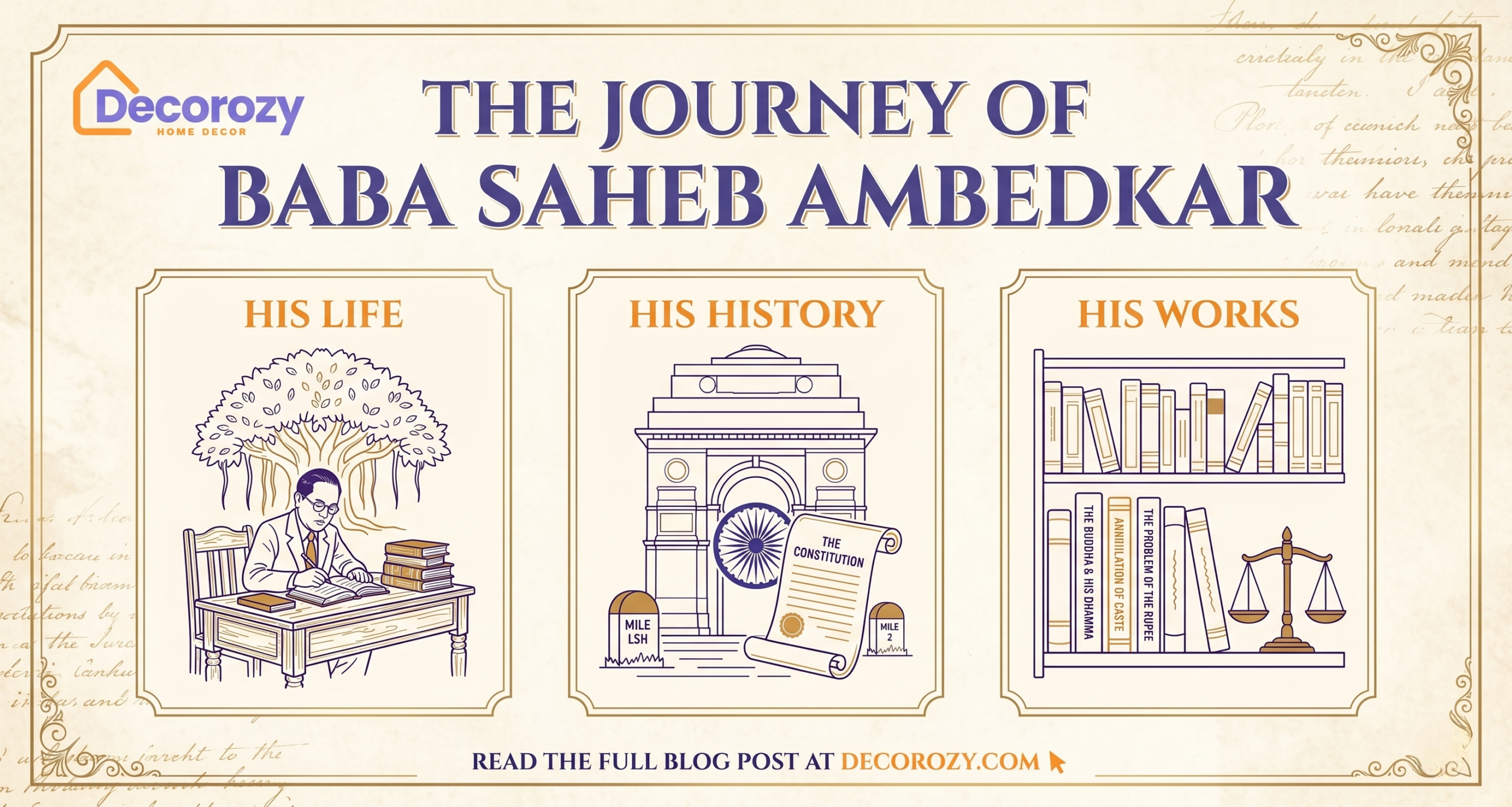
Dr. Bhimrao Ramji Ambedkar remains a towering figure in the global quest for human rights and equality.
Understanding the journey of Baba Saheb Ambedkar – life, history & works is crucial for recognizing the foundation of modern democracy.
His relentless struggle against systemic oppression continues to inspire millions and shape progressive legal frameworks worldwide.
Quick Answer: The journey of Baba Saheb Ambedkar encompasses his rise from facing systemic untouchability to becoming the principal architect of the Indian Constitution. His life, history, and works highlight his relentless advocacy for Dalit rights, women’s empowerment, and economic reform, ultimately shaping modern India’s democratic foundation.
Early Struggles in The Journey of Baba Saheb Ambedkar – Life, History & Works
Born on April 14, 1891, in Mhow, Ambedkar was introduced to the brutal realities of the caste system early on.
Despite facing severe discrimination and segregation in his classrooms, his brilliant mind could not be suppressed.
His extraordinary academic excellence eventually earned him prestigious scholarships to study abroad.
At Columbia University and the London School of Economics, he immersed himself in global philosophies.
This international education profoundly shaped his understanding of jurisprudence, economics, and universal human rights.
He returned to his homeland not just with multiple doctorates, but with a burning desire for social transformation.
These early academic triumphs form a vital chapter in the journey of Baba Saheb Ambedkar – life, history & works.
The Monumental Impact of The Journey of Baba Saheb Ambedkar – Life, History & Works
Ambedkar quickly recognized that political freedom was meaningless without genuine social equality.
He launched powerful grassroots movements to secure basic human rights for the marginalized Dalit communities.
The Mahad Satyagraha of 1927, a protest for the right to drink water from a public tank, was a historic turning point.
To further his cause, he established the Bahishkrit Hitakarini Sabha to promote education and socio-economic upliftment.
He fiercely opposed the deeply entrenched orthodoxies that systematically marginalized millions of citizens.
His courage to publicly burn the Manusmriti demonstrated his uncompromising stance against discriminatory texts.
Through these bold actions, he established himself as the undisputed leader of the Dalit rights movement.
PREMIUM COLLECTIONS
Elevate Your Home with Timeless Elegance
Discover handcrafted God idols, luxury home décor, wooden handicrafts, and pooja essentials designed to create a peaceful and beautiful living space.
🏡
Premium Home Décor Store
Browse our complete collection of premium décor products and handcrafted designs.
Visit
🛕
God Idols Collection
Premium handcrafted idols for home temples, offices, and gifting.
Explore
🌸
Lakshmi Idol Guide
Discover elegant Lakshmi idols symbolizing prosperity and abundance.
Read
💪
Hanuman Idol Guide
Premium Hanuman idols representing strength, courage, and devotion.
Discover
🎨
Animal Décor
Unique decorative figurines crafted to enhance modern interiors.
Browse
🎁
Exclusive Best Deals
Enjoy special discounts on bestselling home décor collections.
Save Now
👜
Handcrafted Bags
Stylish handmade bags designed for everyday elegance.
Shop
Bring Beauty & Positivity to Every Corner
Explore India’s finest handcrafted God idols, traditional décor, and premium home accessories—all carefully curated for your home.
Shop Premium Collection →
Literary Contributions and Powerful Journalism
Dr. Ambedkar was not only a political leader but also a prolific writer and formidable journalist.
He launched several newspapers, including Mooknayak (Leader of the Silent) and Bahishkrit Bharat (Ostracized India).
These publications served as powerful platforms to voice the grievances of the oppressed classes.
His books remain seminal texts in the study of sociology, politics, and historical injustice.
“The Annihilation of Caste” is arguably his most famous work, offering a piercing critique of the Hindu caste system.
He argued logically and passionately that caste was a systemic barrier to national progress and human dignity.
His literary works continue to be essential reading in universities and social justice circles globally.
Drafting the Constitution of India
The defining pinnacle of his public life was his appointment as the Chairman of the Constitution Drafting Committee.
Dr. Ambedkar meticulously studied various global democratic constitutions to craft a robust framework for an independent nation.
He ensured that the new Indian Constitution explicitly guaranteed fundamental rights to all citizens.
Crucially, under his guidance, the Constitution legally abolished the practice of untouchability.
He introduced comprehensive mechanisms for affirmative action to integrate historically disadvantaged groups into the mainstream.
His brilliant defense of the draft constitution in the Constituent Assembly is a masterclass in legal and political rhetoric.
Because of this monumental task, he is universally revered as the Father of the Indian Constitution.
Championing Women’s Rights and Labor Reforms
Dr. Ambedkar’s vision of equality extended far beyond the eradication of the caste system.
He was a staunch advocate for gender equality, recognizing that a society cannot progress if its women are oppressed.
As Law Minister, he introduced the Hindu Code Bill to revolutionize women’s rights in India.
This revolutionary bill sought to grant women equal rights in property inheritance, marriage, and divorce.
Although it faced severe orthodox opposition and forced his resignation, it laid the groundwork for future gender equality legislation.
Furthermore, as a labor minister in the Viceroy’s Executive Council, he introduced the 8-hour workday.
He also championed crucial labor welfare measures, including maternity benefits and equal pay for equal work.
Economic Vision and the Reserve Bank of India
Many historical accounts overlook Dr. Ambedkar’s profound and lasting contributions to the country’s economic structures.
He was a trained economist, and his thesis on “The Problem of the Rupee” was a groundbreaking work.
The guidelines and concepts presented in this thesis directly influenced the establishment of the Reserve Bank of India (RBI).
He consistently argued for a stable currency and equitable taxation policies to foster inclusive national growth.
Ambedkar also emphasized industrialization and agricultural reform as the primary tools for mass poverty eradication.
He believed that a shift from agrarian dependence to industrial development was vital for marginalized communities.
His economic foresight remains highly relevant in modern fiscal policy-making discussions.
The Embrace of Buddhism and Final Years
In his later years, Ambedkar grew deeply disillusioned with the slow pace of social change.
He concluded that true liberation for Dalits was impossible within the rigid hierarchy of the Hindu religion.
In October 1956, he led a historic, peaceful mass conversion to Buddhism in Nagpur.
By embracing a religion rooted in equality and compassion, he provided a new spiritual identity for millions.
He also authored “The Buddha and His Dhamma,” which remains a foundational text for Navayana Buddhism.
He passed away shortly after, on December 6, 1956, leaving behind an unparalleled legacy of social reform.
Today, his birthday is celebrated globally as Ambedkar Jayanti, honoring his relentless pursuit of justice.
Conclusion
The legacy of Dr. B.R. Ambedkar goes far beyond his prestigious political titles and academic degrees.
By deeply studying his life, we uncover the essential blueprint for a fair, democratic, and progressive society.
His intellectual rigor, compassion, and unyielding courage make him a timeless icon of human rights.
For more insightful, well-researched articles on history, culture, and social architecture, keep exploring Decorozy.com!
FAQ Schema
- Question 1: What is the main contribution of Dr. B.R. Ambedkar?
- Answer: Dr. B.R. Ambedkar’s primary contribution was serving as the chief architect of the Indian Constitution. He also led the Dalit rights movement, legally abolished untouchability, championed women’s rights through the Hindu Code Bill, and heavily influenced the establishment of the Reserve Bank of India.
- Question 2: Why is Dr. Ambedkar known as the Father of the Indian Constitution?
- Answer: He is known as the Father of the Indian Constitution because he was the Chairman of the Drafting Committee. He meticulously structured the document, heavily advocating for fundamental rights, democratic principles, and robust minority protections that form the bedrock of modern India.
- Question 3: What was the significance of the Mahad Satyagraha?
- Answer: The Mahad Satyagraha, led by Dr. Ambedkar in 1927, was a historic non-violent protest asserting the rights of Dalits to access public water from the Chavdar tank. It is widely considered the foundational movement for Dalit empowerment and the broader anti-caste struggle in India.