The Divine Fury: Understanding the Narasimha Avatar of Lord Vishnu
The tapestry of Hindu mythology is woven with profound incarnations, but few are as striking as the Narasimha avatar of Lord Vishnu. As the fourth “Dashavatara,” this manifestation represents a unique blend of terrifying power and divine protection, emerging during a time of absolute spiritual crisis.
Quick Answer: Who is the Narasimha Avatar?
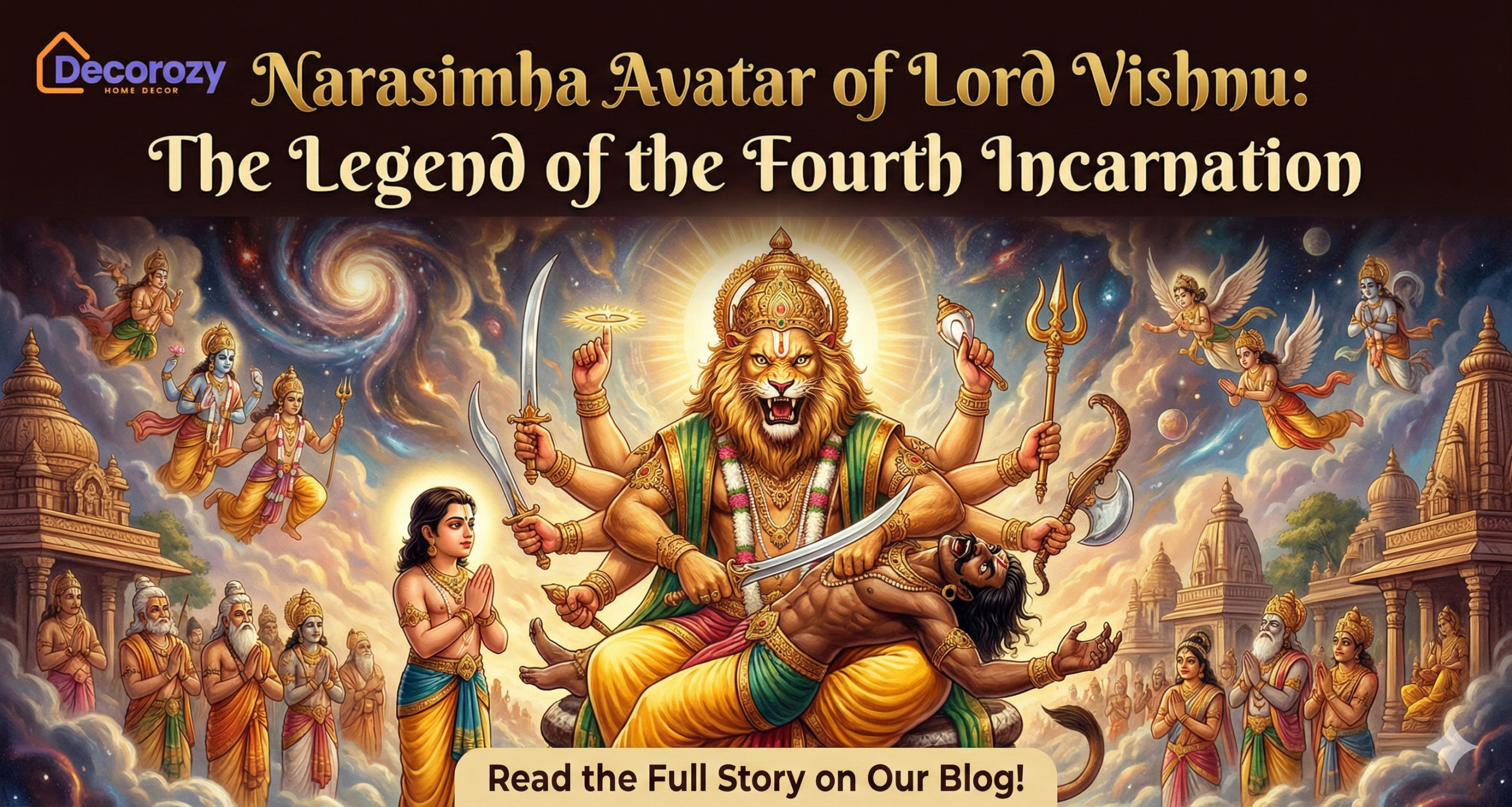
The Narasimha avatar of Lord Vishnu is the fourth incarnation of the Preserver God, appearing as a half-man, half-lion. He manifested to circumvent a complex boon of invincibility held by the demon king Hiranyakashipu, thereby saving the devout child-prince Prahlada and restoring cosmic balance (Dharma).
The Symbolic Origins of the Narasimha Avatar of Lord Vishnu
The story begins with the rise of the demon king Hiranyakashipu. Driven by vengeance for his brother’s death, he performed intense penance to please Lord Brahma. While he couldn’t obtain true immortality, he secured a “watertight” boon: he could not be killed by man or beast, indoors or outdoors, during day or night, on earth or in the sky, nor by any weapon.
This perceived invincibility birthed a tyrant. Hiranyakashipu demanded that the three worlds worship him alone. However, his own son, Prahlada, became his greatest challenger. Despite his father’s cruelty, Prahlada remained an unwavering devotee of Vishnu, proving that true faith cannot be suppressed by fear.
RECOMMENDED COLLECTIONS
Find the Perfect Home Décor for Every Space
From divine God idols to luxury home décor and handcrafted accessories, discover premium collections designed to elevate every corner of your home.
🏠 Explore Our Complete Store
Browse thousands of premium handcrafted décor products in one place.
Visit Homepage →
🌺 Durga Maa Idols
Beautiful Durga Maa idols ideal for temples, festivals, and home worship.
Browse Durga Idols →
🖼️ Wall Décor
Add personality to your walls with premium decorative wall art.
Shop Wall Décor →
🎁 Exclusive Offers
Save more with our latest discounts on premium décor collections.
View Best Deals →
Bring Beauty & Positivity to Your Home
Discover handcrafted idols, luxury home décor, wooden handicrafts, and premium decorative collections designed for modern Indian homes.
Shop Now →
Divine Logic: How the Narasimha Avatar of Lord Vishnu Defeated Evil
When Hiranyakashipu mockingly asked if Vishnu resided in a palace pillar, he struck it with his mace. In a thunderous explosion, the Narasimha avatar of Lord Vishnu emerged. This form was a masterclass in divine logic, designed specifically to navigate the loopholes of Brahma’s boon:
- Neither Man nor Beast: Narasimha possessed a human torso and a lion’s head.
- Neither Indoors nor Outdoors: The battle concluded on the threshold (doorway) of the palace.
- Neither Day nor Night: The execution occurred at twilight (Sandhya Kāla).
- Neither Earth nor Sky: The Lord placed the demon on his lap.
- No Weapon: Narasimha used his razor-sharp claws to annihilate the asura.
Spiritual Benefits of Worshipping the Fourth Incarnation
Devotees across the globe worship this avatar for more than just historical reverence. The energy of Narasimha is considered a potent shield against internal and external negativity.
- Courage and Strength: Praying to this fierce form helps individuals overcome deep-seated fears and anxiety.
- Protection from Evil: Just as he protected Prahlada, he is believed to guard his followers against “Adharma” or injustice.
- Removal of Obstacles: In the Veda, the Narasimha Sukta is often chanted to clear spiritual and physical hurdles.
The celebration of Narasimha Jayanti (falling on the 14th day of the bright half of Vaishakha) serves as a yearly reminder that when devotion is pure, divine intervention is inevitable.
Modern Relevance: Lessons in Faith and Justice
The legend of the Narasimha avatar of Lord Vishnu remains startlingly relevant in our modern era. It teaches us that “Righteousness” (Dharma) is not a rigid set of rules, but a living force that adapts to conquer complex challenges.
Prahlada’s story emphasizes that age is no barrier to wisdom or devotion. It encourages us to maintain our values even when the surrounding environment is hostile. Ultimately, Narasimha proves that while evil may find “loopholes” to prosper temporarily, the universe possesses a corrective force that is both just and unstoppable.
Conclusion
The Narasimha avatar is a beacon of hope for the oppressed and a warning to the arrogant. By balancing the ferocity of a lion with the compassion of a protector, Lord Vishnu restored peace to the three worlds.
Would you like me to create a detailed guide on the specific mantras used for Narasimha worship or provide a list of the major Narasimha temples in India?
FAQ: People Also Ask
1. Why did Lord Vishnu take the form of a half-lion? He took the half-man, half-lion form to bypass the boon given to Hiranyakashipu, which stated the king could not be killed by a human or an animal. By being both, Narasimha fulfilled the condition while still having the power to end the demon’s reign.
2. Where did the Narasimha avatar appear from? Lord Narasimha manifested instantly from a stone pillar in the palace of Hiranyakashipu after the king challenged his son Prahlada to prove that God is omnipresent.
3. What is the significance of the time when Narasimha killed Hiranyakashipu? The execution happened at twilight because the demon’s boon protected him from being killed during the day or at night. Twilight is the transition period that is technically neither.