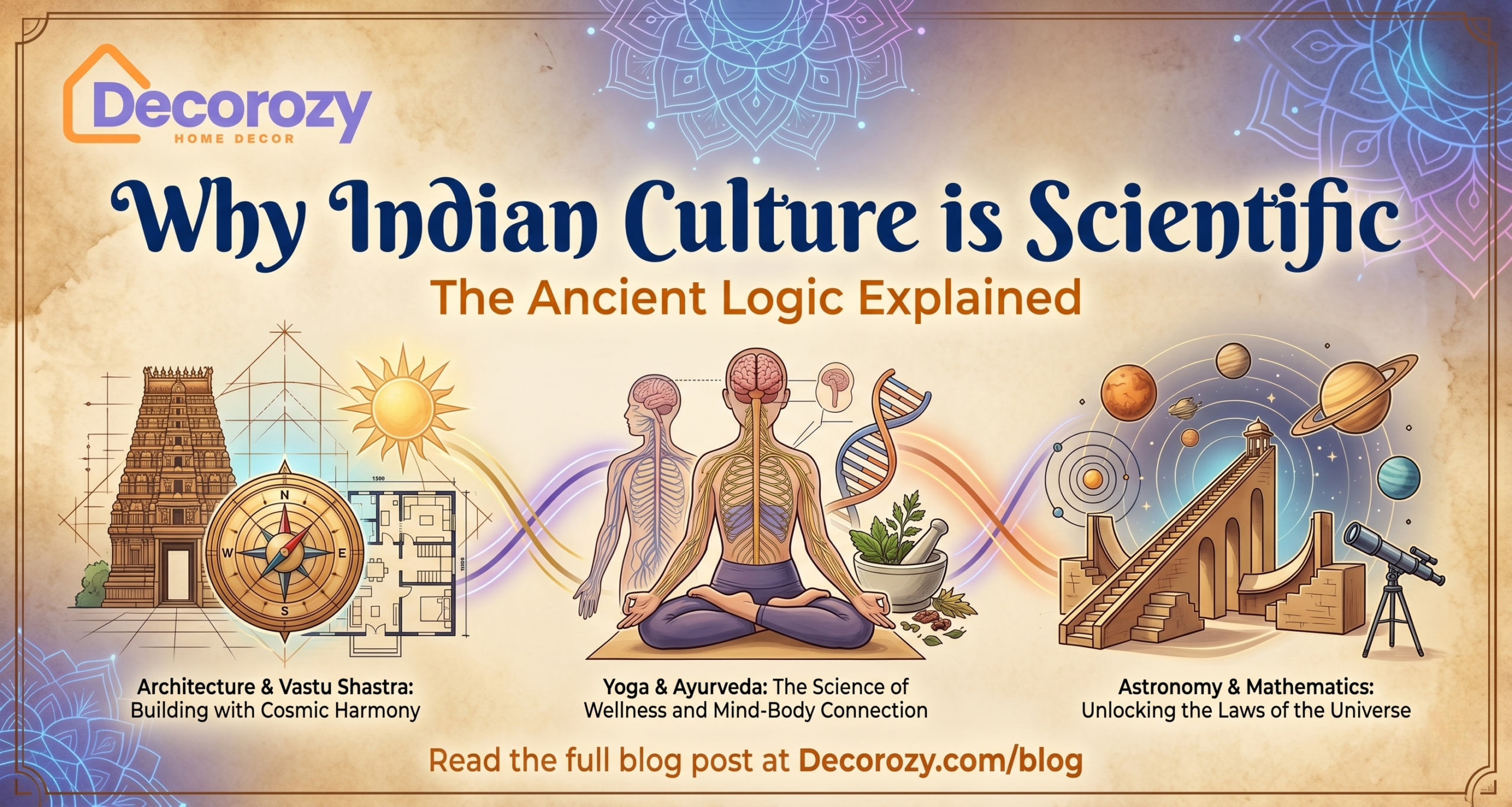
Understanding Exactly Why Indian Culture Is Scientific
For centuries, global scholars have marveled at the profound wisdom embedded in ancient Eastern traditions. Many modern researchers frequently ask why Indian culture is scientific at its very core.
Far from being mere superstition, these ancient practices are deeply rooted in logical, health-promoting, and ecological principles. Modern science is now validating what ancient sages practiced thousands of years ago.
Quick Answer: Indian culture is scientific because its traditional rituals, dietary habits, and daily practices are deeply rooted in physiology, psychology, and environmental sustainability. From Ayurveda and yoga to temple architecture and fasting, these customs align human biology with natural cosmic rhythms to promote holistic well-being.
YOU MAY ALSO LIKE
Discover More Premium Home Décor Collections
Browse our carefully selected handcrafted décor collections including God idols, spiritual accessories, handcrafted art, and luxury home decoration products.
Explore Exclusive Offers & New Arrivals
Discover handcrafted God idols, premium handicrafts, pooja essentials, wall décor, and luxury home accessories at special prices.
View Best Deals →
The Core Concept of Why Indian Culture Is Scientific
To grasp why Indian culture is scientific, we must look at how ancient texts approached human life. The Vedas and Upanishads were not just spiritual guides; they were encyclopedias of early scientific observation.
Ancient scholars used empirical methods to study medicine, astronomy, and mathematics. They seamlessly wove these scientific findings into daily cultural practices and religious rituals.
This integration ensured that the general population followed healthy routines without needing complex medical explanations. By turning science into tradition, they guaranteed the survival of these beneficial practices across generations.
Health Benefits Explaining Why Indian Culture Is Scientific
One of the primary reasons why Indian culture is scientific is its profound impact on human health. Ayurveda, the traditional medicine system, is a prime example of this evidence-based approach to wellness.
Practices like drinking water from copper vessels possess proven antimicrobial properties. Copper naturally purifies water and balances the body’s internal systems, promoting better digestion and immunity.
Similarly, the traditional practice of sitting on the floor cross-legged to eat is highly scientific. This posture, known as Sukhasana, naturally aids digestion by stimulating the vagus nerve and increasing blood flow to the stomach.
Fasting, a common cultural ritual, is another highly scientific tradition designed for longevity. Modern research on intermittent fasting confirms that it promotes cellular autophagy and metabolic reset, just as ancient texts suggested.
Dietary Science and the Mastery of Spices
Another compelling reason why Indian culture is scientific lies in its sophisticated culinary traditions. The daily Indian diet is carefully structured around the medicinal properties of various herbs and spices.
Turmeric, a staple in almost every dish, contains curcumin, a scientifically proven anti-inflammatory compound. Ancient Indians knew that consuming it daily with black pepper drastically increases its absorption in the human body.
The traditional combination of lentils and rice is another brilliant nutritional strategy. Together, they form a complete protein, providing all essential amino acids necessary for maintaining a healthy vegetarian diet.
Detailed Analysis of Traditional Rituals and Architecture
When we analyze traditional daily rituals, their scientific foundation becomes undeniably clear. For instance, greeting others with “Namaste” prevents the physical transfer of germs, a hygienic fact globally appreciated in recent times.
Temple architecture in India is another masterclass in ancient engineering and acoustic science. Temples are traditionally built where the earth’s magnetic wave lines are highly active and concentrated.
The copper plates buried beneath temple idols absorb and radiate these natural magnetic energies. Visiting these spaces naturally aligns your body’s electromagnetic field, reducing stress and enhancing mental focus.
Even the ringing of temple bells is rooted in advanced acoustic science, producing a distinct resonance. The sound synchronizes the left and right brain hemispheres, emptying the mind of chaotic thoughts instantly.
The Science of Circadian Rhythms and Routines
Traditional Indian routines are meticulously aligned with the human body’s natural circadian rhythms. Waking up during the “Brahma Muhurta” (the time just before dawn) is heavily emphasized in ancient texts.
Modern sleep science verifies that during this time, atmospheric pollution is lowest and oxygen levels are pristine. Melatonin levels begin to drop, and cortisol naturally rises to prepare the body for the day ahead.
Eating the largest meal at noon when the sun is highest perfectly aligns with our digestive peak. This demonstrates a profound understanding of chronobiology long before modern science ever defined the term.
Yoga: The Ultimate Scientific Discipline
No discussion on this topic is complete without mentioning the advanced sciences of Yoga and Pranayama. Yoga is an exact science of human anatomy, designed to optimize the endocrine and nervous systems.
Modern neuroscience confirms that deep breathing exercises (Pranayama) actively lower cortisol levels in the bloodstream. They efficiently shift the autonomic nervous system from a state of high stress to deep relaxation.
Physical postures (Asanas) massage internal organs, improve joint mobility, and increase blood circulation. This is applied biomechanics functioning under the accessible guise of cultural spirituality.
Sustainable Living and Environmental Science
Ancient Indian traditions are inherently designed around ecological conservation and sustainable living. The cultural reverence for rivers, trees, and animals was a brilliant, practical conservation strategy for the masses.
Worshipping the Peepal tree, for example, makes perfect scientific sense for environmental preservation. It is one of the few trees that continuously releases a high volume of oxygen, purifying the surrounding environment.
Using biodegradable materials like banana leaves for dining is another eco-friendly cultural staple. It drastically reduces waste, prevents chemical contamination from modern plates, and even adds subtle antioxidants to the hot food.
The traditional Indian lifestyle champions minimalism, respect for nature, and careful resource optimization. This ancient blueprint for sustainability is exactly what modern environmentalists are desperately advocating for today.
By understanding the irrefutable logic behind these practices, we can truly appreciate the genius of our ancestors. It seamlessly bridges the gap between ancient spiritual philosophy and modern empirical science.
We invite you to explore more about integrating this ancient, scientific wisdom into your modern lifestyle. Discover more insightful articles and sustainable living tips right here on Decorozy.com.
FAQ Schema
- Question 1: What is the scientific reason behind applying a bindi or tilak?
- Answer: Applying a bindi or tilak on the forehead stimulates the Ajna Chakra, also known as the pineal gland. Pressing this specific point increases concentration, retains body energy, and promotes blood supply to the facial muscles.
- Question 2: Why do traditional Indians eat with their hands?
- Answer: Eating with hands involves the tactile sensation of touching food, which signals the brain to release specific digestive juices before the food even enters the mouth. It also introduces healthy flora from the skin to the gut microbiome.
- Question 3: Is there a scientific reason for not sleeping with your head facing north?
- Answer: Yes, it is based on biomagnetism. Sleeping with your head facing north aligns your body’s magnetic field with the Earth’s magnetic pull, which can cause increased blood pressure, sleep disturbances, and neurological strain.