The Lord Ganesha Complete Guide: History, Symbolism, and Worship
Welcome to the ultimate Lord Ganesha complete guide, your definitive resource for understanding Hinduism’s most universally beloved deity. Known globally as the remover of obstacles (Vighnaharta) and the god of new beginnings (Adi Devata), his presence graces millions of homes and businesses.
Understanding the profound mythology and highly structured worship methods surrounding this elephant-headed god is essential for any spiritual seeker. This comprehensive analysis decodes the divine history, deep symbolism, and practical rituals required to invoke his supreme blessings.
Quick Answer: Lord Ganesha, the elephant-headed Hindu deity, is globally revered as the supreme remover of obstacles and the god of new beginnings. Worshipped before any major undertaking, he embodies infinite wisdom, spiritual success, and universal adaptability. Devotees honor him through daily pujas, sacred mantras, and grand festivals.
The Divine History Explored in This Lord Ganesha Complete Guide
The mythological origins of Lord Ganesha represent some of the most profound teachings in Hindu scripture. According to the Shiva Purana, Goddess Parvati created him out of profound necessity and divine feminine energy.
Desiring a perfectly loyal guardian, she gathered the turmeric paste (ubtan) from her body before bathing. She breathed life into this molded form, establishing a powerful, unshakeable bond between mother and son.
When Lord Shiva returned to Mount Kailash, the young boy strictly enforced his mother’s orders, blocking the Supreme Destroyer from entering his own home. A fierce cosmic battle ensued, culminating in Lord Shiva severing the boy’s head with his invincible trident.
Goddess Parvati’s subsequent rage threatened to dissolve the entire universe, forcing the divine council to seek an immediate resolution. To restore cosmic balance, Lord Shiva ordered his attendants to bring the head of the first living creature sleeping facing north.
They returned with the head of a powerful elephant, which Shiva instantly fused to the boy’s body, resurrecting him. Bestowing supreme cosmic authority upon him, Shiva declared him “Ganapati,” the ultimate leader of all celestial classes and the first deity to receive worship.
Deep Symbolism Revealed in Our Lord Ganesha Complete Guide
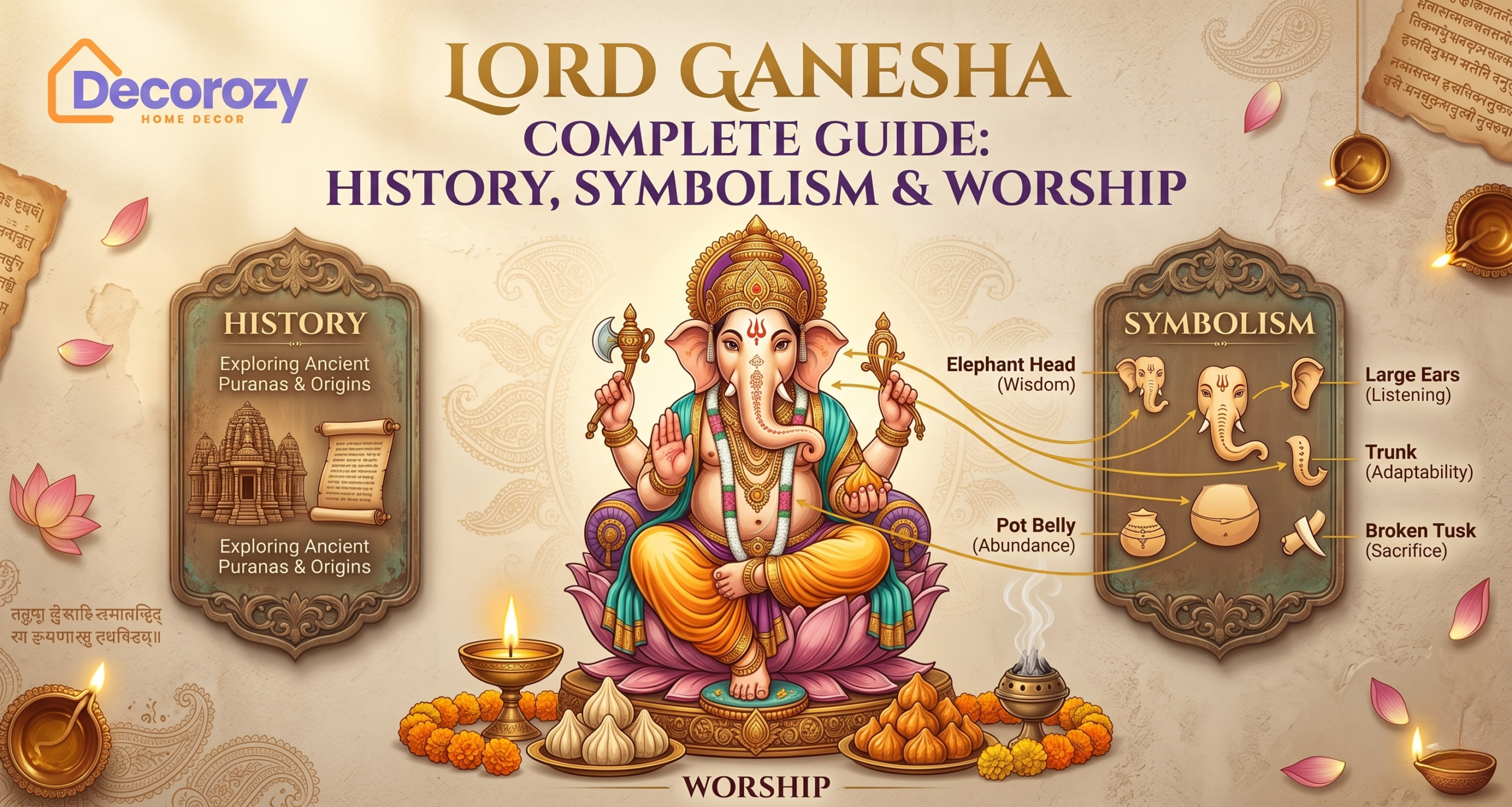
Every physical attribute of Lord Ganesha functions as an advanced spiritual metaphor for human development. His iconic elephant head is the ultimate symbol of supreme wisdom, intellectual capacity, and a memory that retains eternal cosmic truths.
His massive ears indicate the necessity of listening far more than speaking, effectively absorbing knowledge from the surrounding environment. Conversely, his small, highly focused eyes encourage profound concentration and unwavering dedication to one’s spiritual and material goals.
The famously curved trunk demonstrates remarkable adaptability, possessing the raw strength to uproot trees and the delicate precision to pick up a needle. This teaches followers to handle massive life challenges while maintaining perfect attention to minute details.
His large belly (Lambodara) signifies the ability to peacefully digest all the positive and negative experiences of life. It serves as a reminder that the entire universe, with all its chaotic dualities, ultimately resides within our own consciousness.
Furthermore, Lord Ganesha’s chosen vehicle, the tiny mouse (Mushak), illustrates the absolute necessity of conquering human ego and erratic desires. By riding the mouse, he demonstrates that a truly enlightened mind maintains total control over its base impulses.
Essential Worship Rituals and Sacred Mantras
Implementing structured, daily worship is a cornerstone of this spiritual path. A standard daily puja requires dedicated focus, utilizing specific sacred items (Puja Samagri) to effectively invoke divine energy into your home.
Begin by purifying your dedicated space, lighting a cotton wick oil lamp, and mentally invoking his supreme presence. Offer fresh water, bathe the idol symbolically, and apply a vibrant dot of red vermillion or sandalwood paste to his forehead.
Offering exactly 21 blades of Durva grass is highly prescribed, as it holds deep historical significance in cooling his divine energy. Pair this with his favorite red hibiscus flowers, chanting the foundational Mool Mantra: Om Gan Ganapataye Namah.
Conclude your daily ritual by offering freshly prepared Modaks, sweet dumplings fundamentally linked to spiritual perfection and inner joy. Perform the final Aarti with glowing camphor, completely surrendering your ego and personal obstacles to his divine will.
Sacred Temples and Global Festivals
The veneration of Lord Ganesha extends far beyond private home rituals, manifesting in monumental architectural wonders and massive public festivals. The Ashtavinayak Yatra in Maharashtra remains the most elite pilgrimage route, encompassing eight highly sacred, self-manifested Ganesha temples.
Institutions like the Siddhivinayak Temple in Mumbai and the Karpaka Vinayakar Temple in Tamil Nadu draw millions of devoted seekers annually. These historic sites act as massive energetic focal points, generating profound spiritual merit for dedicated pilgrims.
Culturally, Ganesh Chaturthi stands as the ultimate celebration of his divine birth, lasting up to eleven deeply immersive days. Initiated as a public gathering by Lokmanya Tilak, it now serves as a global unifier for Hindu communities.
Millions participate in the final Visarjan, ceremonially immersing clay idols into natural water bodies. This dramatic conclusion visually reinforces the eternal cycle of creation, preservation, and eventual dissolution back into Mother Nature.
Establishing a daily connection with Lord Ganesha absolutely transforms your spiritual trajectory. We invite you to explore more exclusive decor, sacred idols, and spiritual insights right here on Decorozy.com to elevate your daily practice.
FAQ Schema
- Question 1: Why does Lord Ganesha have an elephant head?
- Answer: Lord Ganesha received an elephant head after Lord Shiva accidentally severed his original head in battle. To calm Goddess Parvati’s rage, Shiva replaced it with the head of the first animal his attendants found, which was an elephant, symbolizing supreme wisdom and intellect.
- Question 2: What is the favorite food of Lord Ganesha?
- Answer: Lord Ganesha’s absolute favorite food is the Modak, a sweet steamed dumpling made from rice flour and filled with a rich mixture of freshly grated coconut and jaggery. Devotees traditionally offer 21 Modaks during significant rituals to invoke his supreme blessings.
- Question 3: Which specific items are essential for a basic Ganesha Puja?
- Answer: A highly effective daily Ganesha Puja requires fresh water, a lighted oil lamp, red sandalwood paste, red hibiscus flowers, and exactly 21 blades of three-bladed Durva grass. Incense, camphor for the final Aarti, and sweet offerings like Modaks or fruits are also strictly recommended.
✨ Popular Categories
Browse our most loved collections of handcrafted home décor, divine idols, pooja essentials and exclusive decorative products.
View Deals →
🛕 Divine Collection
Bring peace and positivity with beautifully crafted idols.
Shop God Idols →
💰 Lakshmi Collection
Elegant Lakshmi idols symbolizing wealth and prosperity.
View Products →
🎨 Indian Handicrafts
Traditional handcrafted décor made by skilled artisans.
Explore Now →
🦌 Animal Decor
Unique decorative animal figurines for modern interiors.
Discover More →
🏠 Home Store
Explore our complete range of premium home décor products.
Visit Store →
🪔 Pooja Essentials
Everything you need for daily worship and festive rituals.
Shop Essentials →