The Ultimate Truth Behind Ram Setu Bridge Unveiled
For centuries, historians, scientists, and spiritual seekers have fiercely debated the truth behind Ram Setu bridge. This mysterious maritime structure continues to spark global curiosity and intense academic research.
Bridging the gap between ancient mythology and modern geology, this landmark represents one of the world’s most fascinating geographical wonders. Understanding its origins requires a deep dive into both scientific data and historical texts.
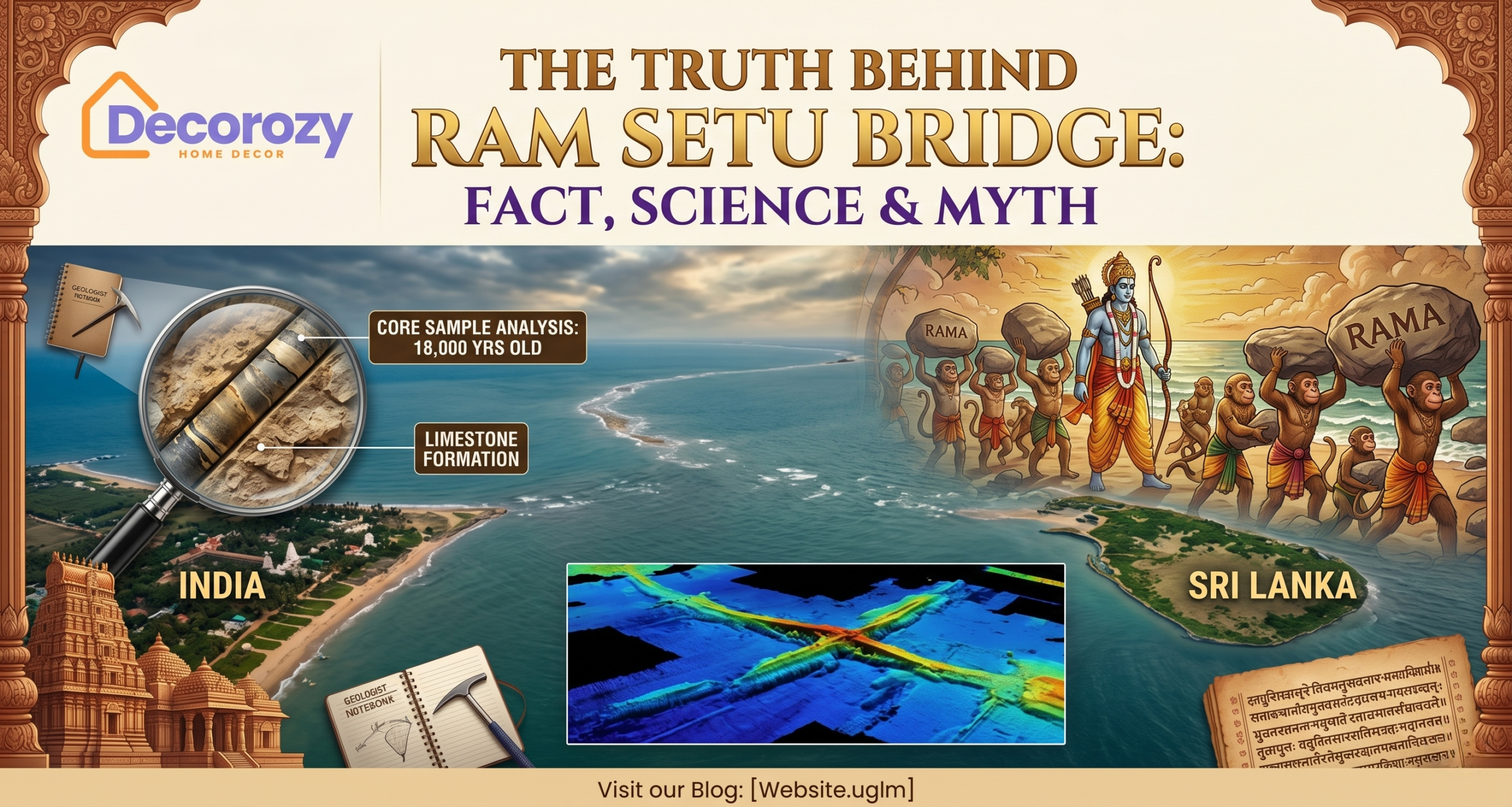
Quick Answer: The Ram Setu, or Adam’s Bridge, is a 48-kilometer chain of limestone shoals between India and Sri Lanka. While Hindu mythology attributes its creation to Lord Rama’s army, geological studies suggest it is a natural formation of ancient sandbanks and coral reefs.
Uncovering the Truth Behind Ram Setu Bridge
To truly grasp the truth behind Ram Setu bridge, we must first look at its physical location and structure. Spanning across the Palk Strait and the Gulf of Mannar, it connects Pamban Island in India to Mannar Island in Sri Lanka.
Satellite imagery from NASA has provided breathtaking views of this submerged, mysterious chain. These high-resolution images clearly outline a remarkable, continuous stretch of shallow underwater terrain.
Oceanographers note that the sea in this region is incredibly shallow, ranging only from one to ten meters deep. This unique bathymetry historically hindered large ship navigation, further adding to the bridge’s legendary status.
The Geological Marvel of Adam’s Bridge
From a purely scientific standpoint, Adam’s Bridge is classified as a series of natural limestone shoals. Geologists argue that these formations are the result of complex tectonic movements and sedimentation processes over millennia.
During the last Ice Age, sea levels were significantly lower than they are today. Scientists believe that India and Sri Lanka were once part of a continuous, connected landmass.
As global temperatures rose and glaciers melted, rising sea levels gradually submerged this land bridge. What remains today are the highest points of that ancient terrestrial connection, forming the shoals we now see.
Historical Evidence and the Truth Behind Ram Setu Bridge
The epic Ramayana provides a vibrant mythological framework for the truth behind Ram Setu bridge. According to the ancient text, an army of Vanaras (monkeys) built the bridge using floating stones to help Lord Rama rescue his wife, Sita.
Interestingly, early Islamic texts and colonial British maps refer to this exact same structure as Adam’s Bridge. Legend states that the first human, Adam, used this bridge to cross from Sri Lanka to India after his expulsion from Eden.
While faith drives the mythological narrative, historical records show that the bridge was reportedly walkable until the 15th century. Historical chronicles suggest a massive cyclone in 1480 deepened the channel, breaking the continuous land link.
The Phenomenon of Floating Stones
One of the most debated aspects of this landmark is the presence of alleged floating stones found along the Rameswaram coastline. Pilgrims and tourists often point to these stones as divine proof of the Ramayana’s historical accuracy.
Geologists have a straightforward, data-driven explanation for this fascinating phenomenon. These stones are predominantly identified as pumice, a highly porous, low-density volcanic rock.
Pumice forms when superheated, highly pressurized rock is violently ejected from a volcano. The rapid cooling and depressurization trap air bubbles inside the rock, making it light enough to float on water.
Carbon Dating and Age Analysis
To pinpoint the exact age of the structure, researchers have relied heavily on radiocarbon dating techniques. Samples taken from the coral reefs and beaches around Dhanushkodi offer vital clues.
Current geological studies suggest that the landmasses forming the bridge are roughly 7,000 to 18,000 years old. This aligns with the end of the last major glacial period when sea levels began their modern rise.
While the shoals themselves are ancient, the exact timeline of human interaction with this landscape remains a subject of ongoing archaeological investigation.
Conservation and Environmental Importance
Regardless of its origins, Ram Setu is an ecological goldmine that demands strict environmental protection. The surrounding Gulf of Mannar Biosphere Reserve is home to thousands of rare marine species.
The shallow waters act as a natural barrier, protecting India’s southern coastline from devastating tsunamis and severe cyclonic storms. Disturbing this delicate ecological balance could have disastrous environmental consequences.
Preserving this region is not just about protecting cultural heritage; it is about maintaining critical marine biodiversity.
At Decorozy, we believe in bringing you the most thoroughly researched, authoritative insights into the world’s greatest wonders. Dive deeper into our archives at Decorozy.com for more fascinating historical and architectural analyses!
FAQ Schema
- Question 1: Is Ram Setu a man-made bridge or a natural formation?
- Answer: Scientific consensus heavily points to Ram Setu being a natural geological formation consisting of limestone shoals and coral reefs. However, historical records indicate it was a continuous, walkable landmass between India and Sri Lanka until a major cyclone in 1480.
- Question 2: Why do stones float at the Ram Setu bridge?
- Answer: The floating stones frequently found near Rameswaram are scientifically identified as pumice. Pumice is a type of volcanic rock that contains trapped air bubbles due to rapid cooling, giving it a low density that allows it to float on water.
- Question 3: How old is the Ram Setu bridge according to science?
- Answer: Radiocarbon dating and geological surveys indicate that the sandbanks and coral reefs of Ram Setu are approximately 7,000 to 18,000 years old. This age corresponds with the geological period when the last Ice Age ended and sea levels began to rise.