Was Mahabharat Real? Evidence Explained & Ancient Spatial Secrets for Your Home
At Decorozy, we believe that true premium home decor transcends mere visual appeal; it is deeply rooted in history, spatial harmony, and the timeless narratives of our past.
When we curate exquisite artifacts, brass accents, and spatial designs, we often draw inspiration from India’s grandest architectural and cultural epoch.
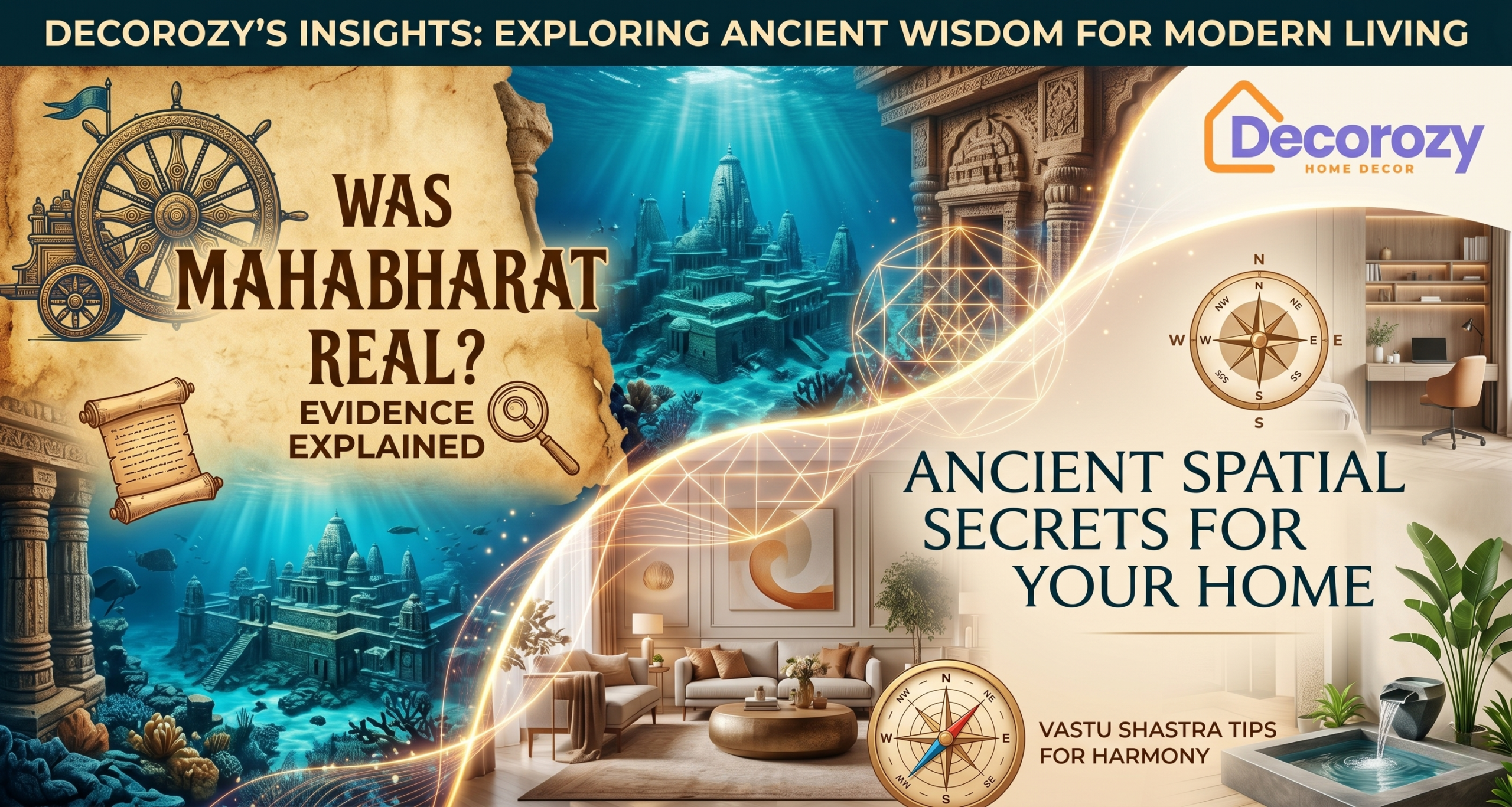
This brings us to a profound question that echoes through time and influences our design philosophies: was the great Indian epic merely a mythological tale, or is there tangible evidence of its existence?
Quick Answer: Yes, significant archaeological and astronomical evidence suggests the Mahabharata is based on real historical events occurring around 1500–3000 BCE. Discoveries like the submerged city of Dwarka and astronomical alignments mentioned in the texts strongly indicate that the epic is rooted in a real, ancient civilization.
Key Takeaways
Marine archaeology in Gujarat has uncovered the submerged, ancient city of Dwarka, aligning with the epic’s architectural descriptions.
Astronomical dating methods confirm that planetary alignments described in the text perfectly match specific dates in ancient history.
The original and real name of Mahabharat in historical texts is “Jaya” or “Jaya Samhita.”
Ancient spatial planning and Vastu Shastra principles from the epic era can be flawlessly integrated into modern luxury homes with Decorozy.
The Quest for Truth: Is Mahabharat Real Story or Myth?
For generations, historians and enthusiasts have debated the historical authenticity of the great Kurukshetra war.
To determine if the events were factual, modern researchers have turned to a combination of marine archaeology, stratigraphy, and advanced archaeo-astronomy.
The evidence discovered in recent decades fundamentally shifts the narrative from pure mythology to historical reality.
One of the most compelling pieces of evidence lies off the coast of modern-day Gujarat in India.
The epic describes Lord Krishna’s magnificent capital, Dwarka, which was said to have been swallowed by the ocean after his departure.
Marine archaeologists from the National Institute of Oceanography (NIO) have discovered massive underwater stone structures, ancient anchors, and fortified walls.
These submerged ruins perfectly match the spatial and architectural descriptions found in ancient texts.
Such premium ancient architecture showcases an advanced understanding of urban planning and spatial harmony.
Furthermore, soil samples from the Kurukshetra region reveal heavy concentrations of iron and ancient metallurgical artifacts.
These findings date back to the estimated time of the great war, proving that massive ancient conflicts indeed took place on those grounds.
The Content Mind Map
Historical Evidence of the Epic
Marine Archaeology -> Submerged ruins of Dwarka matching textual architecture.
Archaeo-astronomy -> Planetary alignments dating the war to ~3139 BCE.
Metallurgical Finds -> Iron weapons and artifacts in the Kurukshetra basin.
Character Identities & Origins
The Epic’s True Title -> Transition from ‘Jaya’ to ‘Mahabharata’.
Heroic Lineage -> Exploring the original birth names of Kunti and Arjuna.
Decorozy Spatial Harmony Integration
The Maya Sabha -> Illusionary architecture and modern luxury mirrors.
Ancient Vastu -> Applying epic-era spatial balance to modern living spaces.
Royal Aesthetics -> Incorporating premium brass and rich textiles from Decorozy.
The Original Identities: What is the Real Name of Mahabharat?
When diving into the historical texts, many wonder about the structural evolution of this massive epic.
If you are asking what is the real name of mahabharat, the answer lies in the earliest verses compiled by Sage Vyasa.
Originally, the epic was not the sprawling 100,000-verse masterpiece we know today.
The real name of mahabharat was originally “Jaya” (meaning Victory), which consisted of around 8,800 verses.
As the narrative was passed down and expanded by Vyasa’s disciple Vaisampayana, it became known as “Bharata” with 24,000 verses.
Finally, as it grew to encompass vast philosophical and spatial wisdom, it became the “Mahabharata.”
For those searching for the real name of mahabharat in hindi, it is traditionally referred to as “जय संहिता” (Jaya Samhita).
Understanding this evolution helps us appreciate the layered depth of ancient Indian history and literature.
Unveiling the Protagonists: Real Names of Epic Heroes
Beyond the overarching epic, the individuals who shaped the narrative had profound, multi-layered identities.
Many readers search for the mahabharat arjun real name, as the great archer was known by various titles depending on his divine attributes.
While we recognize him as Arjuna, he had ten distinct names, including Dhananjaya (winner of wealth), Jishnu (triumphant), and Partha (son of Pritha).
In modern television adaptations, fans often search for the actor’s identity, with Shaheer Sheikh famously portraying him in recent series.
However, historically and textually, Arjuna’s identity is deeply tied to his mother.
This leads to the query regarding the kunti in mahabharat real name.
Before she was known as Queen Kunti, her birth name was Pritha.
Therefore, the mahabharat kunti real name is Pritha, which is why Arjuna is so frequently and lovingly addressed as “Partha” by Lord Krishna.
These deep historical identities add layers of richness and premium heritage to the stories that inspire our modern aesthetic sensibilities.
Comparative Analysis: Ancient Wisdom vs. Modern Decorozy Designs
The architectural marvels described in the epic, specifically the Maya Sabha (Palace of Illusions), represent the pinnacle of ancient spatial design.
At Decorozy, we translate these legendary spatial concepts into premium, modern home decor solutions.
Epic Architectural Concept
Historical Description in the Text
Decorozy Modern Implementation
Impact on Spatial Harmony
The Maya Sabha (Illusions)
Floors that looked like pools of water and doors that appeared as solid walls.
Premium high-gloss resin tables and strategically placed luxury wall mirrors.
Expands visual space and manipulates natural light for a grand aesthetic.
Royal Courtyard Grandeur
Massive, intricately carved pillars holding up expansive, breezy royal halls.
Creates distinct, highly curated zones within an open-concept living area.
Vastu-Aligned Entrances
Grand archways oriented towards the East to welcome the morning solar energy.
Premium Decorozy entrance consoles, warm LED ambient lighting, and brass Urli bowls.
Invites positive energy (Prana) and establishes an immediate luxurious tone.
Divine Geometric Mandalas
Intricate floor patterns used in royal chambers to center universal energies.
Hand-tufted, premium geometric rugs and intricately designed wall art.
Anchors the furniture and provides a grounding, aesthetic focal point.
Expert Implementation & Tips: Bringing Epic Elegance to Your Home
Understanding the historical weight and the factual basis of the ancient era allows us to design with intention.
When you know that these grand architectural concepts were rooted in real historical civilizations, implementing them feels incredibly profound.
Decorozy specializes in merging this ancient Vastu and spatial harmony with cutting-edge, premium luxury decor.
Channeling the Maya Sabha with Reflective Surfaces
The famous Palace of Illusions built by Mayasura for the Pandavas was a masterclass in optical spatial design.
You can replicate this grand, expansive feeling in your own modern home without needing a royal budget.
Utilize Decorozy’s premium oversized mirrors opposite your largest windows to double the natural light.
High-gloss furniture, such as polished marble-top center tables, mimics the reflective water-like floors of the ancient palace.
Grounding Your Space with Premium Brass and Metals
As archaeological evidence of the epic shows, metallurgy was highly advanced during that era.
Brass, copper, and bronze were not just functional; they were highly decorative and auspicious.
Incorporate Decorozy’s handcrafted brass artifacts, such as traditional Urlis or minimalist brass candle holders, into your living room.
These metals bring a warm, earthy elegance that grounds the room’s energy, aligning with ancient Vastu principles.
The Power of Symmetrical Furniture Arrangement
Ancient Indian architecture relied heavily on symmetry to project power, stability, and divine balance.
When arranging your living space, pull your premium Decorozy sofas and accent chairs away from the walls.
Create a balanced, symmetrical conversational circle around a central focal point, much like a royal court setting.
This not only improves the flow of energy (Prana) but also elevates the perceived luxury of the room.
Integrating Natural Elements for Spiritual Harmony
The epic is deeply tied to nature, from the forests of exile to the sacred rivers.
Modern luxury home decor is incomplete without the integration of vibrant, natural elements.
Use Decorozy’s premium ceramic or metallic indoor planters to house lush greenery like Areca palms or Peace Lilies.
Position these natural elements in the corners of your rooms to soften harsh architectural lines and purify the indoor air.
Creating a Vastu-Compliant Master Bedroom
The orientation of your sleeping quarters is crucial for personal restoration and peace.
Ancient texts suggest that sleeping with your head toward the South promotes deep, uninterrupted sleep.
Enhance this tranquil space with Decorozy’s premium, breathable cotton bed linens and heavy, light-blocking velvet drapes.
Keep the decor minimalist, focusing on a few high-quality, meaningful art pieces rather than cluttered accessories.
Lighting as a Tool for Spatial Transformation
In ancient palaces, the strategic placement of oil lamps created dancing shadows and a warm, inviting ambiance.
Today, we replicate this through layered lighting strategies in premium interior design.
Combine Decorozy’s soft, ambient table lamps with targeted accent lighting to highlight your favorite art pieces.
Avoid harsh, overhead cool-white lights; instead, opt for warm-toned LEDs that mimic the comforting glow of ancient firelight.
Curating a Gallery of Heritage and Lineage
The epic places immense importance on lineage, history, and family heritage.
Translate this into your home by creating a curated, premium gallery wall using Decorozy’s elegant photo frames.
Mix black-and-white family portraits with small, framed pieces of traditional Indian textile or ancient script replicas.
This creates a deeply personal, visually stunning focal point that tells your family’s unique story.
The Role of Textiles in Royal Aesthetics
Rich, heavy textiles were a symbol of ultimate wealth and status in ancient Indian kingdoms.
You can instantly elevate a standard living room by draping a Decorozy premium embroidered throw over your sofa.
Invest in high-thread-count cushion covers featuring traditional motifs or deep, jewel-toned velvets.
These tactile elements add essential layers of texture, making the space feel opulent, inviting, and historically grounded.
Harmonizing Colors for Emotional Wellbeing
The ancient texts often describe specific colors associated with different deities and emotional states.
Apply this color psychology to your modern home by selecting a palette that reflects the mood you wish to cultivate.
Use calming, earthy tones like terracotta, deep greens, and warm ochres in your living and dining areas.
Decorozy offers a wide range of soft furnishings in these grounding colors, ensuring your home remains a sanctuary of peace.
Decluttering to Allow Energy Flow
Perhaps the most crucial aspect of ancient spatial harmony is the unobstructed flow of energy.
A cluttered home represents a cluttered, chaotic mind, completely antithetical to premium luxury living.
Utilize Decorozy’s stylish, minimalist storage baskets and hidden organizational furniture to keep surfaces clean.
By maintaining a pristine environment, you allow the premium decor pieces you’ve selected to truly breathe and stand out.
Conclusion: Transforming Your Space with Decorozy
The grand narratives of our history are not just stories; they are blueprints for living a balanced, harmonious life.
By understanding the real evidence behind these ancient epics, we can draw profound inspiration for our daily environments.
At Decorozy, we are committed to helping you bring this timeless elegance, premium quality, and spatial harmony into your modern home.
Visit Decorozy.com today to explore our exclusive collections and begin transforming your living space into a true sanctuary of luxury.
Frequently Asked Questions (FAQs)
Q1: Is mahabharat real story or just a mythological tale? A: Significant archaeological discoveries, such as the submerged city of Dwarka, and precise astronomical dating strongly suggest that the epic is based on a real historical story and actual events.
Q2: What is the real name of mahabharat according to ancient texts? A: The original and real name of the epic, as composed by Sage Vyasa, was “Jaya” or “Jaya Samhita,” which translates to “Victory.”
Q3: What is the real name of mahabharat in hindi? A: In Hindi and traditional Sanskrit texts, the real and original name of the epic is referred to as “जय संहिता” (Jaya Samhita).
Q4: What is the mahabharat arjun real name? A: While widely known as Arjuna, his divine and real names included Partha, Dhananjaya, and Jishnu. In the context of modern television adaptations, the actor’s real name is Shaheer Sheikh.
Q5: What is the kunti in mahabharat real name? A: Before she was adopted and named Kunti, the mahabharat kunti real name given at her birth was Pritha, which is why her sons are often called “Parthas.”
🌟 Trending Collections at Decorozy
Discover our bestselling spiritual décor, handcrafted home accessories, and premium decorative collections designed to bring elegance, positivity, and timeless beauty to your living space.
🏡
Home Décor Store
Explore our complete range of premium home décor and handcrafted collections.