Hindu mythology is filled with fascinating tales of cosmic balance, divine intervention, and spiritual awakening. Among these ancient texts, the concept of the Dashavatara stands out as an absolute masterpiece of storytelling.
If you want to know the real story behind Lord Vishnu’s 10 avatars, you must look beyond surface-level myths. These powerful stories represent a profound framework of biological evolution, moral duty, and the preservation of our universe.
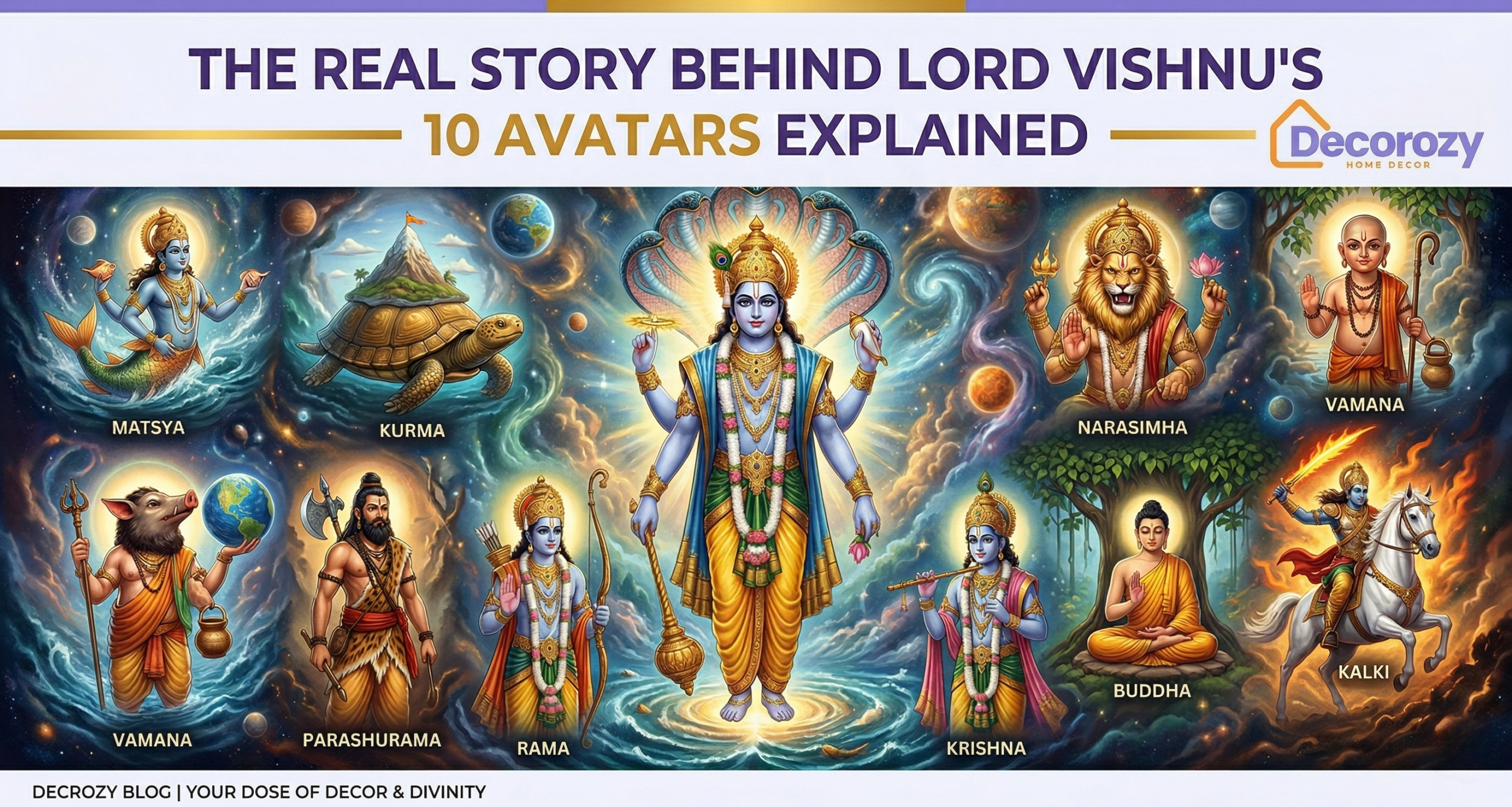
Quick Answer: The real story behind Lord Vishnu’s 10 avatars, known as the Dashavatara, details his earthly incarnations to restore cosmic order (Dharma). From a fish (Matsya) to a future warrior (Kalki), these ten forms symbolize the biological evolutionary stages of life and the ultimate triumph of good over evil.
Understanding The Real Story Behind Lord Vishnu’s 10 Avatars
Lord Vishnu is globally revered as the supreme preserver of the universe within the Hindu trinity (the Trimurti). His primary cosmic duty is to maintain harmony, sustain life, and protect righteous beings from destruction.
Whenever malevolent forces threaten to overwhelm the mortal world, Vishnu descends from the heavens in a physical form. This divine descent is what ancient texts call an “avatar,” a Sanskrit term literally translating to “one who descends.”
The real story behind Lord Vishnu’s 10 avatars is not merely about a god battling various mythical demons. It is a highly structured, philosophical narrative showing the steady progression of consciousness on planet Earth.
The Evolutionary Significance in The Real Story Behind Lord Vishnu’s 10 Avatars
Many modern scholars and historians draw fascinating parallels between the Dashavatara and Charles Darwin’s scientific theory of evolution. The exact sequence of Vishnu’s incarnations closely mirrors the chronological development of life on our planet.
Life begins in the water with Matsya (the aquatic fish), gradually progressing to amphibious life with Kurma (the tortoise). The evolutionary chain then moves to early land mammals with Varaha (the boar) and transitional half-human forms with Narasimha.
Eventually, the avatars evolve into early tribal humans, civilized society builders, and highly enlightened philosophical beings. This deep biological connection makes these ancient Sanskrit texts incredibly relevant to modern scientific and historical understanding.
Detailed Analysis: A Breakdown of the Dashavatara
Understanding the individual incarnations is crucial to grasping the full scope of Vishnu’s cosmic preservation strategy. Here is a detailed, chronological breakdown of the ten primary avatars that shape this ancient theology.
1. Matsya (The Fish): During a catastrophic global flood that threatened all existence, Vishnu appeared as a massive, golden fish. He safely guided the first man, Manu, and the sacred Vedas through the turbulent waters, ensuring life’s continuation.
2. Kurma (The Tortoise): When gods and demons collaborated to churn the cosmic ocean for the nectar of immortality, their churning mountain began sinking. Vishnu swiftly took the form of a gigantic tortoise, acting as a stable foundation to support the mountain.
3. Varaha (The Boar): A powerful, tyrannical demon named Hiranyaksha dragged the Earth into the dark depths of the cosmic ocean. Vishnu transformed into a fierce boar, diving into the abyss to defeat the demon and rescue the planet on his tusks.
4. Narasimha (The Half-Man, Half-Lion): A demon king gained a boon ensuring he could not be killed by man or beast, inside or outside, day or night. Vishnu found a brilliant loophole, appearing as a half-man, half-lion at twilight on a doorway threshold to restore justice.
5. Vamana (The Dwarf): Vishnu incarnated as a brilliant dwarf priest to subdue the arrogant, universe-conquering King Bali. With just three simple strides, Vamana measured and reclaimed the entire universe, teaching humanity the ultimate value of humility.
6. Parashurama (The Warrior with an Axe): As human societies formed, massive corruption and tyranny spread rapidly among the ruling warrior class (Kshatriyas). Parashurama arrived with a divine axe to cleanse the earth of these oppressive rulers and re-establish strict social order.
7. Rama (The Ideal King): As the central hero of the epic Ramayana, Rama represents the perfect human being and the strict embodiment of dharma (duty). He descended to defeat the ten-headed demon king Ravana, setting an eternal moral standard for human behavior.
8. Krishna (The Divine Statesman): A pivotal figure in the Mahabharata, Krishna guided humanity through incredibly complex moral and political dilemmas. He delivered the Bhagavad Gita, offering profound spiritual wisdom regarding duty, action, and devotion that endures globally today.
9. Buddha (The Enlightened One): In many mainstream Hindu traditions, Siddhartha Gautama is celebrated as the ninth avatar of preservation. He appeared to steer humanity away from excessive, rigid rituals and teach the accessible path of inner peace and non-violence.
10. Kalki (The Future Warrior): The tenth and final avatar is prophesied, yet to arrive in our current timeline. Kalki is expected to appear at the end of the Kali Yuga (the dark age) riding a white horse to destroy ignorance.
The Dashavatara remains a brilliant, unmatched blend of deep spirituality, strict morality, and early evolutionary theory. By understanding these diverse divine incarnations, we gain a much deeper insight into the cyclical nature of time and cosmic justice.
Looking to bring a touch of divine inspiration and tranquility into your own living space? Explore our exclusive collection of premium spiritual home decor at Decorozy.com to find stunning pieces that deeply resonate with your soul.
FAQ Schema
- Question 1: Why did Lord Vishnu take 10 avatars?
- Answer: Lord Vishnu took 10 avatars to restore cosmic balance, protect righteous individuals, and destroy overwhelming evil forces. Each incarnation occurred during a specific, critical crisis in the universe to re-establish Dharma (righteousness).
- Question 2: Does the Dashavatara match the scientific theory of evolution? Answer: Yes, modern scholars note a striking resemblance between the two concepts. The avatars progress chronologically from aquatic life (fish) to amphibians, land mammals, early humanoids, and finally to enlightened, advanced human forms.
- Question 3: Who is the 10th avatar of Lord Vishnu?
- Answer: The 10th avatar is Kalki, a divine figure who has not yet appeared on Earth. According to Hindu scriptures, Kalki will arrive at the very end of the Kali Yuga (the current age) to eradicate evil completely.