In the vast tapestry of Hindu mythology, the preservation of the universe is a recurring theme of divinity. Lord Vishnu, the protector, descends to Earth in various forms known as the Dashavatara whenever cosmic balance is threatened by evil.
Quick Answer: What is the Matsya Avatar of Vishnu?
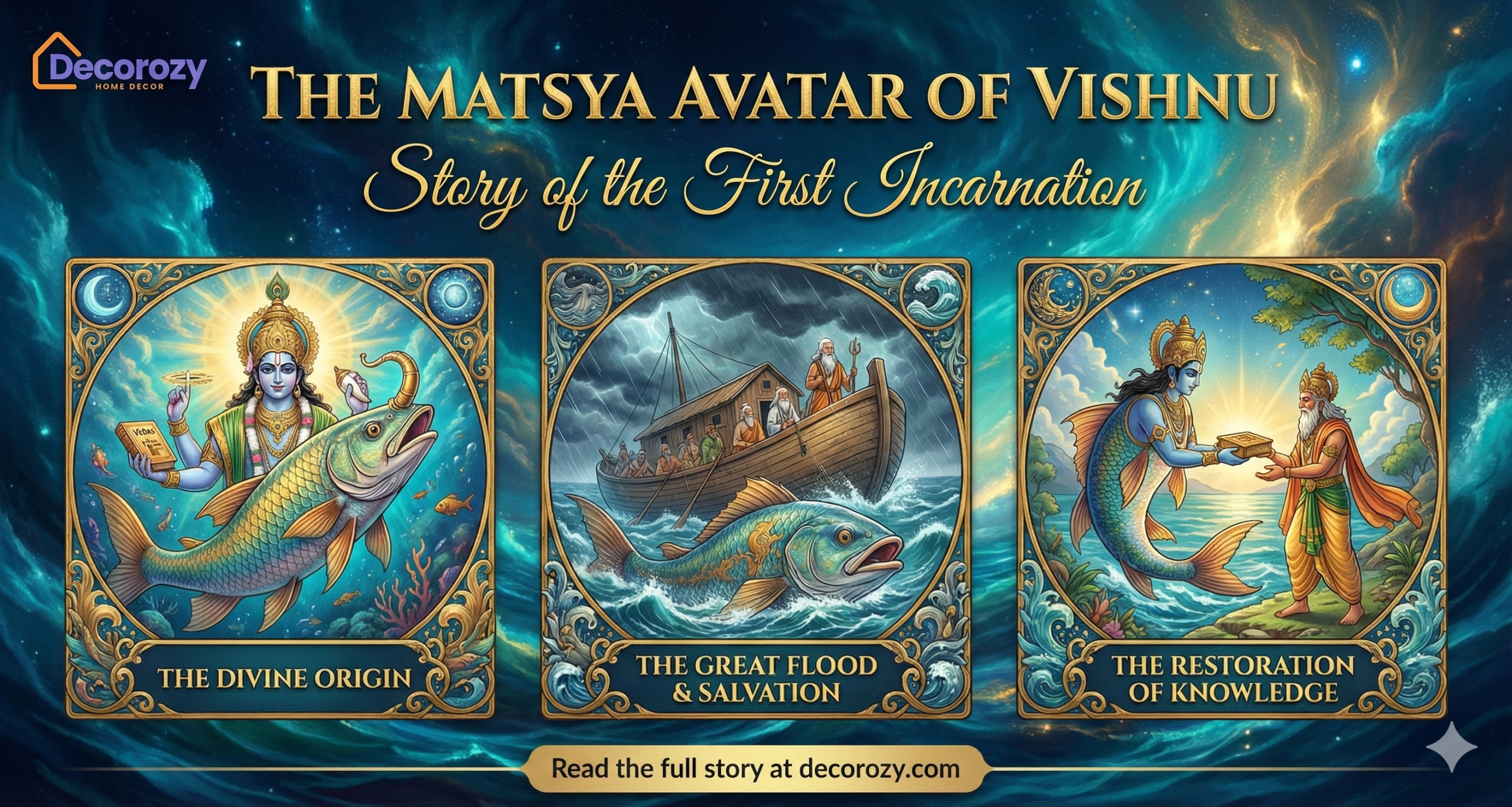
The Matsya Avatar of Vishnu is the first of the ten primary incarnations (Dashavatara), where Lord Vishnu appeared as a giant fish. His divine mission was to rescue the sacred Vedas from the demon Hayagriva and safeguard King Manu, the Saptarishis, and all living species during a catastrophic global flood.
The Origin and Purpose of the Matsya Avatar of Vishnu
Before the dawn of the current era, the world was sinking into a state of immorality and chaos. Lord Brahma, the creator, became exhausted by his duties and fell into a deep slumber.
During this lapse, a horse-headed demon named Hayagriva stole the four Vedas—the ultimate source of knowledge—from Brahma’s nose. Without these sacred texts, the spiritual foundation of humanity was at risk of total extinction.
To retrieve the stolen knowledge and prepare for a cleansing “Jal Pralay” (great flood), Lord Vishnu took the form of a small fish. This Matsya Avatar of Vishnu would serve as the bridge between the old world and the new.
Spiritual Benefits and Symbolism of the First Avatar
Understanding this legend offers more than just historical insight; it provides a roadmap for spiritual growth and the evolution of consciousness.
- Evolutionary Milestone: Symbolically, the fish represents the origin of life in water, mirroring modern scientific theories of biological evolution.
- The Kundalini Connection: Many scholars view the growing fish as a metaphor for the awakening of Kundalini energy, which starts small and eventually encompasses one’s entire being.
- Protection of Dharma: The story reinforces the belief that divine intervention is inevitable when righteousness (Dharma) is under threat.
Detailed Analysis: The Encounter with King Manu and the Great Flood
The Matsya Avatar of Vishnu first appeared to King Vaivasvat Manu while he was performing morning prayers by the river. The tiny fish pleaded for protection from larger predators, prompting the compassionate king to place it in a jar.
Miraculously, the fish outgrew the jar, then a pond, and eventually a river, until it was released into the ocean. Recognizing the divine nature of the creature, Manu bowed in reverence as Vishnu revealed His true form and warned of the impending flood.
Surviving the Cataclysm
On the seventh day, as torrential rains submerged the earth, King Manu boarded a massive ark. He carried the Saptarishis (seven sages), seeds of all plant life, and pairs of every animal species.
The Lord appeared as a golden fish with a massive horn. Using the celestial serpent Vasuki as a rope, Manu tied the ark to the horn of the Matsya Avatar of Vishnu. As they navigated the chaotic waters, Vishnu defeated Hayagriva, reclaimed the Vedas, and imparted the wisdom that would later become the Manusmriti.
Conclusion
The legend of the Matsya Avatar is a profound reminder of the cyclical nature of time and the resilience of knowledge. By preserving the Vedas and the seeds of life, Vishnu ensured that humanity could start anew with a foundation of wisdom and virtue.
Are you looking to invite the protective energy of the Preserver into your home? Browse our collection of handcrafted Lord Vishnu idols and bring a symbol of divine balance to your sacred space.
Section 3: FAQ Schema (Voice Search Optimized)
Q: Why did Lord Vishnu take the Matsya Avatar? A: Lord Vishnu incarnated as Matsya to retrieve the stolen Vedas from the demon Hayagriva and to protect King Manu, the seven sages, and various species from a global flood that was meant to cleanse the world of evil.
Q: Who was the demon killed by the Matsya Avatar? A: The Matsya Avatar defeated the demon Hayagriva (also known as Shankhasura in some versions), who had stolen the sacred Vedas from Lord Brahma while he was sleeping, hiding them in the depths of the ocean.
Q: What is the significance of the fish form in Hinduism? A: The fish form (Matsya) signifies the first stage of life and evolution. Spiritually, it symbolizes the “Matsya Nyaya” (law of the fish), where the divine protects the small and virtuous from being swallowed by the large and chaotic.
Would you like me to generate a high-quality image of the Matsya Avatar guiding King Manu’s boat through the storm to accompany this post?