Understanding the Core Teaching of the Yajurveda
Welcome to our definitive guide on ancient Vedic philosophy and spiritual practices. Today, we are exploring one of the most structurally complex texts in history.
The Vedic literature contains vast oceans of ancient wisdom and historical depth. However, the core teaching of the Yajurveda stands out due to its intensely practical application.
It serves as a vital, active bridge between human physical actions and cosmic universal harmony. Let’s unpack the structural secrets and profound truths held within this remarkable scripture.
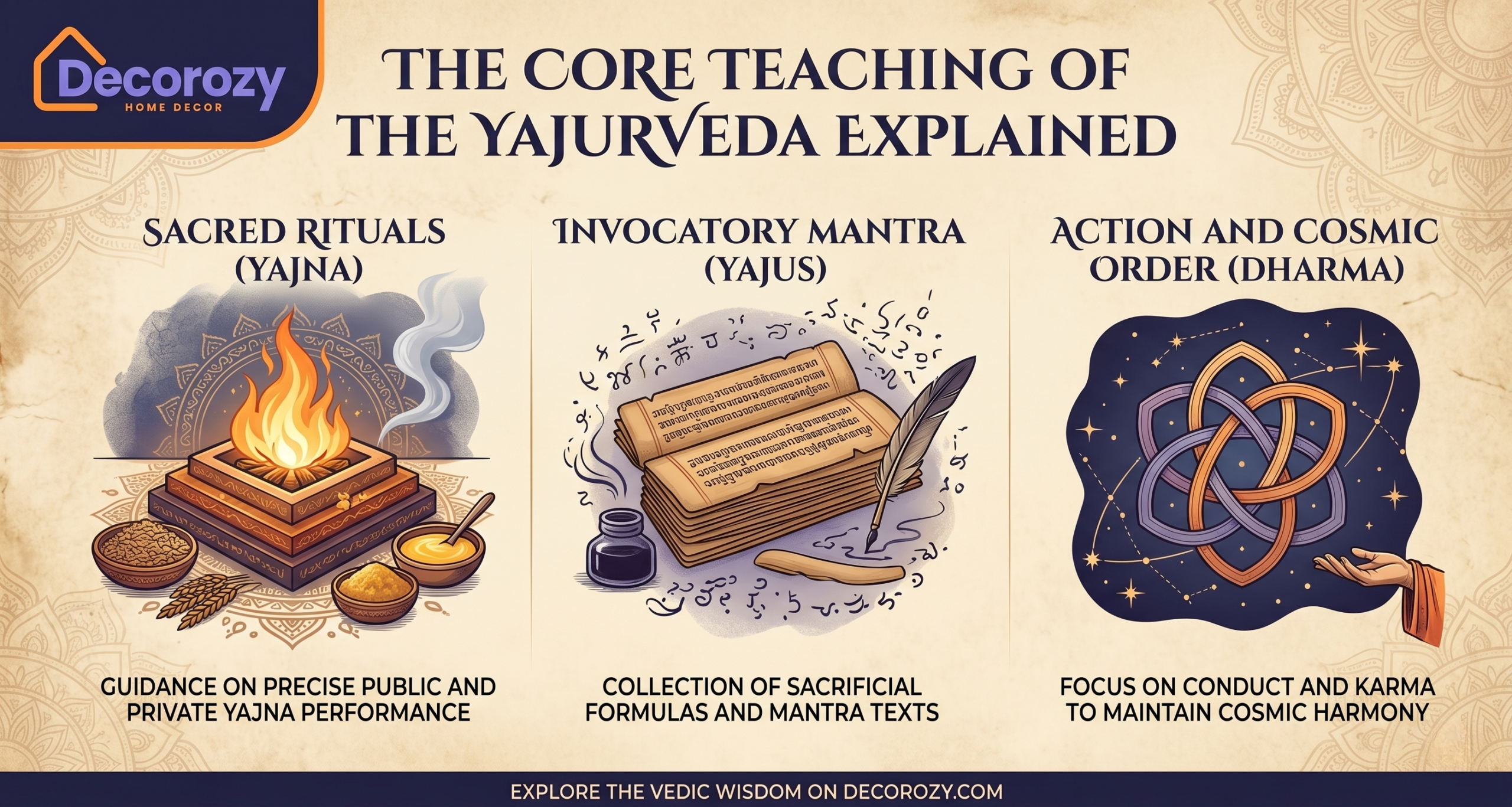
Quick Answer: The core teaching of the Yajurveda emphasizes the precise performance of sacred rituals and sacrifices (Yajnas) to maintain cosmic order and achieve spiritual elevation. It provides the essential, step-by-step procedural mantras to connect the physical realm with the divine universe.
The Historical Context: Core Teaching of the Yajurveda
To fully grasp the core teaching of the Yajurveda, we must look back to its origins. The text originated in ancient India essentially as a highly detailed guidebook for priests.
Unlike the Rigveda, which focuses primarily on poetic praise and hymns, this text is inherently action-oriented. It outlines the precise physical steps and spatial arrangements required for elaborate fire rituals.
These rituals were not merely empty, symbolic traditions. They were considered essential, daily duties required to sustain the delicate balance of the natural world.
The Adhvaryu priests relied heavily on these specific prose mantras. They were the key operators responsible for measuring the altar, preparing the fire, and executing the sacrifices.
Without the exact formulas provided in this text, the sacrifices were believed to be ineffective. Precision in pronunciation, timing, and physical movement was paramount.
Therefore, the text is the ultimate ancient manual for ritualistic perfection. It established the foundational rules for ceremonial worship that would span thousands of years.
PREMIUM COLLECTIONS
Elevate Your Home with Timeless Elegance
Discover handcrafted God idols, luxury home décor, wooden handicrafts, and pooja essentials designed to create a peaceful and beautiful living space.
🏡
Premium Home Décor Store
Browse our complete collection of premium décor products and handcrafted designs.
Visit
🛕
God Idols Collection
Premium handcrafted idols for home temples, offices, and gifting.
Explore
🌸
Lakshmi Idol Guide
Discover elegant Lakshmi idols symbolizing prosperity and abundance.
Read
💪
Hanuman Idol Guide
Premium Hanuman idols representing strength, courage, and devotion.
Discover
🎨
Animal Décor
Unique decorative figurines crafted to enhance modern interiors.
Browse
🎁
Exclusive Best Deals
Enjoy special discounts on bestselling home décor collections.
Save Now
👜
Handcrafted Bags
Stylish handmade bags designed for everyday elegance.
Shop
Bring Beauty & Positivity to Every Corner
Explore India’s finest handcrafted God idols, traditional décor, and premium home accessories—all carefully curated for your home.
Shop Premium Collection →
Spiritual Benefits: Core Teaching of the Yajurveda
Embracing the core teaching of the Yajurveda offers profound, lasting spiritual benefits for the practitioner. The mantras act as powerful sonic vibrations designed to purify the human mind.
By executing these precise, rhythmic ceremonies, practitioners believed they could actively invite divine energy into their lives. This cosmic energy would then bless their homes, crops, and local communities.
Furthermore, the text teaches unparalleled physical discipline and mental focus. The intricate, overwhelming details of the Yajnas require absolute, unwavering mindfulness from the officiating priests.
Interestingly, this external ritualism eventually paved the way for internal spiritualism. Later sections of the text, such as the profound Isha Upanishad, shift the focus entirely.
In these later chapters, the physical fire sacrifice transforms into an internal, metaphorical sacrifice. The ego and selfish desires are offered into the fire of spiritual knowledge.
This dual approach makes the scripture an incredible evolutionary map of human thought. It moves seamlessly from rigid external ceremonies to the highest peaks of internal, non-dual realization.
Detailed Analysis: The Branches of the Yajurveda
The structure of this ancient text is uniquely divided, which is vital for serious scholars. It consists of two primary divisions: the Shukla (White) and the Krishna (Black) Yajurveda.
The Shukla Yajurveda elegantly separates the explanatory, theological prose (Brahmana) from the primary ritualistic mantras (Samhita). This separation makes the memorization and recitation process highly organized.
Conversely, the Krishna Yajurveda integrates the mantras directly alongside the theological explanations. While it appears less organized, it provides immediate context to the verses being chanted.
Both branches, despite their structural differences, uphold the exact same foundational philosophy. They both assert that human action, when aligned with divine law, sustains the universe.
Understanding both of these distinct divisions is absolutely crucial for modern Vedic scholars. It reveals the natural evolution of religious thought, pedagogy, and textual preservation in early civilization.
The lasting legacy of this scripture is undeniably profound and far-reaching. The formulas laid down in these ancient verses continue to shape millions of lives today.
In summary, the foundational texts of ancient India continue to fascinate modern historians and spiritual seekers alike. Their ancient emphasis on ritualistic precision and cosmic harmony remains deeply influential.
The essence of these scriptures reminds us of the profound connection between human intention and universal balance. We hope this deep dive has enriched your historical understanding.
Explore more fascinating deep dives into history, philosophy, and elevated lifestyle concepts here at Decorozy.com. Join our newsletter today for weekly expert insights directly to your inbox!
FAQ Schema
- Question 1: What does the word “Yajurveda” literally translate to?
- Answer: The term translates to the “Veda of sacrificial formulas.” It combines the Sanskrit words “Yajus” (meaning prose mantras used in rituals) and “Veda” (meaning knowledge or wisdom).
- Question 2: Who were the specific priests that chanted the Yajurveda?
- Answer: The hymns and prose formulas of this specific text were primarily chanted by the Adhvaryu priests. They were the highly trained individuals responsible for the precise physical execution of the Vedic fire sacrifices.
- Question 3: Is the philosophy of the Yajurveda still relevant today?
- Answer: Yes, its principles heavily influence modern Hindu ceremonies and rituals. Many specific mantras and spatial arrangements from the text are still actively used during contemporary weddings, home dedications, and sacred fire rituals.