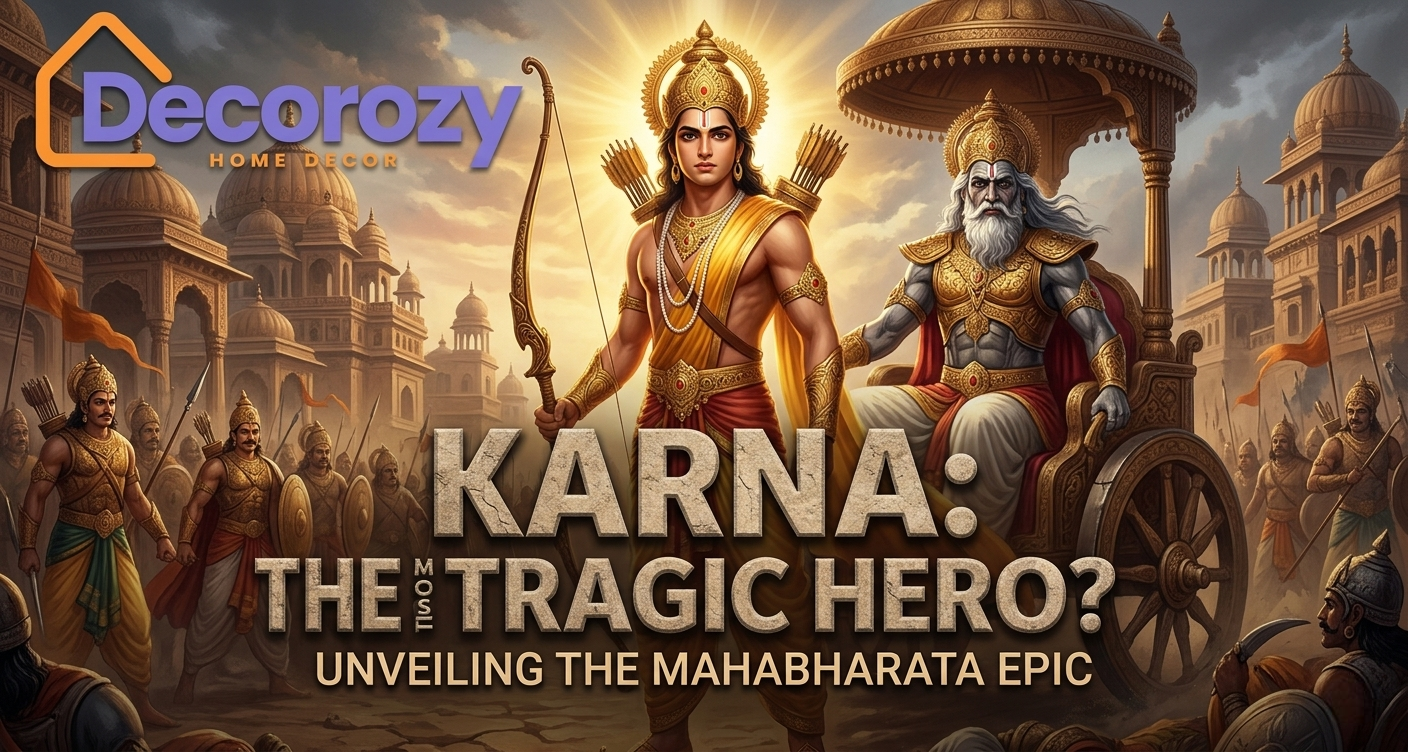
Karna: The Most Tragic Hero? Decoding the Epic Warrior
The Mahabharata is not merely an ancient historical text; it is a masterclass in human psychology, morality, and the inescapable nature of destiny. Among its vast constellation of kings and warriors, one specific figure stands out with an unmatched aura of valor and sorrow.
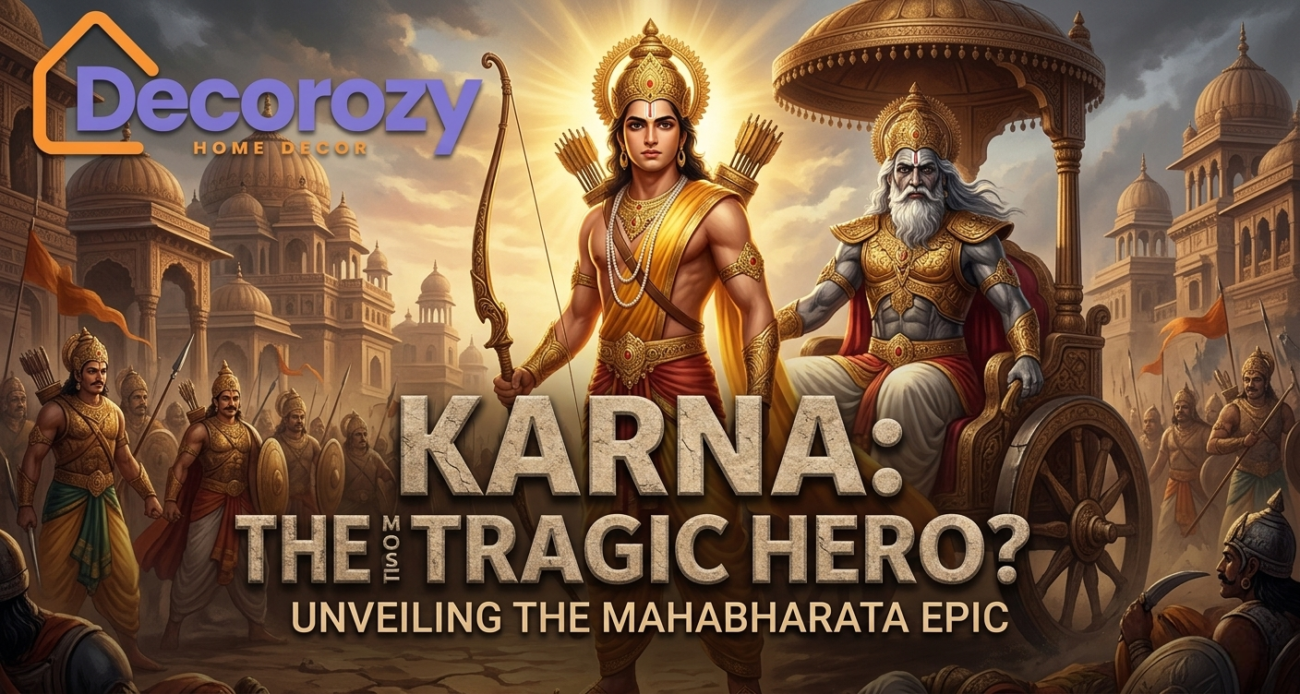
That figure is Karna: the most tragic hero?—a complex warrior whose entire existence was a relentless battle against predetermined fate and rigid societal norms.
To truly understand this epic, we must analyze his origins, his unparalleled generosity, and the devastating choices that defined his ultimate downfall.
Quick Answer: Who is Karna? Karna, deeply revered as Suryaputra, is a pivotal warrior in the Hindu epic Mahabharata. Born to Princess Kunti and the Sun God, he was abandoned at birth. Despite facing lifelong societal discrimination, he became a legendary archer, remembered eternally for his tragic loyalty and unmatched generosity.
Who is Karna: The Origins of Suryaputra
To answer the fundamental question of who is Karna, we must look back to a boon granted to a young Princess Kunti. Long before her marriage to Pandu, she invoked the Sun God, Surya, resulting in a miraculous, divine birth.
Thus, Suryaputra was born, adorned with celestial armor (Kavacha) and earrings (Kundala) that rendered him virtually invincible. However, fearing severe societal backlash as an unwed mother, Kunti made a heartbreaking choice.
She placed her radiant infant in a basket and set him afloat on the Ashwa river, abandoning him to the currents of fate. He was eventually found and raised by a humble charioteer named Adhiratha and his wife Radha.
This dramatic shift from divine royalty to a lower social caste became the defining struggle of the karna mahabharat narrative. Despite possessing the blood of a Kshatriya (warrior class) and a deity, society strictly branded him a Suta-putra (son of a charioteer).
This lifelong stigma fueled his relentless drive to prove his worth through sheer merit, setting the stage for a tragic pursuit of validation and respect.
The Legacy of Danveer Karn in Mahabharat
One cannot discuss karn in mahabharat without marveling at his absolute, unwavering commitment to charity and dharma. He earned the monumental title of danveer karn (the generous hero) due to a vow he took regarding his daily sun worship.
Karna swore that he would never refuse a request made to him after his midday prayers to the Sun God. This profound generosity was not just a personality trait; it was a deeply ingrained spiritual practice that ultimately cost him his life.
Even the gods tested the limits of danveer karan. Recognizing that Karna was invincible as long as he wore his divine armor, Lord Indra approached him disguised as a poor Brahmin.
Indra ruthlessly asked for Karna’s life-protecting Kavacha and Kundala as alms. Fully aware of the disguise and the fatal consequences, Karna did not hesitate.
He physically carved the armor from his own flesh, handing it over with a smile, cementing his legacy as the ultimate philanthropist of the ancient world.
Uncovering the Karnan Real Story: A Tale of Fate
The karnan real story is a masterclass in tragic irony, characterized by a series of devastating curses and misplaced loyalties. His desperate desire for acceptance led him to forge an unbreakable bond with Duryodhana, the Kaurava prince.
Duryodhana was the only royal who offered Karna respect, crowning him the King of Anga when the world mocked his lineage. This debt of gratitude trapped Karna on the wrong side of the great Kurukshetra war.
Furthermore, Karna was severely handicapped by three pivotal curses. His guru, Parashurama, cursed him to forget his divine weapon invocations precisely when he needed them most.
A Brahmin cursed his chariot wheel to sink into the earth during a critical battle, and the Earth Goddess herself vowed not to support him. In his final confrontation with Arjuna, all these curses manifested simultaneously.
Unarmed, attempting to lift his sunken chariot wheel, and bound by his mother Kunti’s promise not to kill the Pandavas (save for Arjuna), Karna was fatally struck. His death represents the ultimate tragedy: a supremely talented, generous soul destroyed by circumstances entirely beyond his control.
Ultimately, the story of Karna teaches us profound lessons about resilience, duty, and the harsh realities of systemic prejudice. While you explore the aesthetics of a well-designed life on Decorozy.com, it is equally important to reflect on the architectural strength of character shown by figures like Karna.
FAQ Schema
- Question 1: Who is Karna in the Mahabharata?
- Answer: Karna, also known as Suryaputra, is a central character in the Mahabharata. He is the biological son of Kunti and the Sun God, raised by a charioteer, who became a legendary archer and the most loyal friend to Duryodhana.
- Question 2: Why is Karna known as Danveer Karn?
- Answer: Karna is celebrated as Danveer Karn because of his absolute, unwavering generosity. He made a vow to never refuse a beggar after his midday prayers, famously peeling off his divine, life-protecting armor to give as alms to Lord Indra.
- Question 3: What was the real tragedy of Suryaputra Karna?
- Answer: The real tragedy of Karna lies in his systemic marginalization despite his divine birth. He was burdened by lifelong caste discrimination, devastating curses, and a tragic loyalty to the Kauravas that forced him to fight against his own biological brothers.