World Press Freedom Day 2026 Theme & The History of Press in India: A Decorozy Guide to Intellectual Freedom
At Decorozy, we believe that the ultimate expression of luxury is the freedom to think, speak, and curate your surroundings. The spaces we inhabit should reflect our deepest values, including our fundamental human right to access truth and knowledge.
As the world turns its attention to independent journalism, we are taking a moment to honor the profound impact of global media. Designing a premium home is about more than just aesthetics; it is about creating sanctuaries where ideas can flourish without censorship.
Quick Answer: World Press Freedom Day, observed globally on May 3, defends media independence and fundamental human rights. The World Press Freedom Day 2026 theme is “Shaping a Future at Peace,” highlighting journalism’s vital role in combating misinformation and fostering global transparency.
Key Takeaways
Global Observance: 3 May World Press Freedom Day acts as a critical reminder of the importance of an independent, pluralistic media landscape.
2026 Core Theme: The World Press Freedom Day 2026 theme, “Shaping a Future at Peace,” underscores the intersection of accurate journalism and global stability.
Historical Context: The history of press in India reveals a long, turbulent journey from colonial-era censorship to the vibrant, multifaceted media ecosystem of today.
Index Rankings: The World Press Freedom Index 2026 continues to highlight severe challenges, tracking the safety of journalists and the impacts of political pressures worldwide.
Aesthetic Integration: At Decorozy, we translate the concept of intellectual freedom into interior design by curating dedicated reading spaces, home libraries, and mindful decor that celebrates the written word.
The Genesis of 3 May World Press Freedom Day
The foundation of this global observance is deeply rooted in the universal desire for transparent, unhindered communication. Proclaimed by the United Nations General Assembly in 1993, this day was established following the 1991 Windhoek Declaration.
This historic declaration was a statement of principles drawn up by African journalists to promote a free, independent, and pluralistic African press. Today, the day serves multiple critical purposes across the globe.
It acts as a mirror, reflecting the current state of media independence, and serves as a shield, defending the media from relentless attacks on their independence. Most importantly, it is a day of remembrance for the brave journalists who have lost their lives in the pursuit of a story.
Without the free flow of information, democratic societies cannot thrive, and intellectual growth stagnates. This profound reality influences how we consume information and, by extension, how we design the spaces where we process that information.
Exploring the World Press Freedom Day 2026 Theme
Every year, a specific motif is chosen to highlight a pressing issue within the realm of journalism. The official World Press Freedom Day 2026 theme is “Shaping a Future at Peace.”
This powerful theme emphasizes the undeniable correlation between access to accurate information and the maintenance of peaceful, stable societies. In an era dominated by rapid digital transformation and artificial intelligence, the threat of misinformation is higher than ever.
Meaning and Global Impact
The 2026 theme goes beyond traditional reporting; it addresses the urgent need for technological accountability. Free and independent journalism contributes to global peace by promoting accountability and strengthening public trust.
When citizens have access to unbiased data, they are empowered to make informed decisions that impact their communities and their nations. Furthermore, the theme highlights the growing necessity of protecting journalists who report from conflict zones.
Their work provides the critical narrative required to hold power structures accountable and to foster sustainable, peaceful development. At Decorozy, we view this theme as an inspiration to cultivate home environments that promote clarity, peace, and intellectual safety.
The Content Mind Map: Media, Freedom, & Society
World Press Freedom Day Fundamentals
Origins: 1991 Windhoek Declaration -> UN Proclamation in 1993.
Core Goals: Evaluate media independence -> Defend against censorship -> Honor fallen journalists.
World Press Freedom Day 2026 Theme
“Shaping a Future at Peace”: Focuses on accurate information as a foundation for stability.
Modern Challenges: AI-generated misinformation -> Algorithmic bias -> Digital surveillance.
The History of Press
Global Milestones: The Gutenberg Press -> The Enlightenment -> Modern Digital Media.
History of Press in India: Hicky’s Bengal Gazette -> The Vernacular Press Act -> Post-Independence Democracy.
The World Press Freedom Index 2026
Evaluation Metrics: Political environment -> Legal framework -> Safety of journalists.
Global Trends: Rising self-censorship -> Economic instability of independent outlets.
The Deep-Rooted History of Press in India
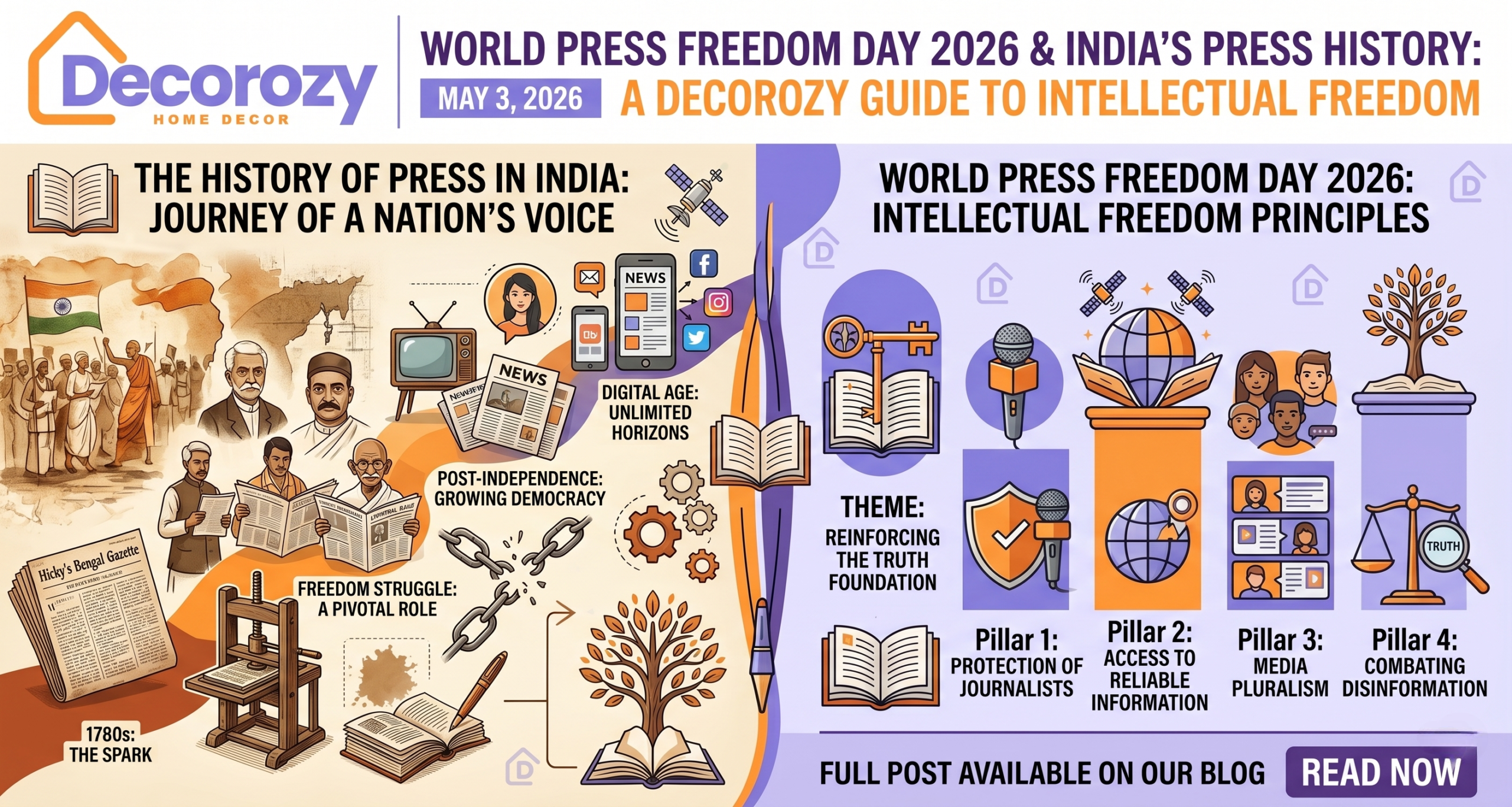
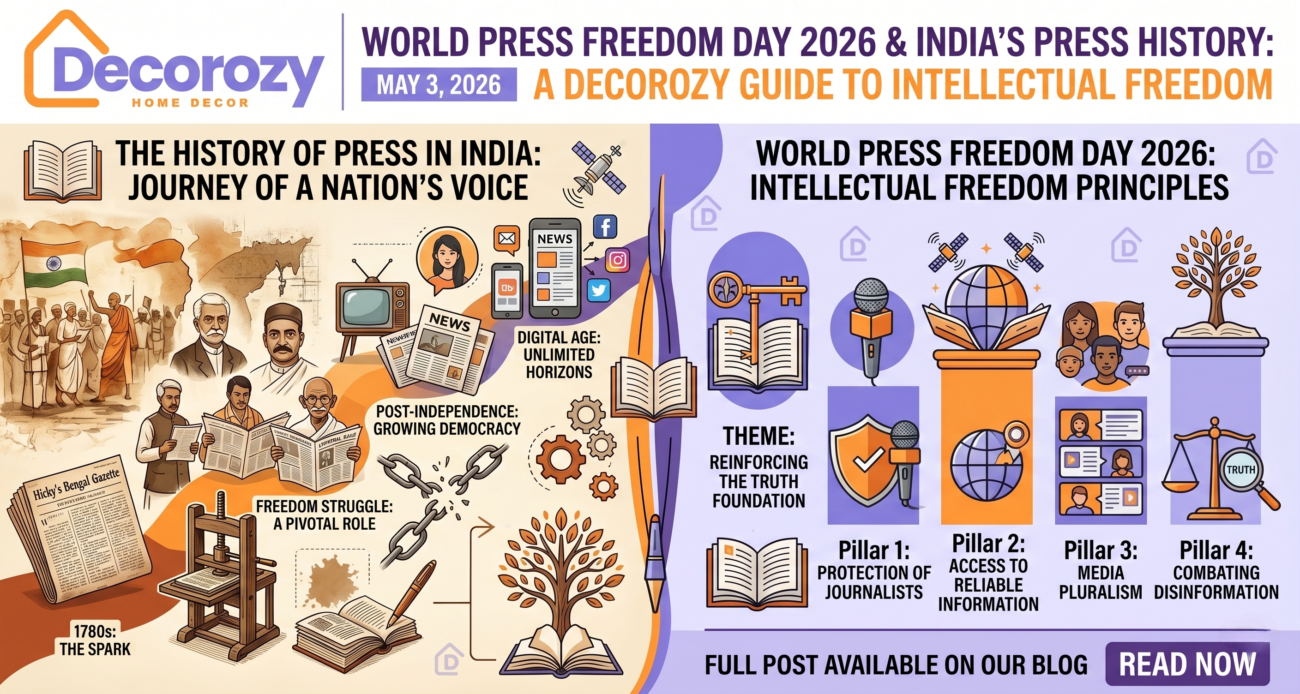
To truly appreciate World Press Freedom Day, one must understand the complex history of press in India. The journey of Indian print media is a fascinating tale of rebellion, intellect, and the relentless pursuit of freedom.
The story begins in 1780 with James Augustus Hicky, an Irishman who launched Hicky’s Bengal Gazette, the first printed newspaper in the Indian subcontinent. This bold publication laid the very foundation for the history of press in India, despite facing severe backlash from the East India Company.
The Role of Press in the Freedom Struggle
Throughout the 19th and early 20th centuries, the press became the most potent weapon in India’s struggle for independence. Visionary leaders like Raja Ram Mohan Roy, Bal Gangadhar Tilak, and Mahatma Gandhi utilized newspapers to mobilize the masses.
Publications such as Kesari, Amrita Bazar Patrika, and Harijan were not just news outlets; they were the heartbeat of the revolution. They fostered a sense of national identity and boldly criticized oppressive colonial policies.
The British administration retaliated with draconian laws, most notably the Vernacular Press Act of 1878, designed to silence non-English publications. Yet, the spirit of the Indian press remained unbroken, adapting and thriving underground when necessary.
Post-Independence and Modern Media
Following independence in 1947, the history of press in India entered a new era. The Indian Constitution, under Article 19(1)(a), implicitly guaranteed the freedom of the press through the broader right to freedom of speech and expression.
Today, India boasts one of the largest and most diverse media ecosystems in the world, with thousands of publications operating in dozens of languages. However, this vast landscape is not without its modern challenges, ranging from corporate consolidation to political pressures.
Understanding this rich history enhances our appreciation for the liberties we enjoy today. It reminds us that the right to read, write, and think freely was hard-won—a legacy worth honoring in our daily lives and our personal spaces.
Comparative Analysis: World Press Freedom Index 2026
The World Press Freedom Index, compiled annually by Reporters Without Borders (RSF), is a crucial barometer for assessing the state of journalism globally. The 2026 report paints a complex picture of the ongoing struggle for media independence.
The index evaluates 180 countries based on five distinct contextual indicators: political context, legal framework, economic context, sociocultural context, and safety. A higher score directly correlates to better press freedom and fewer restrictions on reporters.
Below is a comparative analysis of global trends observed in the 2026 index, illustrating the stark contrasts in media environments across different regions.
Region / Country Profile
2026 Index Category
Key Environmental Characteristics
Challenges Faced by Journalists
Nordic Countries (e.g., Norway, Denmark)
Good (Top Tier)
Robust legal frameworks, high institutional transparency, strong public trust.
Minimal; occasional challenges regarding digital privacy laws.
Western Europe
Satisfactory
Generally free media, independent regulatory bodies, pluralistic landscape.
Growing economic pressures on independent outlets; political polarization.
Global South (Developing Democracies)
Problematic
Vibrant but highly polarized media; mixed legal protections.
Threats of defamation lawsuits, political interference, online harassment.
India (2026 Insights)
Problematic to Difficult
Vast media diversity, strong constitutional foundations, but rising structural issues.
Safety concerns, self-censorship, legal hurdles under national security laws.
Authoritarian Regimes
Very Serious (Bottom Tier)
State-controlled narratives, severe censorship, lack of independent outlets.
Imprisonment, physical violence, complete digital surveillance and blackouts.
The data from the World Press Freedom Index 2026 underscores a global decline in media independence. It highlights the urgent need for international cooperation to protect the fundamental right to information, aligning perfectly with the World Press Freedom Day 2026 theme.
Expert Implementation & Tips: Designing for Intellectual Freedom
At Decorozy, our expertise lies at the intersection of profound global themes and premium interior aesthetics. The concept of “freedom of expression” extends naturally into how we design our homes.
When you honor the history of press and the freedom of information, you naturally gravitate toward spaces that encourage reading, deep thought, and intellectual growth. Here is our Decorozy Masterclass on curating spaces that celebrate the written word.
Curating the Ultimate Home Library
A home library is the ultimate testament to the freedom of information. It is a sanctuary where history, art, and journalism converge. To create a premium Decorozy library, focus first on spatial flow and architectural shelving.
Opt for floor-to-ceiling bespoke wooden bookshelves that exude warmth and permanence. Organize your collection not just by color, but by genre and historical significance, placing volumes on the history of press in India alongside classic literature.
Incorporate a rolling library ladder for a touch of classic elegance. Ensure the room has adequate natural light during the day, which not only preserves the books but also creates an inviting atmosphere for deep reading.
The Anatomy of a Decorozy Reading Nook
You do not need a massive room to celebrate World Press Day; a well-curated reading nook can be just as impactful. The key to a luxurious nook is ergonomic comfort combined with sensory aesthetics.
Select a high-backed, plush armchair upholstered in premium velvet or top-grain leather—a piece that invites hours of uninterrupted reading. Pair it with a handcrafted Decorozy side table, perfectly sized to hold a cup of coffee and the morning newspaper.
Lighting is paramount. Install an adjustable brass floor lamp that provides targeted, warm illumination without casting harsh shadows on the pages. Add a tactile element, such as a cashmere throw, to elevate the physical comfort of the space.
Integrating Press History into Modern Decor
The aesthetic of vintage journalism brings a unique, intellectual charm to premium home decor. Framed front pages of historically significant newspapers make for striking, conversation-starting wall art.
Consider sourcing archival prints from major moments in the history of press in India, such as the first issue of Hicky’s Bengal Gazette or independence-era publications. Frame them in sleek, minimalist gallery frames to contrast the vintage typography with modern design.
You can also incorporate antique printing press elements, such as vintage letterpress blocks or restored typewriters, as sculptural accents on console tables. These pieces act as tangible reminders of the power of the printed word and the ongoing fight for World Press Freedom Day.
Acoustic Considerations for Focused Spaces
True intellectual freedom requires an environment free from modern distractions. When designing spaces dedicated to reading and thought, acoustic management is a vital component of luxury interior design.
Use heavy, sound-dampening drapery to soften external noise and create a cocoon-like environment. Layering plush, high-pile Decorozy area rugs over hardwood floors not only adds texture but also significantly reduces acoustic reverberation.
By carefully managing the sensory input of the room, you create a physical space that mirrors the clarity and focus demanded by independent journalism. This is how the ethos of world press day translates into actionable, elevated living.
The Intersection of Global Awareness and Premium Living
Understanding global events like 3 May World Press Freedom Day enriches our perspective and deepens the meaning behind our lifestyle choices. It reminds us that the ability to curate our lives, read diverse opinions, and express our personal style are privileges built on the foundation of freedom.
At Decorozy, we are committed to providing you with more than just exceptional home decor. We strive to offer inspiration that connects high-end design with high-minded ideals. A beautiful home should be a reflection of a beautifully informed mind.
When we advocate for press freedom, we are advocating for the right to inspiration, creativity, and truth. These are the very elements that allow art, architecture, and interior design to evolve and thrive across generations.
Conclusion & Your Decorozy Consultation
As we observe World Press Freedom Day 2026, let us reflect on the profound theme of “Shaping a Future at Peace.” Let us honor the tireless journalists worldwide who ensure that truth remains accessible, and let us remember the rich, complex history of press in India that paved the way for our modern liberties.
Transforming these abstract ideals into tangible beauty is what we do best. Your home should be your personal sanctuary of free expression and refined taste.
Discover how to infuse your living spaces with intellect, comfort, and unparalleled aesthetics by exploring our exclusive collections. Visit Decorozy.com today to schedule your premium design consultation and begin curating a home that truly speaks volumes.
Frequently Asked Questions (FAQs)
Q1: What is the exact date of World Press Freedom Day? A: World Press Freedom Day is celebrated globally every year on 3 May. It was officially declared by the UN General Assembly in 1993 to promote and evaluate media independence worldwide.
Q2: What is the World Press Freedom Day 2026 theme? A: The official theme for 2026 is “Shaping a Future at Peace.” It focuses on how access to accurate, unbiased journalism is fundamental to resolving conflicts and maintaining global stability.
Q3: What is the World Press Freedom Index? A: The World Press Freedom Index is an annual ranking published by Reporters Without Borders (RSF). It evaluates 180 countries based on media independence, the safety of journalists, and the political and legal frameworks affecting the press.
Q4: Why is the history of press in India significant today? A: The history of press in India is significant because it highlights the media’s crucial role in the fight for independence against colonial rule. It serves as a historical reminder of the ongoing need to protect free speech and democratic values.
Q5: How can interior design reflect the values of World Press Day? A: At Decorozy, we believe interior design reflects these values through the creation of dedicated reading spaces, home libraries, and the use of historically significant press memorabilia as decor, fostering environments dedicated to intellectual freedom.