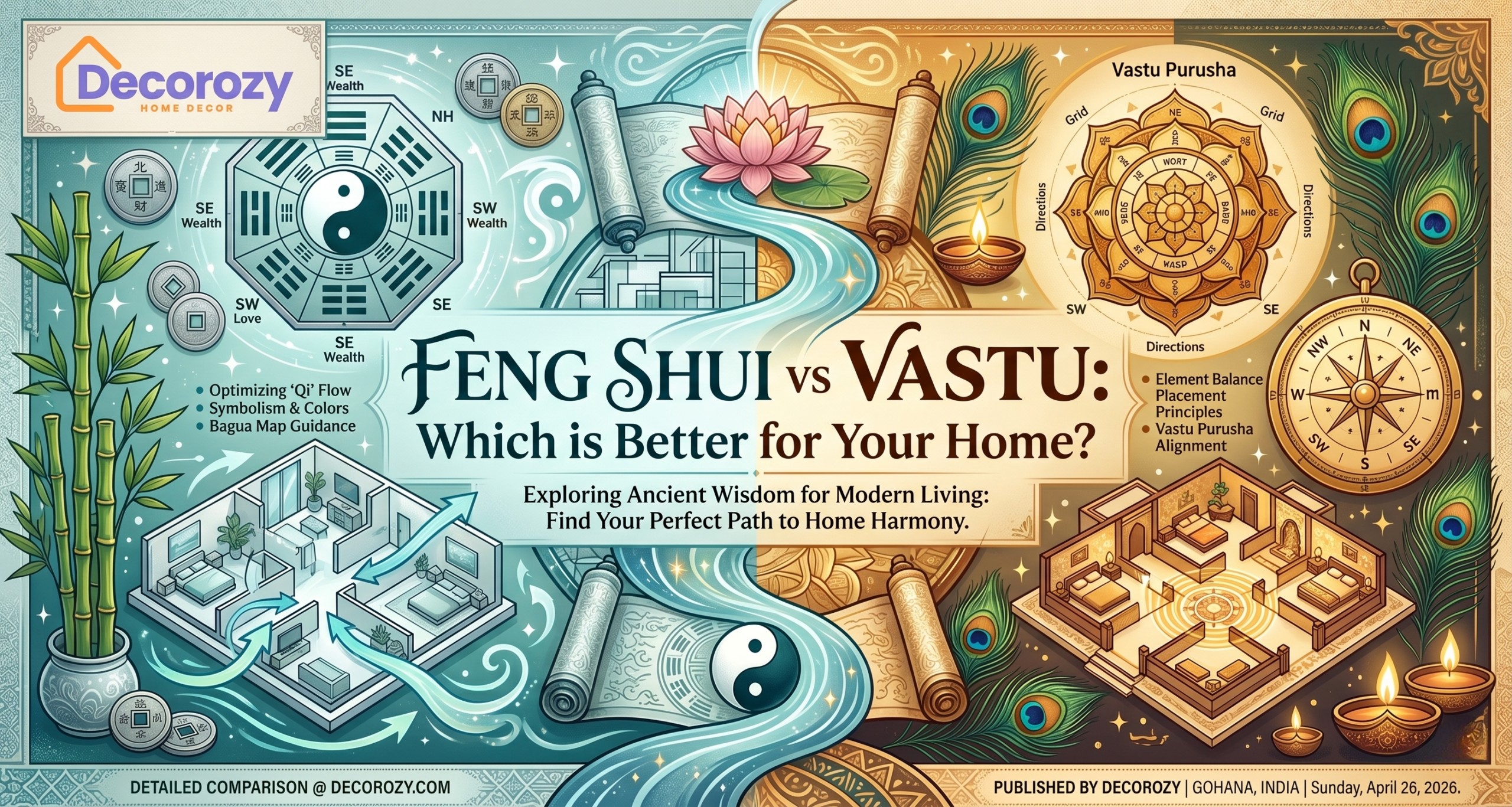
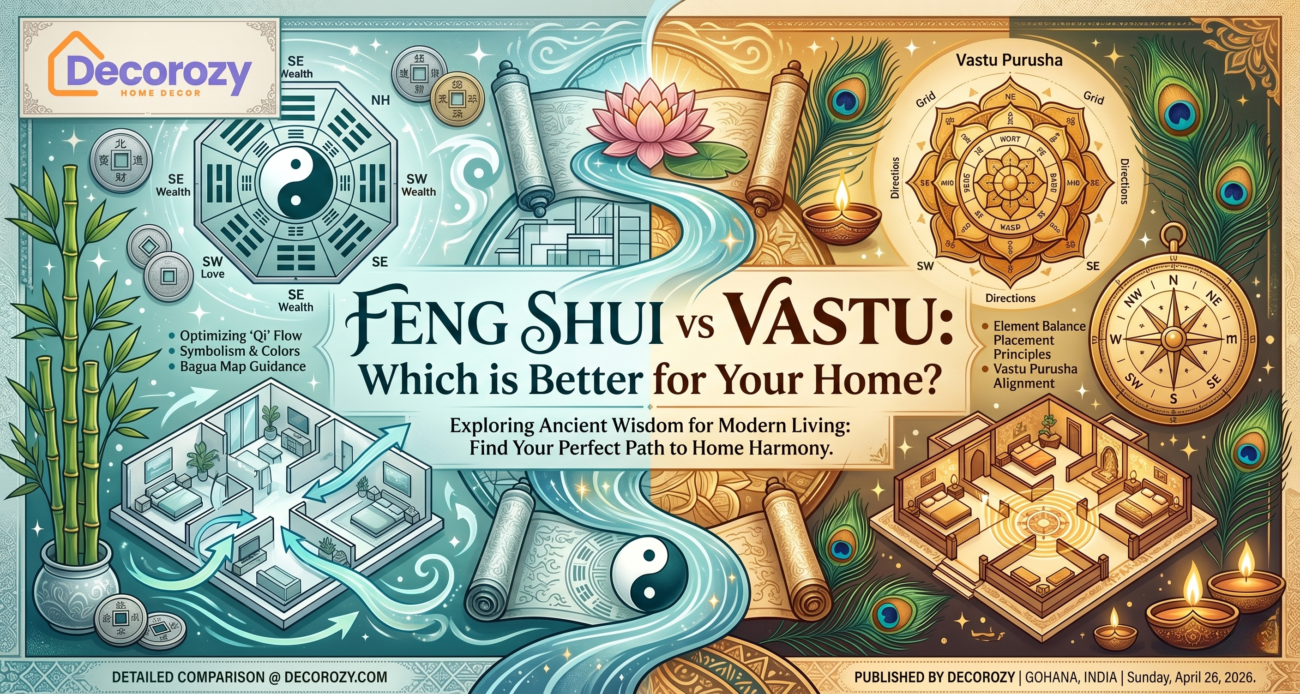
Feng Shui vs Vastu: Which is Better for Your Home?
Imagine your home radiating perfect, balanced energy, boldly declaring to the world, “Look at colourful me ,looking very attractive.” Achieving this level of domestic harmony often brings up a classic architectural debate: feng shui vs vastu. Both ancient systems promise to transform your living space into a sanctuary of health and wealth, but picking the right framework is crucial for your modern lifestyle.
Quick Answer: When comparing feng shui vs vastu, Vastu Shastra is an Indian architectural science focusing on building layout and cosmic directional alignments. Feng Shui is a Chinese practice emphasizing spatial arrangement and energy (Chi) flow. Use Vastu for new construction and Feng Shui for interior styling.
Understanding Feng Shui vs Vastu Principles
Both of these disciplines share a common goal: harmonizing human life with the surrounding environment. They rely on ancient wisdom to maximize spatial energy and improve daily well-being.
Vastu Shastra operates as a highly scientific, architectural rulebook. It calculates the influence of the sun, magnetic fields, and specific cardinal directions on a building’s foundation.
Conversely, Feng Shui is fluid and adaptable to existing structures. It uses the Bagua map to balance five natural elements, optimizing the flow of life force, or “Chi,” throughout your rooms.
Core Differences in Feng Shui vs Vastu
The primary distinction between these practices lies in their geographic origins. Vastu emerged from the ancient Indian Vedic texts, while Feng Shui developed from early Chinese philosophical traditions.
Vastu strictly dictates the exact placement of rooms during the blueprint phase. For example, to align with the fire element, a Vastu-compliant kitchen must ideally sit in the southeast corner.
Feng Shui focuses heavily on curing poor layouts using strategic decor. It allows you to shift energy dynamics using mirrors, colors, and furniture placement without knocking down structural walls.
Benefits of Applying Vastu Shastra
Implementing Vastu from the ground up ensures your home is structurally aligned with cosmic forces. This foundational balance is historically believed to bring long-term prosperity and stability.
A Vastu-compliant home naturally maximizes daylight and cross-ventilation based on solar pathways. This logical architectural approach dramatically improves your daily health and aligns your circadian rhythms.
Residents of Vastu homes often report a profound sense of psychological grounding. The strict geometric alignment fosters an environment of structured peace and reduces domestic friction.
Advantages of Choosing Feng Shui
If you are renting or living in a pre-built house, Feng Shui offers incredibly practical, non-destructive solutions. You can easily apply its principles using everyday home decor.
By simply decluttering and repositioning key items, you can immediately shift a room’s vibe. This flexibility makes it highly accessible and popular for modern apartment dwellers.
Feng Shui places a strong emphasis on psychological comfort and intuitive design. It encourages a mindful relationship with your belongings, turning your home into a personalized, restorative sanctuary.
Elemental Equivalents in Both Systems
Both practices rely heavily on balancing elemental forces, though their exact classifications differ. Vastu recognizes earth, water, fire, air, and space as its five core pillars.
Feng Shui utilizes wood, fire, earth, metal, and water to map out distinct energy zones. Understanding these differences helps designers select the exact right decor materials.
While fire and earth overlap in both systems, wood and metal offer distinct decorative remedies in Chinese traditions. Mastering these elements empowers you to curate a perfectly balanced aesthetic.
Practical Bedroom Optimization
The bedroom is considered a critical zone for physical rejuvenation in both ancient sciences. Vastu strongly recommends locating the master bedroom in the southwest corner to promote grounding.
Feng Shui emphasizes placing your bed in the “commanding position.” This means ensuring you can clearly see the door from your mattress without being directly in line with it.
Interestingly, both systems completely agree on avoiding mirrors facing the bed. This shared rule prevents restless energy from bouncing around, ensuring a deep, uninterrupted sleep cycle.
Combining Both for Ultimate Harmony
You do not necessarily have to choose one philosophy over the other. Many modern designers successfully blend the architectural rules of Vastu with the interior styling of Feng Shui.
You can build your house using Vastu’s strict directional guidelines for fundamental room placement. Once built, you can decorate those rooms utilizing Feng Shui’s elemental color palettes and furniture rules.
This hybrid approach maximizes both structural cosmic alignment and fluid internal energy movement. It represents the ultimate strategy for creating a holistically balanced, deeply nourishing living environment.
Ultimately, deciding between these two ancient sciences depends on your current living situation and budget. Embrace the philosophy that resonates most with your personal aesthetic and spatial constraints. Transform your space today with expert design tips and premium home accessories from Decorozy.com!
FAQ Schema
- Question 1: Can I use Vastu and Feng Shui together in the same house?
- Answer: Yes, you can combine them effectively. Use Vastu Shastra principles for the architectural construction and room placement, and apply Feng Shui techniques for interior decoration and furniture arrangement to maximize positive energy flow.
- Question 2: Which practice is historically older, Vastu or Feng Shui?
- Answer: Vastu Shastra is generally considered the older of the two. Its origins trace back to the ancient Indian Vedic texts written over 5,000 years ago, whereas Feng Shui developed in ancient China around 3,000 years ago.
- Question 3: Does Feng Shui work well in a rented apartment?
- Answer: Absolutely. Feng Shui is highly adaptable and ideal for apartments. Because it focuses on spatial arrangement, decluttering, and balancing elements through decor, it does not require permanent structural changes to be effective.