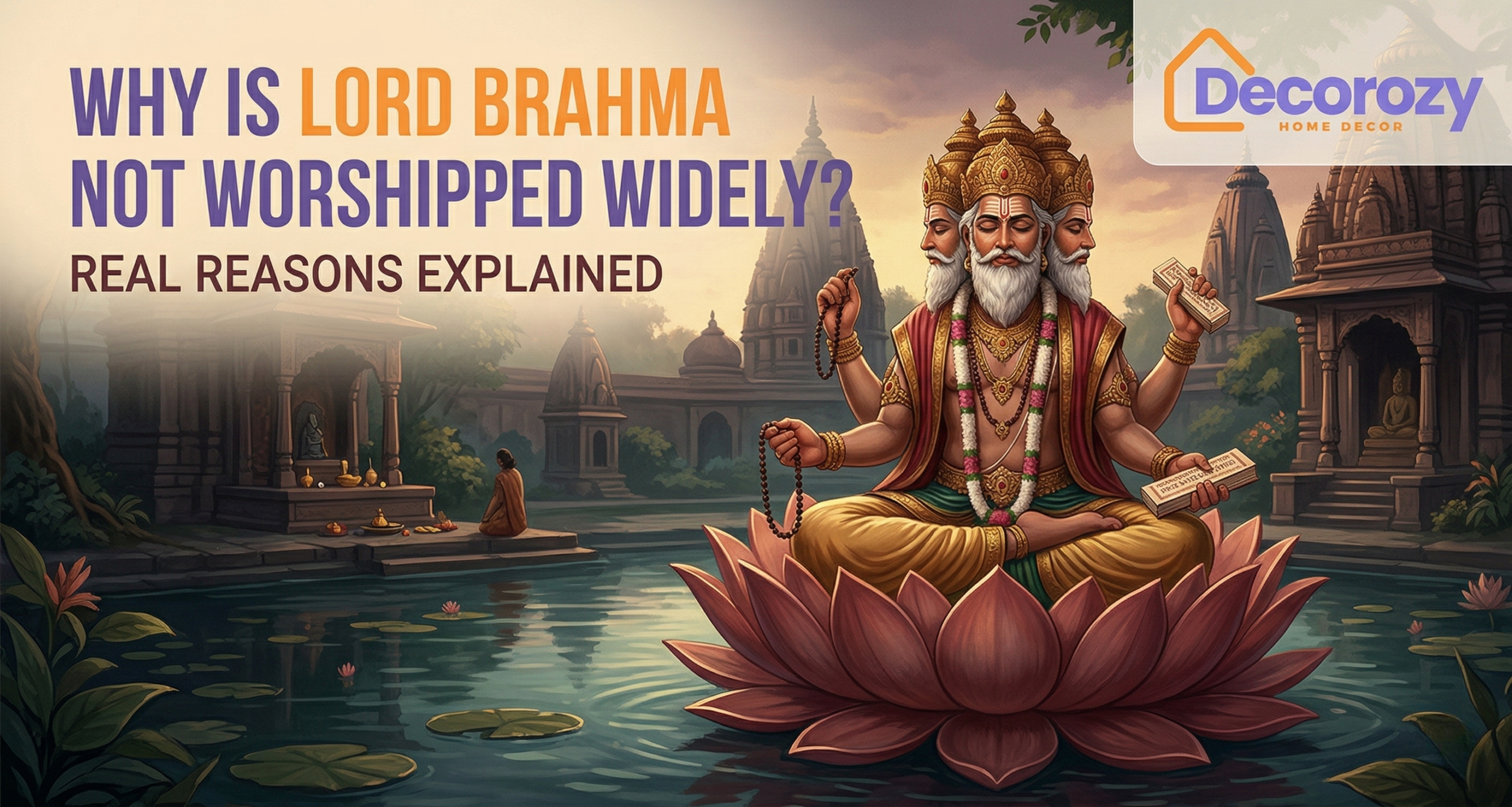
The Hindu pantheon is governed by the powerful Trimurti, consisting of the Creator, the Preserver, and the Destroyer. However, a common question arises among scholars and spiritual seekers alike: why is lord brahma not worshipped widely? While millions of temples are dedicated to Lord Shiva and Lord Vishnu across the globe, temples devoted solely to Lord Brahma are incredibly rare. This stark contrast in devotion is rooted in ancient scriptures, cosmic duties, and historical evolution.
Quick Answer: Lord Brahma is not worshipped widely primarily due to a mythological curse from Lord Shiva after Brahma lied about finding the end of an infinite cosmic pillar. Furthermore, philosophically, his role as the creator is complete, leading devotees to focus on deities who actively preserve and transform their current lives.
The Mythological Origins: Why Is Lord Brahma Not Worshipped Widely?
To understand the lack of Brahma temples, we must first examine the ancient Puranic scriptures. The most prominent explanation comes from the Shiva Purana, involving a test of supremacy.
According to the legend, a dispute arose between Lord Brahma and Lord Vishnu over who was the greatest deity. To settle the debate, Lord Shiva manifested as an infinite, blazing pillar of light known as the Lingodbhava.
Shiva challenged both gods to find the end of this cosmic pillar. Vishnu transformed into a boar and dug downward, while Brahma took the form of a swan and flew upward.
After ages of searching, Vishnu admitted defeat. However, Brahma encountered a Ketaki flower falling from the top and convinced it to falsely testify that he had reached the summit.
Enraged by this deception, Lord Shiva cursed Brahma. He decreed that Brahma would never be revered or worshipped by humanity, explaining why is lord brahma not worshipped widely today.
Another Tale: The Curse of Goddess Saraswati
Beyond the Shiva Purana, other sacred texts offer alternative explanations for this religious phenomenon. Another famous legend involves Goddess Saraswati and a grand fire sacrifice (Yagna).
Lord Brahma was preparing to conduct a highly auspicious Yagna, a ritual that strictly required the presence of his wife. However, Goddess Saraswati was delayed in arriving at the ceremonial grounds.
Unable to wait for the auspicious planetary alignment to pass, Brahma married a local milkmaid named Gayatri to complete the rituals on time. When Saraswati finally arrived, she was furious.
In her anger, she cast a powerful curse upon her husband. She proclaimed that he would never be worshipped anywhere on Earth, save for one specific location: the sacred city of Pushkar.
The Philosophical Perspective: The Creator’s Work is Done
While ancient myths provide fascinating narratives, there is also a deeply philosophical reason explaining why is lord brahma not worshipped widely. This relates to the concept of time and cosmic duty.
Lord Brahma is the architect of the universe. His primary function is creation, an event that has already occurred at the dawn of the current cosmic cycle.
Because his work is essentially finished, human beings do not feel the need to seek his daily intervention. There is no ongoing, day-to-day requirement for his specific cosmic energy.
In contrast, Lord Vishnu is the preserver, responsible for daily sustenance, wealth, and harmony. Humans constantly pray to Vishnu and his avatars (like Krishna and Rama) for continuous protection.
Similarly, Lord Shiva is the destroyer and transformer. Humans revere and fear him, seeking his blessings to overcome obstacles, destroy inner demons, and navigate life’s inevitable changes.
Historical and Sectarian Shifts in Ancient India
From an academic and historical standpoint, the religious landscape of ancient India underwent massive transformations. The Vedic period saw different deities prioritized than the Puranic period.
As Hinduism evolved, powerful sectarian movements began to consolidate influence. The Bhakti movement heavily favored personal devotion to either Vishnu (Vaishnavism) or Shiva (Shaivism).
These two major sects built massive temple complexes, wrote extensive literature, and gathered immense royal patronage. Over centuries, the worship of Brahma was organically overshadowed by these growing movements.
Today, while he remains highly respected as a fundamental part of the holy Trinity, active worship is directed elsewhere. Understanding this shift provides a complete picture of the religious dynamics at play.
If you are fascinated by the rich tapestry of ancient history, mythology, and spiritual architecture, explore more in-depth guides right here on Decorozy.com!
FAQ Schema
- Question 1: Where is the only temple of Lord Brahma?
- Answer: While it is often referred to as the “only” temple, the most famous and prominent one is the Jagatpita Brahma Mandir located in Pushkar, Rajasthan, India. There are a few other minor shrines dedicated to him in Asia, but Pushkar remains the primary pilgrimage destination.
- Question 2: Who cursed Lord Brahma?
- Answer: According to various Hindu texts, Lord Brahma received curses from multiple figures. He was primarily cursed by Lord Shiva for lying about finding the top of a cosmic pillar, and in another prominent legend, he was cursed by his consort, Goddess Saraswati, for marrying another woman to complete a ritual.
- Question 3: What are the three main gods in Hinduism?
- Answer: The three main deities form the cosmic Trinity known as the Trimurti. This includes Lord Brahma (the Creator), Lord Vishnu (the Preserver), and Lord Shiva (the Destroyer). Together, they manage the endless cycle of creation, sustenance, and dissolution of the universe.