Who is the Real Father of Sita? The Eternal Mystery
For generations, the Ramayana has been the cornerstone of Indian storytelling. We all know the tale of Lord Rama’s birth, but the origins of his consort, Sita Mata, remain shrouded in divine enigma. While most grew up believing she was simply found in a furrow, a deeper look into ancient texts reveals a complex web of biological and spiritual lineages.
Quick Answer: Who is Sita’s Father?
In the traditional Valmiki Ramayana, King Janaka of Mithila is considered Sita’s father after discovering her in a field. However, in the Jain Ramayana and Uttar Purana, it is suggested that Ravana was her biological father, having abandoned her due to a prophecy that she would cause his demise.
The Discovery: King Janaka and the Earthly Birth
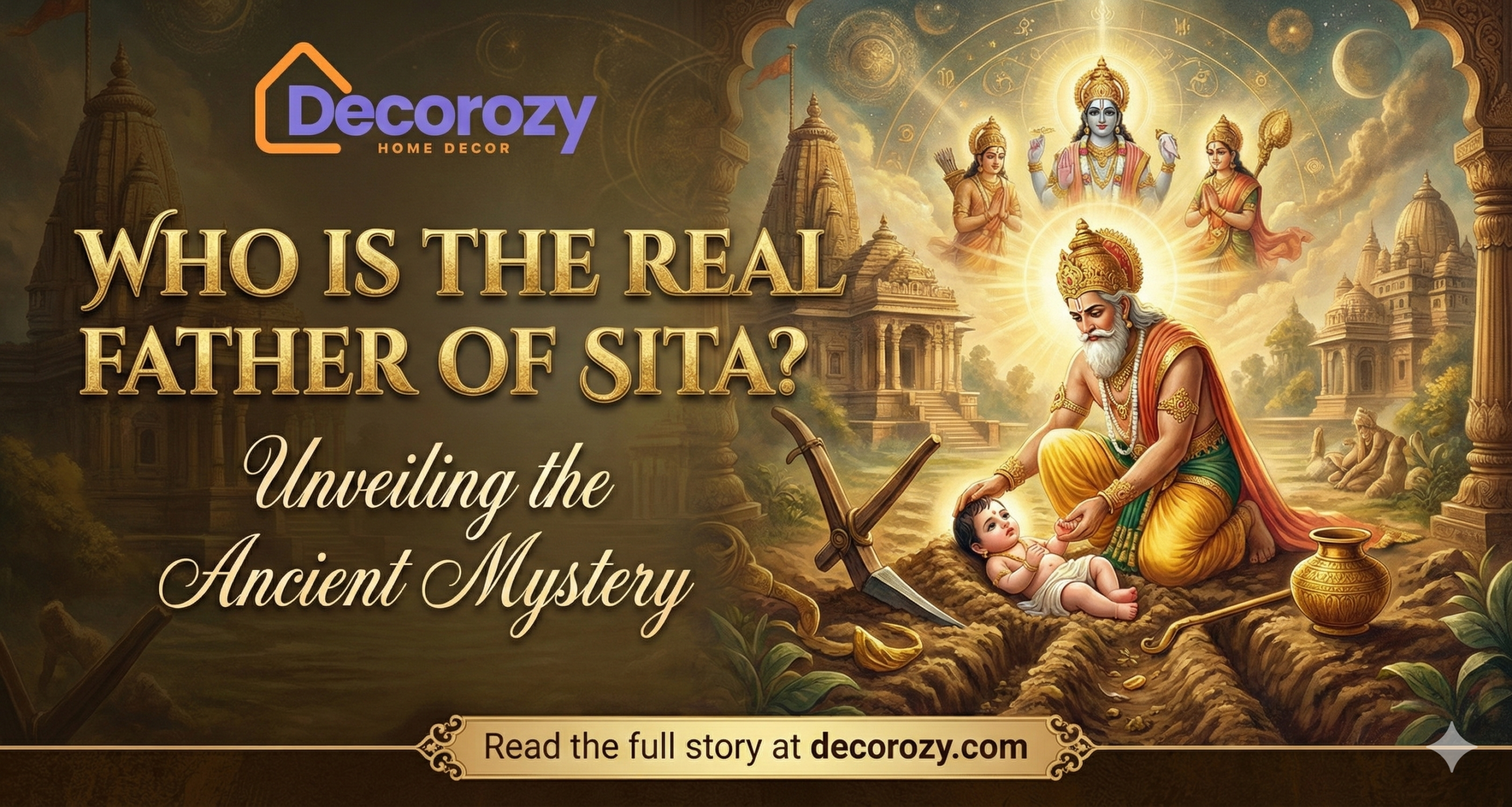
In the most widely accepted version of the epic, King Janaka of Mithila was performing a yajna (sacred ritual) to end a drought. While ploughing the ritual ground, he unearthed a golden casket containing a radiant infant.
Naming her “Sita” (meaning “furrow”), Janaka and Queen Sunaina raised her as their own. This narrative emphasizes that who is the real father of Sita is defined by love and duty (Dharma) rather than just biology. To millions, Janaka is the only father she ever knew.
The Alternative Theory: Is Ravana the Biological Father?
Despite the popular narrative, several ancient versions of the Ramayana offer a startling alternative. In Sanghadasa’s Jain Ramayana, a woman named Vedavati is harassed by Ravana and self-immolates, vowing to return to destroy him.
She is reincarnated as a girl born to Ravana’s wife, Mandodari. Fearing the prophecy that this child would bring his end, Ravana orders her to be cast away. This infant is eventually found by Janaka, suggesting a blood connection between the villain and the heroine that complicates the moral landscape of the story.
Detailed Analysis: Variations Across the Uttar Purana
The Uttar Purana provides another layer to the mystery, naming Manivati as the catalyst for Ravana’s downfall. In this version, Manivati is reborn as the daughter of Ravana and Mandodari.
- The Curse: Ravana, aware of the curse, orders the child’s death.
- The Escape: Instead of killing her, a servant buries the child in Mithila.
- The Finding: King Janaka discovers her shortly after, bridging the gap between the biological father (Ravana) and the foster father (Janaka).
While the Valmiki Ramayana remains vague on her genetic ancestry, these variations invite us to look at Sita not just as a princess, but as a cosmic force destined to balance the scales of justice.
Conclusion: A Legacy of Devotion
Whether you view Sita as the biological daughter of Ravana or the miraculous gift to King Janaka, her legacy remains unchanged. She represents purity, strength, and resilience. The question of who is the real father of Sita may never have a singular answer, as the Ramayana lives through its many interpretations.
Want to explore more Vedic mysteries? Subscribe to our newsletter for weekly insights into ancient Indian epics!
Section 3: FAQ Schema (People Also Ask)
Q1: Who was the biological mother of Sita? Answer: In the traditional Valmiki version, Sita is considered the daughter of Bhooma Devi (Mother Earth). However, in the Jain and Uttar Purana versions, Mandodari, the wife of Ravana, is described as her biological mother.
Q2: How many children did Ravana have? Answer: Ravana had seven sons across his two wives. With Mandodari, he had Meghanada (Indrajit), Akshayakumara, and Prahasta. With his second wife, Dhanyamalini, he had Narantaka, Devantaka, Trishira, and Atikaya.
Q3: Where was Sita Mata born? Answer: There are two primary beliefs regarding her birthplace. Many devotees believe she was found in Sitamarhi, Bihar, while others identify her birthplace as Janakpur in modern-day Nepal, which was the capital of King Janaka’s kingdom.
Would you like me to create an SEO-optimized image prompt to accompany this blog post?