The departure of Lord Krishna marks one of the most profound and widely debated moments in Hindu mythology. For thousands of years, devotees and scholars have asked: exactly what happened to Krishna’s body after his death? As the Dwapara Yuga ended and the Kali Yuga began, the ultimate incarnation of Lord Vishnu left his physical form. This transition left behind mysteries, deep spiritual lessons, and fascinating legends that continue to captivate the world today.
Quick Answer: According to Hindu epics, after Lord Krishna was fatally shot by a hunter, his physical body was cremated by the Pandava prince, Arjuna. While his mortal remains turned to ashes, his divine heart reportedly remained unburned. These sacred remains were immersed in the river and later became a legendary relic.
The Events Leading to What Happened to Krishna’s Body After His Death
To understand the aftermath, we must first look at the cosmic events leading to Krishna’s mortal exit. Following the devastating Mahabharata war, Queen Gandhari was overwhelmed with grief over the loss of her sons, the Kauravas.
In her sorrow, she cursed Lord Krishna, decreeing that his Yadava clan would perish and he would meet a similar lonely fate. Accepting this with a divine smile, Krishna allowed destiny to take its course.
Years later, the Yadava men succumbed to intoxication and infighting, destroying their own lineage. Krishna then retreated to the forests near the Hiran River to meditate. There, a hunter named Jara mistook Krishna’s left foot for a deer and shot him with an arrow.
This fulfilled an ancient karmic debt, as Krishna had defeated the monkey king Bali in his previous avatar as Lord Rama. Jara was Bali reincarnated, proving that the laws of Karma apply universally.
A Detailed Analysis: What Happened to Krishna’s Body After His Death?
Once Krishna departed his physical vessel, his devoted friend Arjuna arrived to find his mortal remains. Arjuna was profoundly heartbroken, weeping for the loss of his guide and savior.
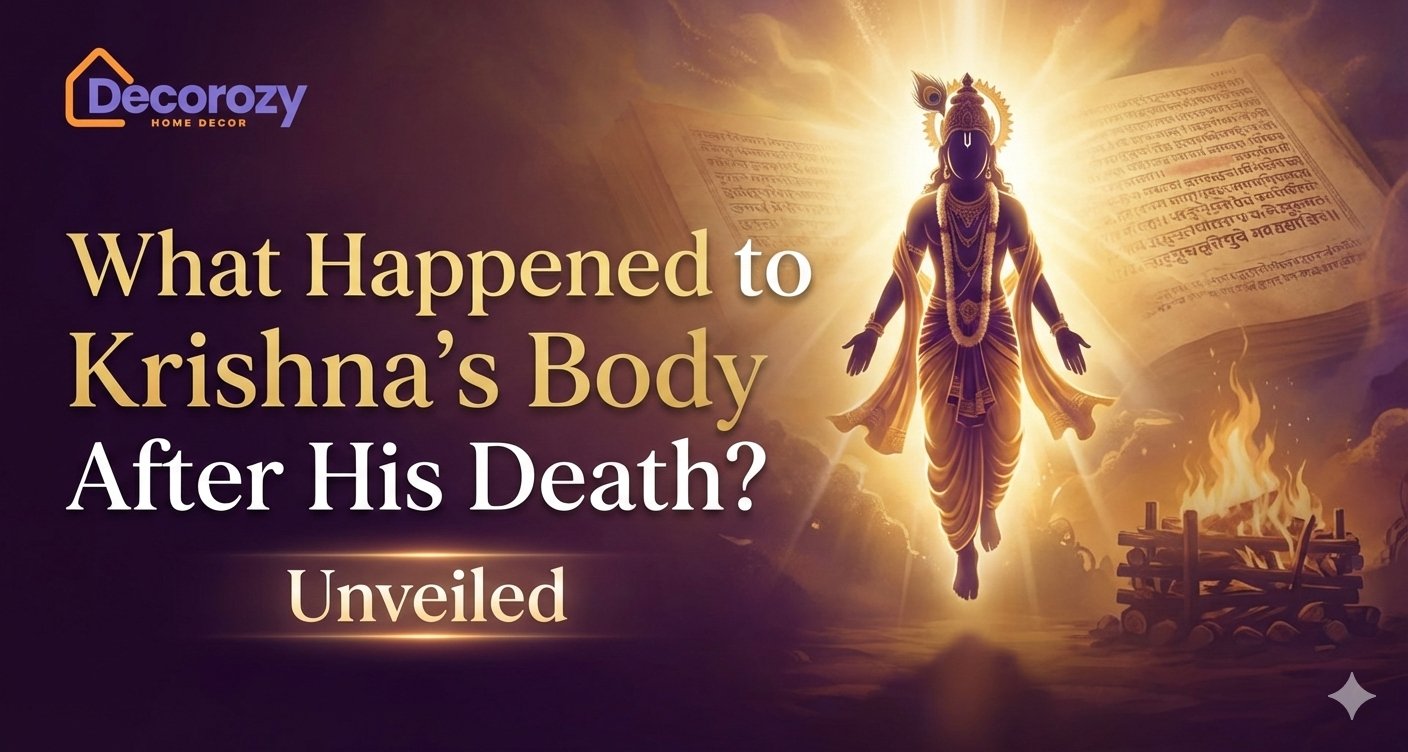
Arjuna took on the heavy responsibility of performing the final rites. He cremated Sri Krishna’s body, alongside the remains of Krishna’s elder brother, Balarama, deep within the dense forest.
Ancient texts suggest a miraculous occurrence during this cremation. While the fire consumed the physical flesh and turned the body to ashes, Krishna’s heart—referred to as the pinda—refused to burn. It remained intact, glowing with eternal divine energy.
Arjuna gathered these ashes and the unburned heart, immersing them into the holy Yamuna River. Following this solemn duty, Arjuna evacuated the surviving women and children from Dwaraka before the raging ocean completely swallowed the magnificent city.
The Spiritual Significance and Hidden Blessings
While the tale of his departure seems tragic, it carries immense spiritual benefits for truth-seekers. Krishna’s mortal death reinforces the concept that the physical body is temporary, but the soul is eternal.
It demonstrates the inescapable power of Karma. By accepting Gandhari’s curse and the hunter’s arrow, Krishna showed that even the Supreme Being honors the cosmic laws of cause and effect.
Furthermore, his departure stripped Arjuna of his divine martial powers. This taught humanity that strength and abilities are granted by the divine for a specific purpose, and fade once that purpose is fulfilled.
The Mystical Legend of the Puri Jagannath Temple
Perhaps the most fascinating aspect of this story lies in regional traditions. A popular legend states that Krishna’s unburned heart did not remain in the river.
Instead, it floated eastward toward the coast of Puri in modern-day Odisha. Devotees recovered this divine artifact and placed it safely inside a sacred wooden idol.
Today, this idol is worshipped as Lord Jagannath. Because the immense energy of the divine heart gradually damages the wood, the temple priests perform a highly secretive ritual called Navakalevara every twelve years.
During this sacred ceremony, they carve new idols and carefully transfer the hidden heart from the old wooden body to the new one, keeping Krishna’s physical legacy alive for modern devotees.
Conclusion The physical departure of Lord Krishna was not an end, but a magnificent transition. From the solemn cremation by Arjuna to the enduring mystery of his unburned heart in Puri, his final journey is as awe-inspiring as his life. Ultimately, Krishna lives on not through his physical body, but through the timeless wisdom of the Bhagavad Gita and the unconditional love he planted in the hearts of his devotees. Section 3: FAQ Schema
How did Lord Krishna die? Lord Krishna died after a hunter named Jara mistook his foot for a deer and shot it with a poisoned arrow. Krishna was resting in a forest near the Hiran River at the time. This event was the culmination of Queen Gandhari’s curse and a karmic debt from a past life.
Why didn’t Lord Krishna’s heart burn during cremation? According to Hindu legends, while Lord Krishna’s physical body turned to ashes during cremation, his heart (pinda) remained unburned. This is believed to signify his eternal divine energy and the indestructible nature of the supreme soul, which cannot be consumed by mortal fire.
Where is Lord Krishna’s heart kept today? Local legends and traditions strongly suggest that Lord Krishna’s unburned heart is enshrined within the wooden idol of Lord Jagannath in Puri, Odisha. The sacred heart is supposedly transferred to a newly carved wooden idol every twelve years during a ritual known as Navakalevara.