The concept of moving through different temporal dimensions often feels like a purely modern science fiction trope.
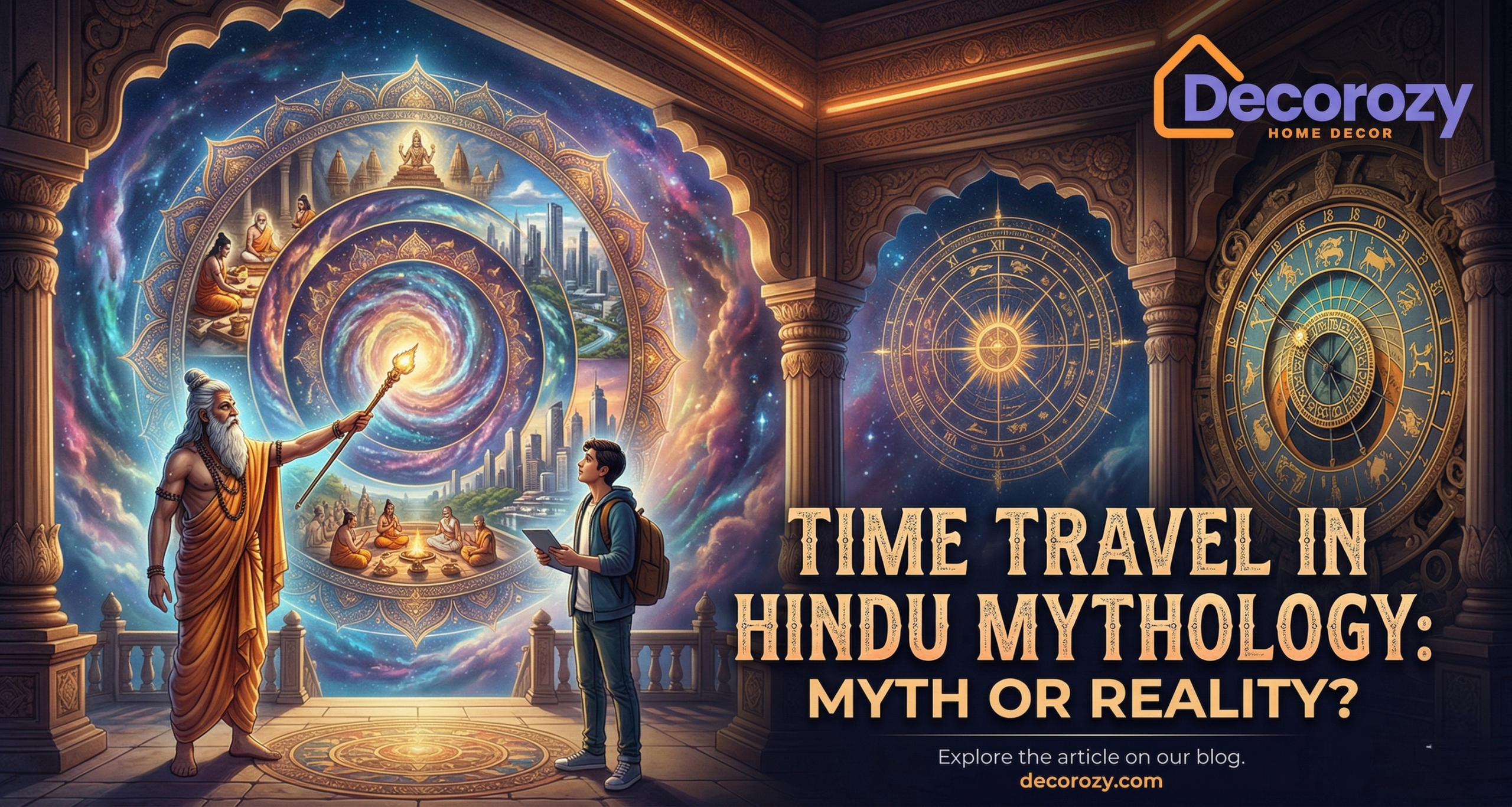
However, examining time travel in Hindu mythology reveals surprisingly advanced, ancient perspectives on the nature of space and time.
Scholars and science enthusiasts alike often wonder if these ancient accounts are mere storytelling or echoes of advanced cosmological understanding.
Quick Answer: Is time travel in Hindu mythology a myth or reality? While modern physics views it theoretically, ancient Hindu texts present it as a conceptual reality. Stories like King Kakudmi’s visit to Brahma illustrate time dilation, closely mirroring Einstein’s theory of relativity centuries before modern science.
The Core Concept of Time Travel in Hindu Mythology
To understand time travel in Hindu mythology, we must first look at the ancient texts known as the Puranas.
These sacred scriptures describe time not as a straight, absolute arrow, but as a cyclical and relative phenomenon.
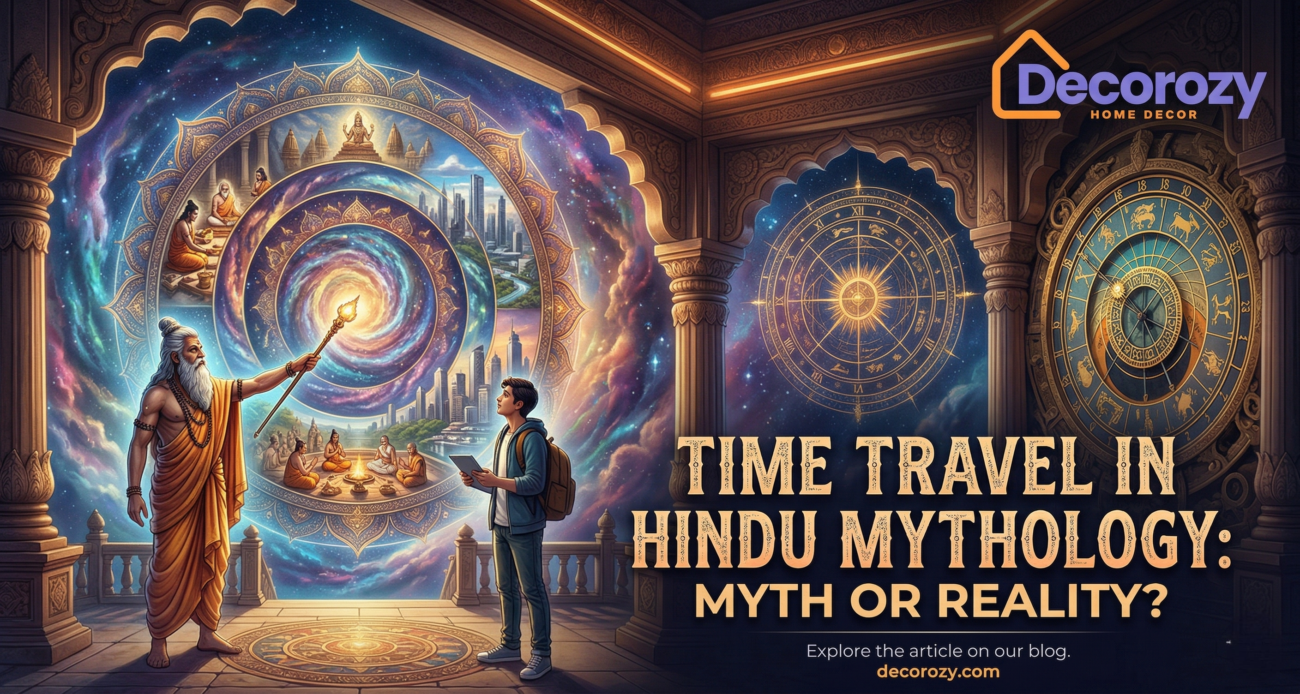
The most famous example is the story of King Kakudmi and his daughter, Revati, found in the Bhagavata Purana.
Seeking a suitable husband for Revati, the King traveled to Brahmaloka to consult the creator god, Brahma.
Upon arriving, they had to wait briefly while Brahma finished listening to a musical performance.
When Kakudmi finally presented his list of potential suitors, Brahma laughed, explaining that time runs differently on his plane of existence.
During their short wait in Brahmaloka, millions of years had passed on Earth, and all the King’s friends, family, and potential suitors had long perished.
Why Time Travel in Hindu Mythology Matters Today
Analyzing time travel in Hindu mythology is crucial because it bridges the gap between ancient philosophy and modern quantum physics.
It demonstrates that ancient Indian thinkers possessed a profoundly complex understanding of the universe’s mechanics.
Long before Albert Einstein introduced his theory of relativity, these texts described a universe where time is fundamentally relative to the observer.
This challenges our modern assumptions about the evolution of human knowledge and scientific thought.
It suggests that humanity’s conceptual grasp of time dilation and multiverse theories existed thousands of years ago.
For readers at Decorozy, exploring these intersections offers a fascinating glimpse into how ancient wisdom anticipated modern scientific discoveries.
A Detailed Analysis of Cosmic Time Dilation
To deeply analyze these accounts, we must look at the structural measurement of time in Hindu cosmology.
Time is divided into massive epochs called Yugas, which cycle continuously through creation and destruction.
One day for Brahma, known as a Kalpa, equals 4.32 billion human years.
This immense scale of time perfectly illustrates the concept of cosmic time dilation.
When characters in these epics move between earthly realms and divine planes, they experience a localized flow of time.
Another compelling account is the story of King Muchukunda, who slept for millions of years in a cave.
When he finally awoke, he realized the world had aged drastically, and humanity had diminished in size and stature.
These narratives are not about building a mechanical time machine, but rather navigating the relativity of the cosmos.
They suggest a profound, intuitive understanding of astrophysics encoded within spiritual and religious allegory.
Whether viewed as a myth or a metaphorical reality, these stories remain a testament to human imagination and intellect.
Thank you for exploring the mysteries of the ancients with us. For more deep dives into fascinating historical and cultural phenomena, continue your journey at Decorozy.com!
FAQ Schema
- Question 1: Is there any mention of time travel in the Vedas or Puranas?
- Answer: Yes, the Puranas extensively detail concepts of relative time. The most prominent example is in the Bhagavata Purana, which tells the story of King Kakudmi experiencing massive time dilation after visiting the realm of Brahma.
- Question 2: Who travelled through time in Hindu mythology?
- Answer: King Kakudmi and his daughter Revati are the most famous time travelers in Hindu mythology. By visiting a higher-dimensional realm (Brahmaloka), they inadvertently traveled millions of years into the Earth’s future due to time dilation.
- Question 3: How does Hindu time dilation compare to modern science?
- Answer: Hindu time dilation remarkably mirrors Einstein’s Theory of Relativity. Both propose that time is not absolute but relative to the observer’s location, speed, and gravitational field, meaning time passes differently across various parts of the cosmos.