Ancient texts often hold profound mysteries about our origins and the nature of reality. For history enthusiasts, scholars, and spiritual seekers alike, one major question frequently arises: does the Rigveda talk about universe creation? Exploring the depths of this ancient Sanskrit scripture reveals some of humanity’s earliest and most sophisticated cosmological speculations.
Quick Answer: Yes, the Rigveda explicitly discusses universe creation. The 10th Mandala features multiple hymns detailing cosmic origins, most notably the Nasadiya Sukta (Hymn of Creation). This ancient text explores primordial nothingness, the emergence of existence, and profound philosophical questions about the universe’s ultimate creator.
The Core Concept of Rigveda Universe Creation
When analyzing Rigveda universe creation theories, we must look primarily at the 10th Mandala. This specific section of the text contains humanity’s earliest known philosophical inquiries into how the cosmos came to be.
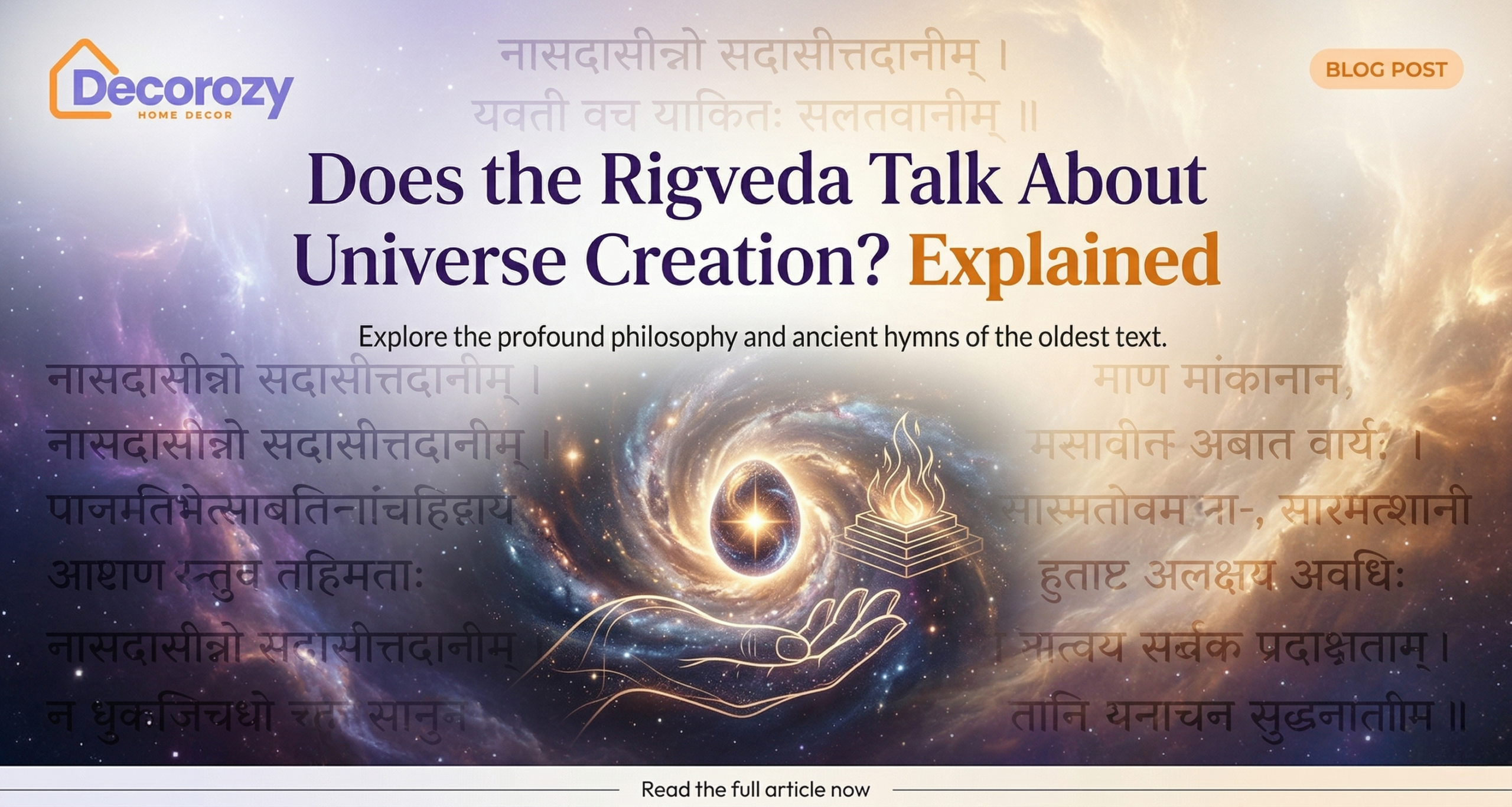
The most famous hymn regarding this topic is the Nasadiya Sukta (Rigveda 10.129). It famously begins by stating that before creation, there was neither existence (Sat) nor non-existence (Asat), establishing a concept of a primal void.
This hymn suggests a primordial state of undifferentiated darkness and deep, boundless cosmic waters. From this profound emptiness, the universe allegedly arose through the power of primal heat or cosmic energy, known as ‘Tapas’.
Another crucial text is the Hiranyagarbha Sukta (Rigveda 10.121). It introduces the concept of the “Golden Embryo” or “Golden Womb,” serving as the singular source from which the universe, stars, and all life were born.
The Philosophical Importance of Rigveda Universe Creation Stories
Understanding the Rigveda universe creation narratives is vital for grasping the rapid evolution of ancient human thought. These hymns represent a massive leap from simple mythological storytelling to complex metaphysical philosophy.
What makes these ancient texts globally significant is their remarkable intellectual humility. Rather than offering rigid, unyielding dogmas, the hymns often end with profound, open-ended questions about the true nature of reality.
For instance, the Nasadiya Sukta famously questions whether even the highest divine overseer in heaven truly knows how the universe was formed. This reflects an incredibly advanced, early form of philosophical skepticism and scientific inquiry.
These verses demonstrate that ancient Vedic scholars were keen, analytical observers of the natural world. They utilized rich poetic metaphors to describe cosmological events that surprisingly mirror modern theoretical concepts.
Detailed Analysis: How the Rigveda Explains the Cosmos
A detailed textual analysis of the Rigveda reveals a highly structured, multi-layered view of cosmic evolution. Beyond the void, the Purusha Sukta (Rigveda 10.90) offers a more allegorical and interconnected perspective on creation.
This specific hymn describes the universe forming from the cosmic sacrifice of an infinite, primordial being named Purusha. From his cosmic body, the elements of the natural world and the structures of society were systematically formed.
His mind became the moon, his eyes the sun, and his breath the wind, powerfully illustrating the interconnectedness of all life. Furthermore, the Rigveda identifies ‘Kama’ (desire or primal will) as the very first seed of the universal mind.
This profound statement implies that consciousness, intent, or desire preceded physical manifestation in the cosmos. The transition from an absolute, formless void to a beautifully structured universe remains the core backbone of Vedic cosmology.
The cosmological insights found within these ancient hymns are truly staggering in their philosophical depth and vision. Whether viewed through a spiritual, historical, or literary lens, these verses continue to fascinate modern scholars worldwide. For more deep dives into ancient history, cultural insights, and design inspiration drawn from antiquity, keep exploring Decorozy.com.
FAQ Schema
- Question 1: What is the Nasadiya Sukta?
- Answer: The Nasadiya Sukta, also known as the Hymn of Creation, is the 129th hymn of the 10th Mandala of the Rigveda. It is a profound philosophical poem that explores the origins of the universe, questioning how existence emerged from primordial nothingness.
- Question 2: Does the Rigveda mention the Big Bang?
- Answer: While the Rigveda does not use modern scientific terms like the “Big Bang,” its concept of the Hiranyagarbha (the Golden Womb) describes the universe expanding from a singular, glowing, infinitely hot cosmic seed, which closely parallels modern cosmological theories.
- Question 3: Who created the universe according to the Vedas?
- Answer: The Rigveda does not point to a single anthropomorphic creator. Instead, it offers multiple perspectives, including creation from a cosmic being (Purusha), emergence from a Golden Womb (Hiranyagarbha), and evolution from a state of formless energy and desire, often questioning if the true origin is knowable at all.