India is a land of profound spiritual significance, home to numerous sacred shrines. Among the most revered are the twelve Jyotirlingas, representing the infinite light of Lord Shiva.
Understanding the Omkareshwar jyotirlinga history and mythology offers a fascinating glimpse into ancient Hindu traditions. This sacred site blends breathtaking geography with deep-rooted spiritual lore.
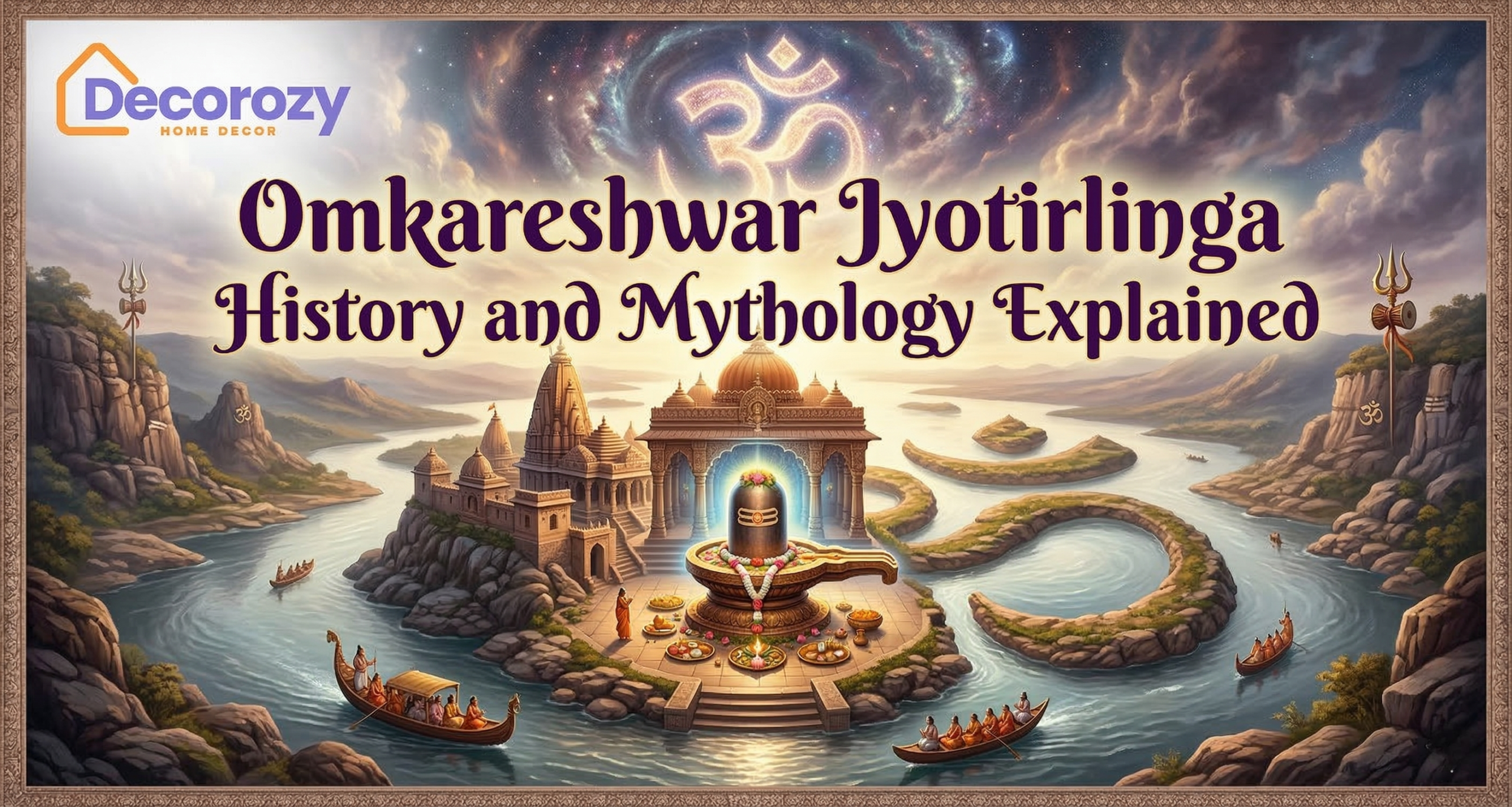
Located in Madhya Pradesh, the temple sits gracefully on the Mandhata island within the Narmada River. The island itself naturally forms the shape of the sacred Hindu symbol “Om,” drawing millions of devotees annually.
Quick Answer: Omkareshwar is a sacred Hindu temple on Mandhata island, representing one of the 12 Jyotirlingas. Its mythology centers on Mount Vindhya’s intense penance to Lord Shiva. Historically, the site was nurtured by the Paramara dynasty and beautifully restored by Maratha Queen Ahilyabai Holkar in the 18th century.
The Core of Omkareshwar Jyotirlinga History and Mythology
To truly grasp the Omkareshwar jyotirlinga history and mythology, we must dive into ancient Puranic texts. These texts describe the origins of this powerful spiritual epicenter.
The most prominent legend involves Mount Vindhya, the deity of the Vindhya mountain range. According to the Shiva Purana, sage Narada once visited Mount Vindhya and subtly mocked its lack of height compared to Mount Meru.
Driven by a desire to become the greatest mountain, Vindhya undertook rigorous penance. He created a sacred geometric diagram and worshipped Lord Shiva with unwavering devotion for months.
Pleased by this intense dedication, Lord Shiva appeared and granted Vindhya his desired boon of continuous growth. At the request of the gods and sages present, Shiva split the lingam into two parts.
One half became Omkareshwar, meaning “Lord of Omkara,” and the other became Amareshwar, or “Lord of the Immortals.” This duality is a unique feature of the Omkareshwar shrine.
Benefits of Understanding Omkareshwar Jyotirlinga History and Mythology
Exploring the Omkareshwar jyotirlinga history and mythology enriches your cultural and spiritual knowledge. It provides a deeper context for the rituals and practices still observed today.
For travelers and spiritual seekers, knowing these stories transforms a simple visit into a profound pilgrimage. The stones and rivers cease to be just physical elements and become living testaments to faith.
Furthermore, analyzing this history helps us appreciate the architectural evolution of India. The temple’s structure reflects the artistic styles of various ruling dynasties over the centuries.
Historians and architects study these structures to understand medieval Indian engineering. The blend of Nagara style architecture with later Maratha additions is a visual timeline of the region’s past.
Detailed Analysis: Historical Timeline and Rulers
The historical record of Omkareshwar is just as captivating as its mythological roots. The island was historically known as Mandhata, named after a famous ancient king.
King Mandhata, an ancestor of Lord Rama, is believed to have ruled this region and worshipped Shiva here. This connection firmly roots the island in the grand epics of Indian literature.
Moving into recorded history, the region saw the rise and fall of several powerful dynasties. The Paramara rulers of Malwa held control during the 11th and 12th centuries, contributing significantly to the temple’s early structures.
Later, the Chauhan Rajputs and the Marathas played crucial roles in the temple’s preservation. During the Islamic invasions, many temples faced destruction, but the dense forests of the Narmada valley offered some protection.
The golden era of restoration came under the visionary leadership of Maharani Ahilyabai Holkar of Indore in the 18th century. She poured immense resources into rebuilding the temple complexes and bathing ghats.
Detailed Analysis: The War of Devas and Danavas
Another fascinating layer of the temple’s lore involves a cosmic battle. Ancient texts narrate a massive war between the Devas (gods) and the Danavas (demons).
The Devas, facing imminent defeat at the hands of the powerful demons, turned to Lord Shiva for salvation. They prayed fervently, asking for his divine intervention to restore cosmic balance.
Answering their prayers, Lord Shiva emerged in the form of the Omkareshwar Jyotirlinga. His radiating divine light vanquished the demons and secured victory for the righteous Devas.
This story highlights Shiva’s role as the ultimate protector in Hindu mythology. It reinforces the belief that the Jyotirlinga is a physical manifestation of divine salvation and power.
Architectural Marvels of the Mandhata Island
The main Omkareshwar temple is a stunning example of complex Indian architecture. Built primarily of locally sourced stone, it features intricate carvings that have withstood the test of time.
The temple stands on a multi-tiered foundation, with a grand assembly hall (Mandapa) supported by heavily carved pillars. These pillars feature detailed motifs of deities, nature, and geometric patterns.
Interestingly, the sanctum sanctorum (Garbhagriha) is not perfectly aligned with the main entrance. This slight asymmetry is a unique architectural quirk that puzzles historians to this day.
Above the main shrine, there are subsequent floors housing other deities, including the Mahakaleshwar lingam. This multi-story structure allows devotees to experience different aspects of the divine within one complex.
The Significance of the Narmada River
No discussion of this sacred site is complete without mentioning the Narmada River. In Hindu tradition, the Narmada is considered one of the seven holiest rivers in India.
The river bifurcates to form the Mandhata island, physically shaping the “Om” symbol. Taking a holy dip in the Narmada before visiting the shrine is a mandatory ritual for pilgrims.
It is believed that the Narmada River originated from the sweat of Lord Shiva during a cosmic dance. Therefore, the waters are thought to possess immense purifying properties.
The Parikrama, or circumambulation of the Narmada River, is a grueling but highly rewarding spiritual journey. Omkareshwar serves as a vital stopping point and milestone for these dedicated pilgrims.
Planning Your Visit and Spiritual Journey
Today, Omkareshwar is easily accessible by road from major cities like Indore. The modern infrastructure, combined with the ancient spiritual aura, offers a seamless travel experience.
Visitors can walk across the river via a beautiful suspension bridge or take a short boat ride to the island. Both options offer stunning views of the temple and the surrounding natural landscape.
The best time to visit is during the festive seasons of Mahashivratri or Kartik Purnima. During these times, the entire island comes alive with vibrant processions, chants, and hundreds of illuminating lamps.
Understanding the deep roots of this sacred site enhances every step of your journey. It transforms an ordinary trip into an unforgettable exploration of India’s spiritual heart.
In conclusion, the rich tapestry of legends and factual history makes this destination truly unique. We hope this guide helps you appreciate the divine legacy of Lord Shiva’s holy island.
Are you ready to explore more sacred destinations and elevate your travel experiences? Browse Decorozy.com for more expertly crafted travel guides and historical deep dives!
FAQ Schema
- Question 1: Why is Omkareshwar called a Jyotirlinga?
- Answer: Omkareshwar is a Jyotirlinga because it is believed to be a self-manifested (Swayambhu) column of divine light representing Lord Shiva. It is one of only twelve such supremely sacred Shiva shrines across India, offering spiritual liberation to devotees.
- Question 2: Who built the Omkareshwar temple?
- Answer: The original builders are lost to antiquity, but the temple saw major contributions from the Paramara dynasty in the 11th century. The current expansive structure and surrounding ghats were heavily restored and rebuilt by Maratha Queen Ahilyabai Holkar in the 18th century.
- Question 3: What is the shape of the Omkareshwar island?
- Answer: The island of Mandhata, where the Omkareshwar temple is located, naturally forms the shape of the sacred Hindu symbol “Om.” This unique geographical formation is created by the bifurcation of the holy Narmada River.