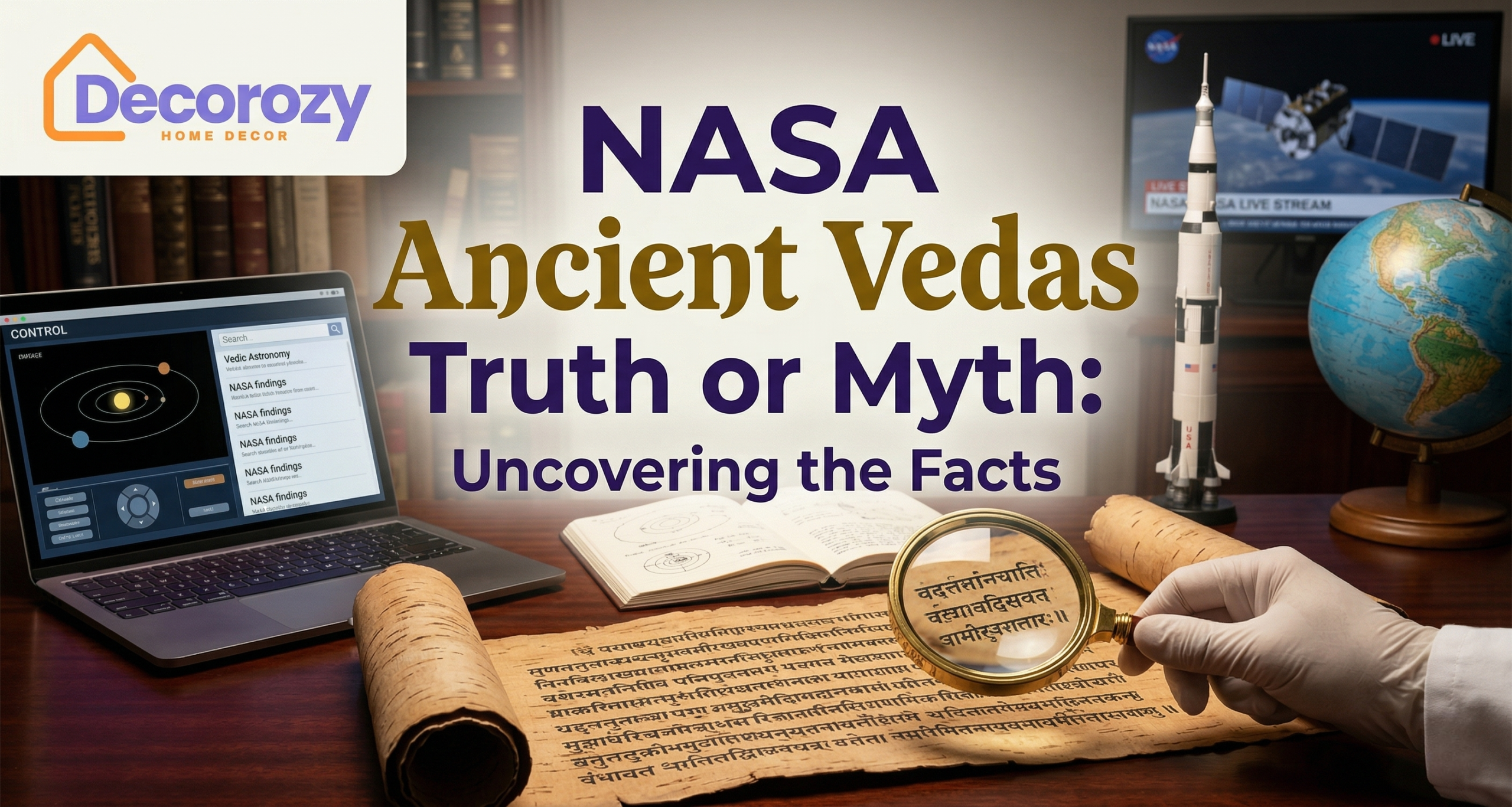
The internet is filled with sensational stories linking modern space agencies to ancient Indian texts. If you are wondering about the NASA ancient Vedas truth or myth, you are not alone in your curiosity.
Many viral posts claim that modern scientists secretly rely on ancient wisdom for technological breakthroughs. We need to look at the historical data, scientific papers, and actual agency statements to separate reality from digital fiction.
Quick Answer: The claim that NASA officially uses ancient Vedas for modern space technology is a myth. However, a 1985 paper by a researcher associated with NASA did highlight Sanskrit’s strict grammatical rules as highly suitable for artificial intelligence and natural language processing.
Unpacking the Origin: NASA Ancient Vedas Truth or Myth
To understand the NASA ancient Vedas truth or myth, we must look back to 1985. A researcher named Rick Briggs published a paper in the AI Magazine regarding natural language processing.
Briggs noted that the ancient language of Sanskrit, used in the Vedas, has a highly rigid and unambiguous mathematical structure. He suggested this precise grammar made it an excellent model for artificial intelligence syntax.
This single research paper sparked decades of exaggerated internet rumors. People falsely stretched this linguistic observation into claims that NASA actively uses Sanskrit to write software or build spacecraft.
The truth is much simpler: linguists appreciate the brilliance of ancient Sanskrit grammar. However, NASA relies on modern programming languages like C++, Python, and Java for its actual aerospace engineering.
The Importance of Clarifying the NASA Ancient Vedas Truth or Myth
Understanding the NASA ancient Vedas truth or myth is crucial for promoting genuine scientific literacy. When we blindly accept internet hoaxes, we undermine the rigorous scientific method.
Ancient Indian texts offer profound philosophical, mathematical, and astronomical insights that deserve immense historical respect. We do not need to invent fake endorsements from modern space agencies to validate their cultural importance.
By debunking these viral myths, we protect the true legacy of ancient scholars. We can appreciate early Vedic contributions to geometry and astronomy without pretending they contained blueprints for modern rockets.
Furthermore, clear fact-checking prevents the spread of misinformation in the digital age. It teaches readers to demand primary sources and think critically about sensational headlines shared on social media.
Detailed Analysis: Separating Vedic Science from Internet Rumors
When analyzing the claims surrounding Vedic science, it is vital to differentiate between philosophical concepts and applied engineering. Many ancient texts describe cosmic events in beautifully metaphorical and poetic language.
Some internet theorists mistake these poetic descriptions of flying chariots, or Vimanas, for literal mechanical blueprints. Modern aeronautics requires precise physics, metallurgy, and aerodynamics, which are not detailed in these ancient scriptures.
NASA’s missions are built upon centuries of documented, observable, and peer-reviewed global scientific progress. While early Indian mathematicians made undeniable contributions to global knowledge, space exploration relies on modern physics.
Ultimately, bridging the gap between ancient wisdom and modern science requires an objective lens. We must celebrate historical achievements accurately while acknowledging that the viral claims of NASA using Vedic technology are entirely a myth.
Thank you for exploring this fascinating topic with us. For more deep dives into the intersection of history, science, and modern trends, keep reading the authoritative guides here on Decorozy.com!
FAQ Schema
- Question 1: Did NASA state that Sanskrit is the best language for artificial intelligence?
- Answer: A 1985 paper by researcher Rick Briggs noted that Sanskrit’s strict, unambiguous syntax could be highly useful for natural language processing in AI. However, NASA does not officially use Sanskrit for its software or space operations.
- Question 2: Has NASA found evidence of ancient Vedic spacecraft or Vimanas?
- Answer: No. Claims that NASA has discovered physical evidence or blueprints of ancient flying machines (Vimanas) are internet hoaxes. NASA’s work is based on modern aerospace engineering, not ancient texts.
- Question 3: Why are NASA and the ancient Vedas frequently linked on social media?
- Answer: Misinformation often combines highly respected modern institutions like NASA with ancient, revered texts to make sensational claims appear credible. This tactic is commonly used to generate viral engagement and clickbait online.