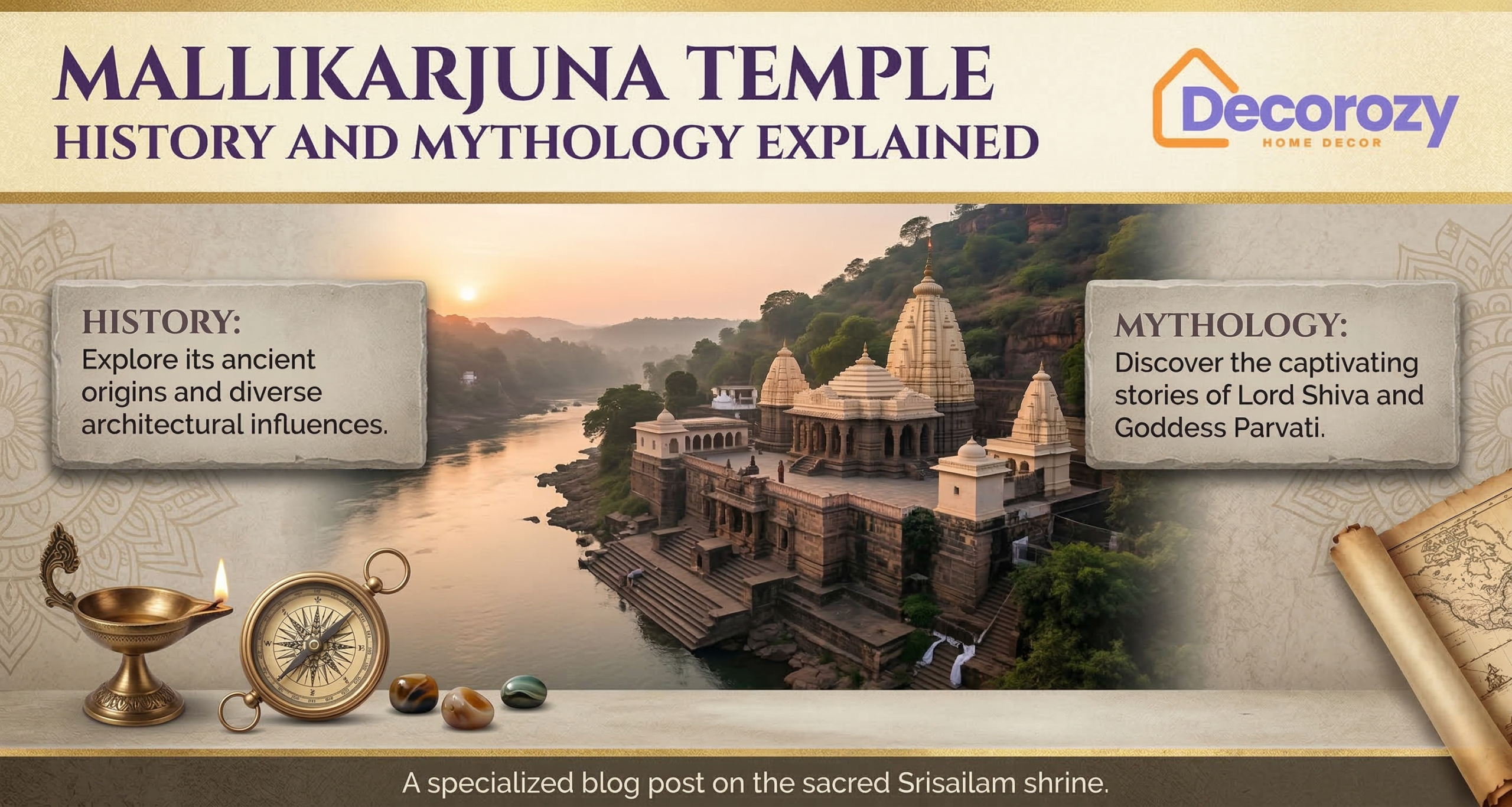
Exploring ancient Indian architecture requires a deep dive into sacred sites that shaped cultural heritage. Understanding the mallikarjuna temple history and mythology provides profound insights into both spiritual traditions and classical design.
This sacred shrine, nestled in the Nallamala Hills of Andhra Pradesh, stands as a testament to centuries of devotion. Let us explore the rich tapestry of stories and historical milestones that define this monumental structure.
Quick Answer: The Mallikarjuna Temple in Srisailam is uniquely revered as both a sacred Jyotirlinga and a Maha Shakti Peetha. Its mythology centers on Lord Shiva and Parvati appeasing their son Kartikeya, while its history spans ancient dynasties like the Chalukyas and Vijayanagara Empire, reflecting centuries of architectural evolution.
Tracing Mallikarjuna Temple History and Mythology
The origins of the Srisailam sanctuary are deeply rooted in the ancient Puranic texts of India. Scholars believe the shrine has existed since the dawn of documented Hindu spiritual history.
Historical records trace early structural developments back to the Satavahana dynasty in the 2nd century AD. These early builders recognized the geographic and spiritual importance of the Krishna River basin.
Subsequent empires recognized the site’s power and continually added to its grandeur. The complex you see today is a composite of centuries of architectural dedication.
Divine Origins in Mallikarjuna Temple History and Mythology
According to the Shiva Purana, the core legend revolves around Lord Shiva, Goddess Parvati, and their two sons. Ganesha and Kartikeya (Kumara) were challenged to circumnavigate the globe to determine who would marry first.
Ganesha won the contest by walking around his parents, claiming they were his entire universe. Kartikeya, who actually traveled the physical world, returned to find his brother already married.
Furious and feeling slighted, Kartikeya retreated to the Krauncha Mountain. To pacify their son, Shiva and Parvati followed him and manifested on the Srisailam hills as Mallikarjuna and Bhramaramba.
The Unique Dual Significance of Srisailam
One of the most remarkable aspects of this site is its dual spiritual classification. It is incredibly rare for a single temple complex to hold two major religious titles simultaneously.
Firstly, it is one of the twelve Jyotirlingas, representing the infinite, fiery column of light of Lord Shiva. This makes it a primary pilgrimage destination for Shaivites across the globe.
Secondly, it is one of the eighteen Maha Shakti Peethas, dedicated to Goddess Parvati. Devotees believe the neck of the goddess Sati fell here, manifesting as Bhramaramba.
Dynasty Contributions and Architectural Evolution
The true physical history of the temple reflects the shifting powers of Southern India. The Ikshvakus, Pallavas, and Chalukyas all made significant architectural contributions during their respective reigns.
However, the golden era of construction occurred during the Vijayanagara Empire. King Harihara I is credited with building the magnificent stepped structures and main mandapams in the 14th century.
The Reddi Kings also left their mark by constructing the stepped path leading down to the Patalganga. This path remains a vital route for modern pilgrims seeking ritual baths.
The Legend of Princess Chandravathi
Another fascinating layer of local lore involves a princess named Chandravathi. Legend states she abandoned her royal life to live a simple, ascetic existence in the Srisailam forests.
Every day, she noticed one of her cows standing over a natural rock formation, releasing its milk. Upon digging at the site, she discovered a Swayambhu (self-manifested) Linga.
She began worshipping the Linga with jasmine flowers, known locally as “Mallika.” This devotion is said to have given the deity the name Mallikarjuna, meaning the lord adorned with jasmine.
Dravidian Masterpieces and Structural Layout
For enthusiasts of historical architecture, the temple is a prime example of the Dravidian style. The layout is enclosed by massive, intricately carved walls that stretch for miles.
The main entrances are marked by towering Gopurams (gateways) adorned with detailed stucco figures. These figures depict various deities, mythological scenes, and ancient lifestyle motifs.
The Mukha Mandapa, a pillared hall leading to the inner sanctum, showcases the exceptional stone-carving skills of Vijayanagara artisans. Every pillar tells a story from Hindu epics.
Spiritual Impact on Modern Devotees
Today, the Srisailam shrine remains a bustling center of active worship and cultural preservation. Millions of devotees visit annually, especially during the auspicious festival of Maha Shivaratri.
The ongoing rituals provide a living link to the ancient past, keeping the mythology vibrant. The temple authorities maintain these traditions while managing modern crowd control.
Understanding this site is crucial for anyone studying the intersection of faith and structural design.
Are you fascinated by the blend of ancient architecture and divine lore? Explore more insights into historical design, sacred geometry, and cultural heritage right here on Decorozy.com!
FAQ Schema
- Question 1: Why is the Mallikarjuna Temple in Srisailam so famous?
- Answer: The Mallikarjuna Temple is exceptionally famous because it is one of the rare spiritual sites in India that serves as both a Jyotirlinga for Lord Shiva and a Maha Shakti Peetha for Goddess Parvati, drawing millions of pilgrims annually.
- Question 2: Who built the Srisailam Mallikarjuna Temple?
- Answer: The temple’s construction spans multiple centuries and dynasties. While early structures date back to the Satavahanas (2nd century AD), major architectural expansions were completed by the Chalukyas, Reddi Kings, and the Vijayanagara Empire in the 14th century.
- Question 3: What is the main story behind the Srisailam temple?
- Answer: The primary mythological story states that Lord Shiva and Goddess Parvati manifested at Srisailam to pacify their son, Kartikeya. He had retreated to the nearby mountains in anger after his brother Ganesha won a contest to marry first.