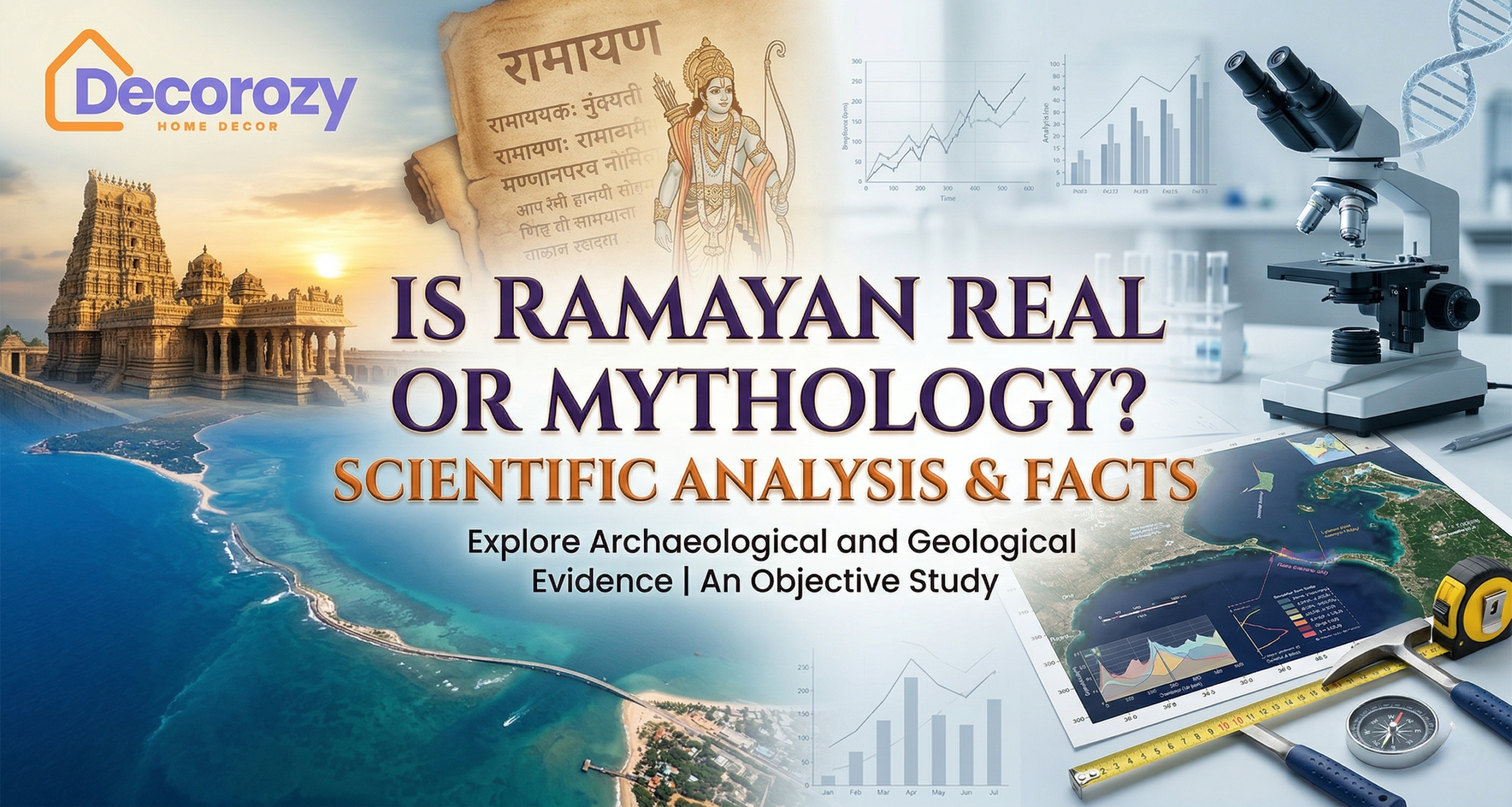
For centuries, scholars and historians have heavily debated the true origins of ancient India’s greatest epic. Many wonder: is ramayan real or mythology ? scientific analysis is now providing fascinating new answers.
By combining modern technology with ancient texts, researchers are uncovering data that challenges long-held historical timelines. We are no longer relying solely on faith; we are looking at hard, empirical data.
Quick Answer: Modern scientific analysis suggests the Ramayana is based on true historical events, not just mythology. Evidence from astronomical dating software, geological surveys of Ram Setu, and archaeological excavations in Ayodhya and Sri Lanka strongly align with the locations and timelines described by Sage Valmiki.
The Core Debate: Is Ramayan Real or Mythology ? Scientific Analysis Explains
To understand the historicity of this ancient text, we must first separate poetic exaggeration from geographical reality. Sage Valmiki, the original author of the Ramayana, described himself as a contemporary of Lord Rama.
Valmiki did not classify his work as a myth, but rather as “Itihasa,” a Sanskrit term that translates directly to “thus it happened.” This classification is crucial for modern historians attempting to verify the events.
When examining whether is ramayan real or mythology ? scientific analysis requires an interdisciplinary approach. Experts now use astronomy, geology, and genetics to verify the claims made in the ancient verses.
The Importance of Astronomical and Geographical Dating
One of the most compelling pieces of evidence comes from the highly specific astronomical observations recorded in the Valmiki Ramayana. The text mentions exact planetary positions for major events, such as Lord Rama’s birth.
Using modern planetarium software, archaeo-astronomers have mapped these precise planetary alignments. The software reveals that these unique celestial configurations actually occurred in the sky around 5114 BCE.
Furthermore, the geographical descriptions in the epic are stunningly accurate. The route taken by Rama from Ayodhya to Sri Lanka maps perfectly onto the modern geography of the Indian subcontinent.
Detailed Evidence: Is Ramayan Real or Mythology ? Scientific Analysis
Archaeological excavations led by the Archaeological Survey of India (ASI), particularly those by B.B. Lal, have uncovered pillar bases and artifacts in Ayodhya. These findings confirm the existence of an ancient, monumental structure at the disputed site.
Another massive piece of evidence is the Ram Setu, or Adam’s Bridge, a chain of limestone shoals between India and Sri Lanka. Geological studies and satellite imagery suggest that the bridge possesses artificial characteristics atop natural shoals, aligning with the epic’s narrative.
Botanical evidence also plays a role in this investigation. Researchers in Sri Lanka have identified specific Himalayan medicinal herbs growing exclusively around the areas where Hanuman is said to have dropped the Sanjeevani mountain.
Ultimately, while the epic contains poetic embellishments, the foundational events are deeply rooted in reality. The convergence of multiple scientific disciplines provides a compelling case for the Ramayana’s historicity.
Are you ready to explore more deep dives into ancient history and modern design? Keep reading Decorozy.com for more authoritative content that bridges the gap between the past and the present.
FAQ Schema
- Question 1: Is Ram Setu a natural formation or man-made?
- Answer: Scientific analysis indicates that while the base of Ram Setu is a natural limestone shoal, the top layer of boulders appears to have been placed there artificially thousands of years ago, supporting the Ramayana’s narrative.
- Question 2: What is the exact historical date of the Ramayana?
- Answer: By using modern planetarium software to map the exact planetary alignments mentioned by Sage Valmiki, researchers estimate that the events of the Ramayana occurred around 5114 BCE.
- Question 3: Is there any archaeological proof of the Ramayana in Sri Lanka?
- Answer: Yes, researchers in Sri Lanka have identified several sites matching Valmiki’s descriptions, including the Ashok Vatika and specific areas containing non-native Himalayan plants believed to be brought during the war.