



Blog

Importance of Kashi Vishwanath Temple in Varanasi Explained
Varanasi, often referred to as the spiritual capital of India, pulses with ancient traditions and divine energy. At the very center of this sacred geography lies a monument of unparalleled reverence. Grasping the true importance of Kashi Vishwanath temple in Varanasi is essential for anyone seeking to understand Hindu philosophy.
Quick Answer: The importance of Kashi Vishwanath Temple in Varanasi lies in its status as one of the twelve Jyotirlingas, representing Lord Shiva’s infinite light. Millions of Hindus believe that visiting this sacred shrine and bathing in the Ganges river grants Moksha, the ultimate spiritual liberation.
Historical Importance of Kashi Vishwanath Temple in Varanasi
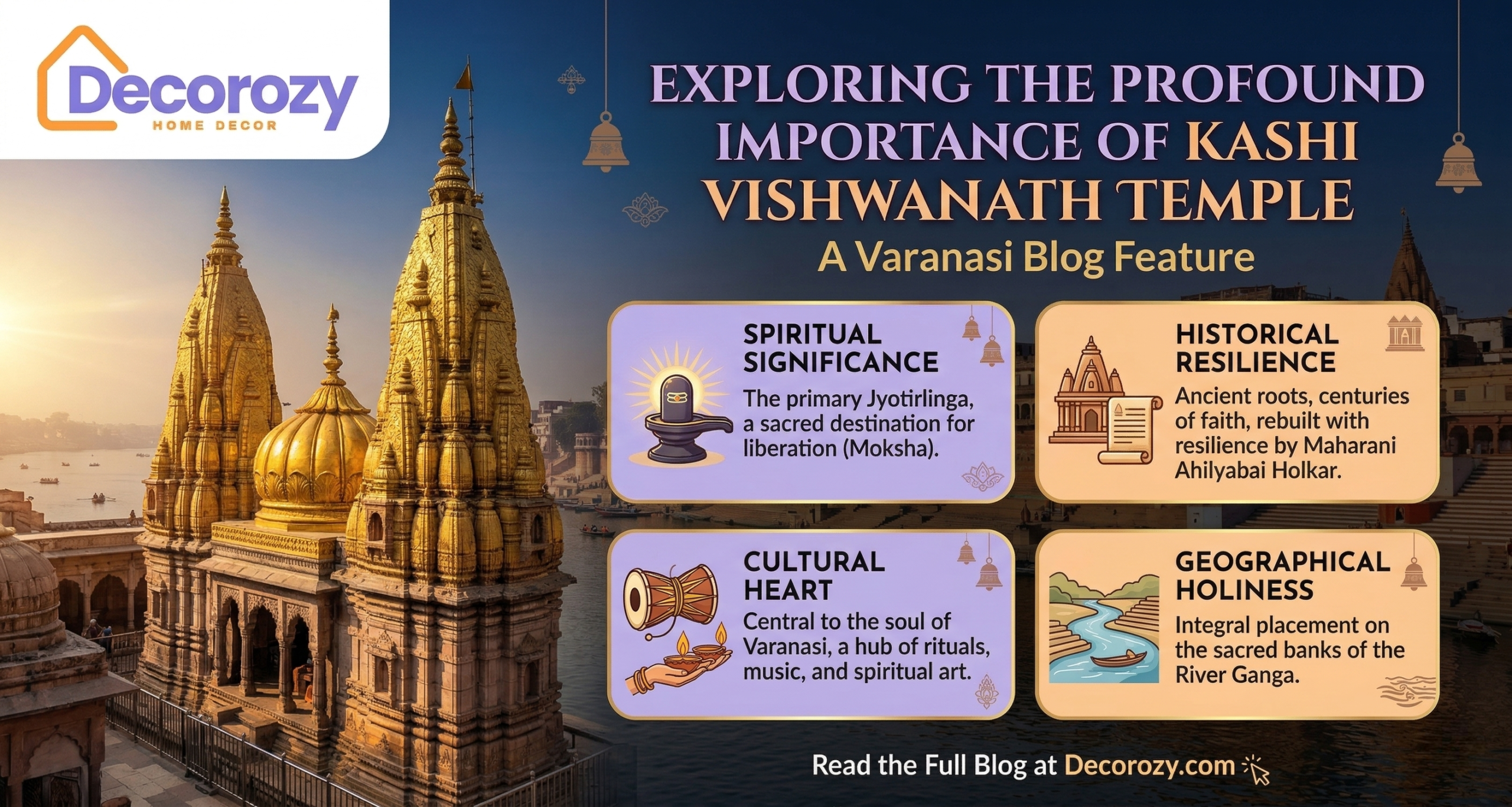
The historical timeline of this magnificent structure is a testament to the resilience of faith. Throughout centuries, the site has witnessed both devastating destruction and glorious reconstruction.
The current, breathtaking structure was championed by the Maratha monarch, Rani Ahilyabai Holkar, in 1780. Her unwavering devotion restored the sacred site to its former glory, preserving its legacy for future generations.
Later, in 1835, Maharaja Ranjit Singh donated a massive quantity of gold to plate the temple’s iconic dome. This generous act earned it the famous and enduring moniker, “The Golden Temple of Varanasi.”
Spiritual Importance of Kashi Vishwanath Temple in Varanasi
For millions of devoted seekers, this shrine is the ultimate destination for religious pilgrimage. It houses the supreme Jyotirlinga, a powerful and infinite manifestation of Lord Shiva’s cosmic light.
The primary spiritual draw of this location is the profound promise of Moksha, which signifies breaking the endless cycle of rebirth. Pilgrims firmly believe that Shiva himself guides departing souls in this holy city.
A visit to the shrine remains spiritually incomplete without a purifying dip in the adjacent holy river Ganges. The synergistic, purifying energy shared between the sacred river and the temple is the cornerstone of the pilgrim experience.
Architectural Evolution and Cultural Impact
Beyond its immense religious weight, the temple complex stands as a brilliant architectural marvel. It features deeply intricate stone carvings and a traditional North Indian, intricate spatial layout.
Recently, the monumental Kashi Vishwanath Corridor project completely transformed the surrounding urban landscape. This modern development successfully connected the main temple directly to the historic ghats of the Ganges.
This revitalization not only improved the daily pilgrim experience but also stimulated the local economy. It continues to unite diverse sects of Hinduism, standing as a proud pillar of India’s enduring cultural heritage.
Are you looking to design a space that reflects tranquility and spiritual balance? Explore more cultural deep-dives, architectural inspiration, and mindful living tips at Decorozy.com!
FAQ Schema
- Question 1: Why is Kashi Vishwanath temple so famous?
- Answer: It is famous for housing one of the twelve sacred Jyotirlingas of Lord Shiva. Furthermore, it is universally revered as the ultimate destination for Hindus seeking Moksha, or spiritual liberation from the cycle of rebirth.
- Question 2: Who built the present Kashi Vishwanath temple?
- Answer: The current architectural structure of the temple was built in 1780 by the devoted Maratha queen, Ahilyabai Holkar of Indore. The iconic golden spire was later donated by Maharaja Ranjit Singh.
- Question 3: Is it necessary to bathe in the Ganges before visiting the temple?
- Answer: While it is not strictly mandatory by rule, it is a deeply held and widely practiced tradition. Pilgrims take a holy dip in the Ganges river to spiritually and physically purify themselves before entering the sanctum.
Categories
- Astrology & Spirituality
- Budget Home Decor
- Divine Mysteries
- Divine Symbols Meaning
- DIY Home Decor
- Fact
- Festival
- Festival Celebrations
- Festival Decoration Ideas
- Ganesha Idols
- Gifting Ideas
- Handicrafts of India
- Hidden Truths & Mysteries
- Hinduism Guide
- Home Decor Ideas
- Home Vastu
- Important personality
- Indian Culture & Traditions
- Interior Design
- Mantras
- Meditation
- Mythological Tales
- Religious Practices
- Spiritual Books
- Spiritual Home Decor
- Spiritual Journey
- Spiritual Life Lessons
- Uncategorized