Ancient Indian literature offers a rich tapestry of spiritual and historical insights. For many scholars and spiritual seekers, navigating these ancient texts can feel overwhelming.
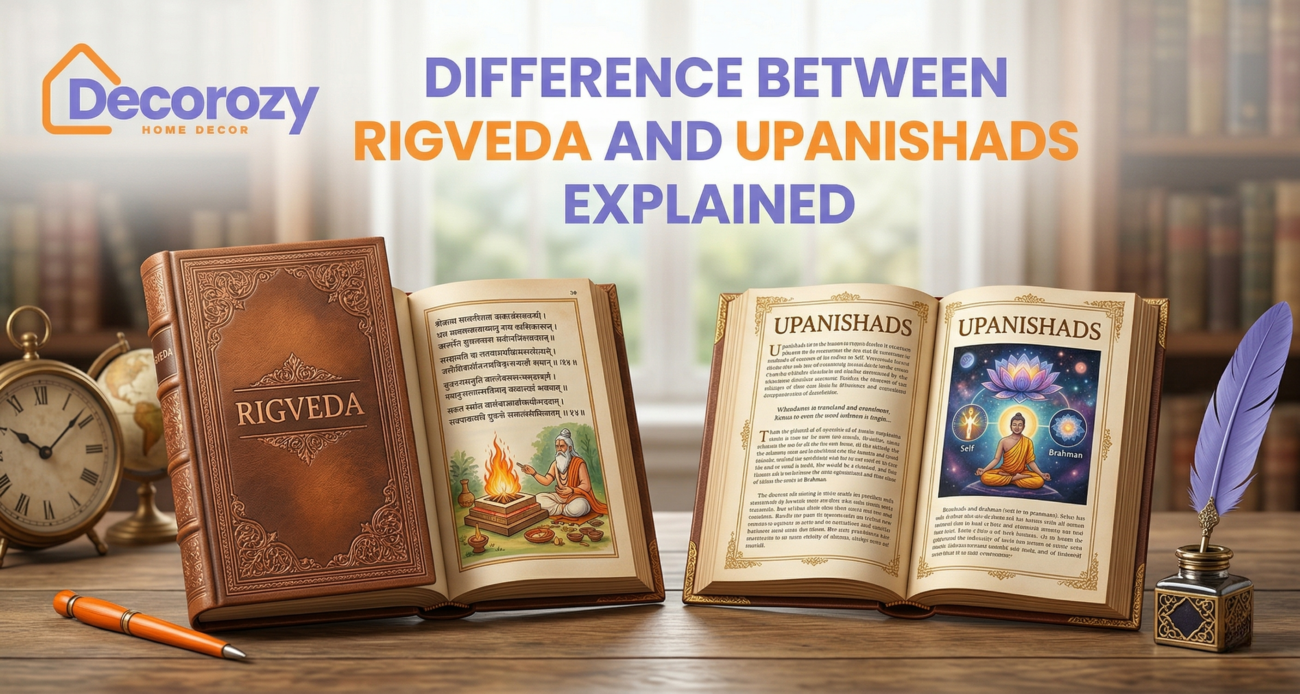
If you want to grasp the roots of Vedic philosophy, you must understand the exact difference between rigveda and upanishads. These two texts represent distinct eras and approaches to spirituality.
At Decorozy.com, we believe that understanding these historical shifts provides incredible value for your personal knowledge base. Let us break down how ancient rituals transformed into deep philosophical inquiries.
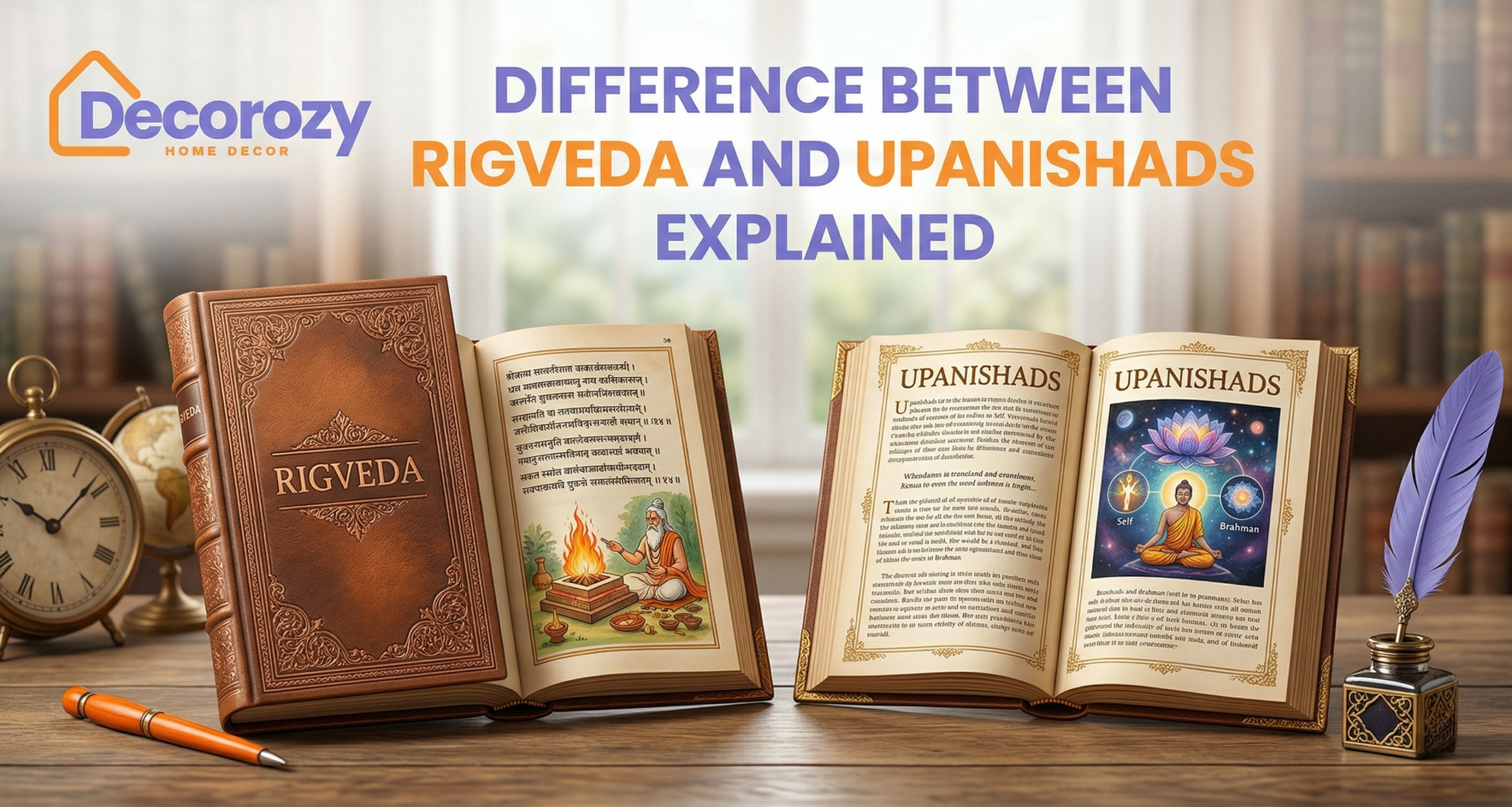
Quick Answer: The primary difference between Rigveda and Upanishads lies in their core focus. The Rigveda is an ancient collection of hymns praising deities and outlining external rituals. In contrast, the Upanishads contain profound philosophical teachings, shifting the focus inward to self-realization and the nature of ultimate reality.
Exploring the Core Concept: What is the Difference Between Rigveda and Upanishads?
To truly grasp the difference between rigveda and upanishads, we must look at their foundational purposes. The Rigveda is the oldest known Vedic Sanskrit text.
It functions primarily as a liturgical collection. The text is filled with mantras and hymns directed at nature deities like Agni, Indra, and Surya.
The Upanishads, however, emerged much later as the concluding part of the Vedas. This section is often referred to as Vedanta, meaning the end of the Vedas.
Instead of focusing on external sacrifices, the Upanishads explore internal wisdom. They question the very nature of existence, introducing concepts like Brahman (the universal soul) and Atman (the individual soul).
Why Knowing the Difference Between Rigveda and Upanishads Matters
Understanding the difference between rigveda and upanishads is crucial for mapping the evolution of human thought. It highlights a massive shift in ancient Indian society.
Early civilization relied heavily on pleasing the gods for physical prosperity. The Rigveda perfectly encapsulates this transactional approach to spirituality and nature.
Over centuries, human consciousness expanded. Thinkers began to realize that rituals alone could not answer the deeper questions of life and death.
This realization birthed the Upanishads. By studying this transition, we gain valuable insights into how philosophical reasoning replaced blind ritualism.
Detailed Analysis: Moving from Action to Knowledge
Scholars often categorize the Vedas into two distinct sections: the Karma Kanda and the Jnana Kanda. The Rigveda falls strictly into the Karma Kanda.
Karma Kanda translates to the “section of action.” It dictates the precise physical actions and sacrifices required for religious ceremonies.
Conversely, the Upanishads constitute the Jnana Kanda, or the “section of knowledge.” They assert that true liberation (Moksha) comes from knowledge, not physical actions.
This dramatic shift from outer action to inner reflection remains one of the most important developments in religious history. It paved the way for modern philosophical thought in the East.
Thank you for exploring this deep historical analysis with Decorozy.com. Be sure to bookmark our site for more expert breakdowns of complex historical and philosophical topics!
FAQ Schema
- Question 1: Which is older, the Rigveda or the Upanishads?
- Answer: The Rigveda is significantly older. It was composed between 1500 and 1000 BCE, while the principal Upanishads were composed much later, primarily between 800 and 300 BCE.
- Question 2: Are the Upanishads part of the Rigveda?
- Answer: Yes, some Upanishads are attached to the Rigveda. Each of the four Vedas (Rigveda, Yajurveda, Samaveda, Atharvaveda) has its own specific Upanishads that serve as its philosophical conclusion.
- Question 3: What is the main message of the Upanishads compared to the Rigveda?
- Answer: The Rigveda focuses on external rituals and praising deities to attain worldly success. The main message of the Upanishads is that the individual soul (Atman) and the universal reality (Brahman) are one, and realizing this brings ultimate liberation.