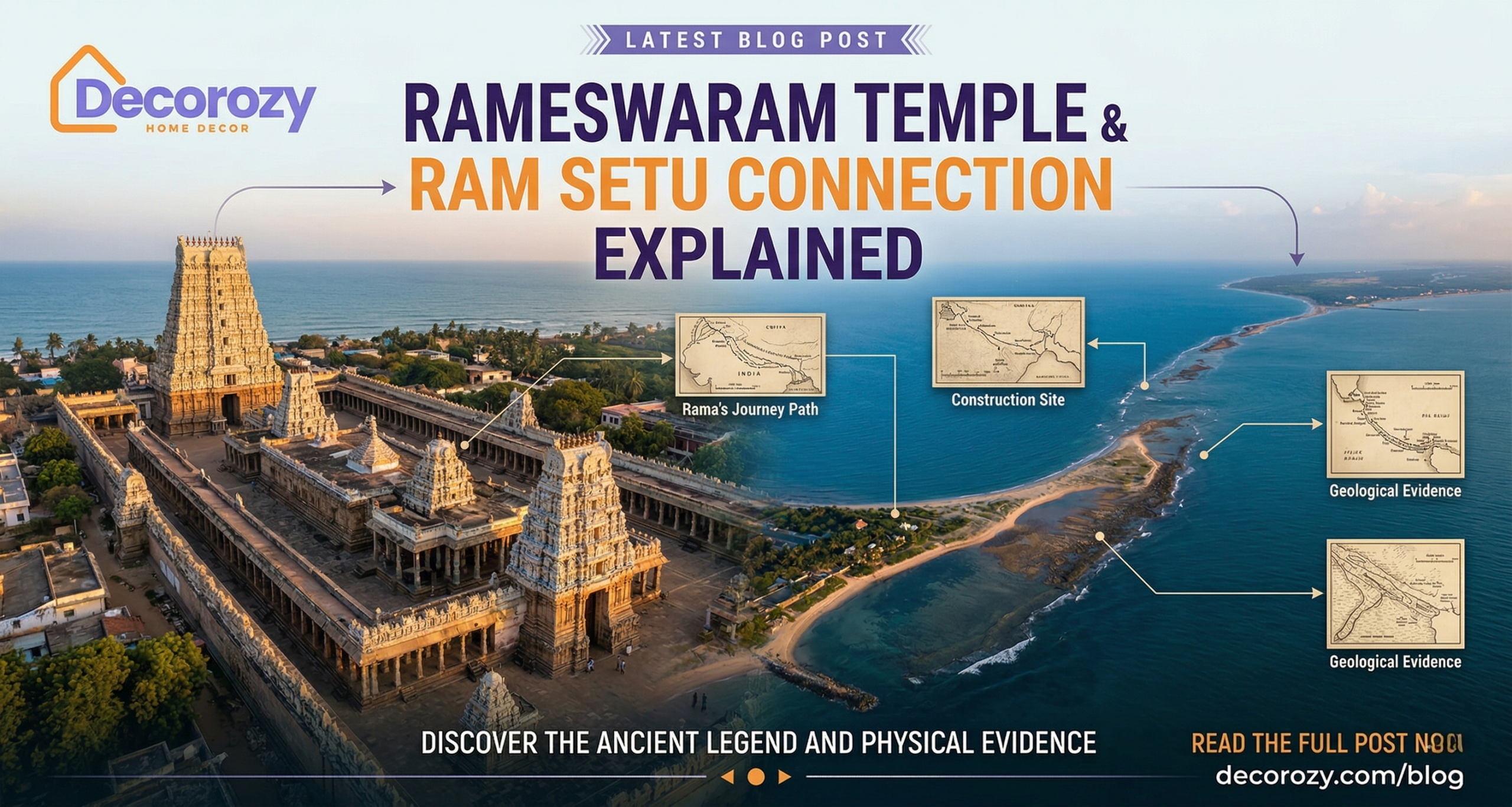
India’s spiritual landscape is defined by ancient tales of devotion, valor, and divine intervention. Millions of pilgrims travel south each year to uncover the sacred connection between Rameswaram Temple and Ram Setu. This journey traces the exact footsteps of Lord Rama during the epic Ramayana.
Quick Answer: The connection between Rameswaram Temple and Ram Setu is rooted in the Ramayana. Lord Rama built Ram Setu to rescue Sita from Lanka. To cleanse the sin of defeating Ravana, Rama subsequently established the Rameswaram Temple to worship Lord Shiva.
The Mythological Connection Between Rameswaram Temple and Ram Setu
To fully understand this sacred link, we must look at the epic verses of the Ramayana.
Lord Rama reached the southern tip of India while searching for his abducted wife, Goddess Sita.
He needed to cross the treacherous ocean to reach the island kingdom of Lanka.
With the help of the Vanara Sena (monkey army), Rama constructed a massive, floating bridge.
This legendary chain of limestone shoals is known globally today as Ram Setu or Adam’s Bridge.
However, defeating the demon king Ravana came with a heavy spiritual cost for Rama.
Because Ravana was a devout Brahmin and a scholar, Rama incurred the sin of Brahmahatya.
To cleanse himself of this profound sin, Lord Rama needed to pray to Lord Shiva.
He established a sacred Shiva Lingam at the very coastal site where his journey began.
This powerful act of devotion gave birth to the magnificent Ramanathaswamy Temple we revere today.
Why the Connection Between Rameswaram Temple and Ram Setu Matters
The deep connection between Rameswaram Temple and Ram Setu creates a powerful pilgrimage circuit.
Rameswaram is universally recognized as one of the holiest Char Dham pilgrimage sites in India.
It uniquely bridges the Vaishnavite and Shaivite traditions of the Hindu faith.
Lord Rama, an avatar of Vishnu, worshipped Lord Shiva here, symbolizing ultimate divine unity.
Pilgrims believe that bathing in the temple’s 22 holy wells (tirthas) purifies the soul entirely.
Visiting the origin point of Ram Setu at Dhanushkodi completes this spiritual purification ritual.
The geological remnants of the bridge serve as tangible proof of our ancient mythologies.
This physical evidence deeply reinforces the enduring faith of millions of global devotees.
Historians and marine geologists continue to study the Palk Strait to understand this ancient marvel.
The spiritual energy here remains unmatched, offering absolute peace and redemption to all visitors.
Exploring the Route: Tracing the Connection Between Rameswaram Temple and Ram Setu
Modern travelers can easily trace the historic connection between Rameswaram Temple and Ram Setu.
The journey typically begins on Pamban Island at the grand Ramanathaswamy Temple.
Here, visitors marvel at the longest temple corridor in the world, renowned for its Dravidian architecture.
After offering prayers, devotees travel towards the abandoned, picturesque coastal town of Dhanushkodi.
Dhanushkodi sits at the southeastern tip of Pamban Island, facing the vast Indian Ocean.
It is from this exact sandy strip that the legendary Ram Setu officially originates.
Standing at the shore, you can view the limestone shoals stretching toward the coast of Sri Lanka.
The stark contrast between the calm Bay of Bengal and the turbulent Indian Ocean is breathtaking.
Local guides frequently share fascinating, age-old tales of the floating stones used by the Vanara army.
Experiencing this sacred geographical route firsthand brings the ancient verses of the Ramayana vividly to life.
Understanding this profound historical link deeply enriches any traveler’s spiritual journey.
It serves as a constant reminder of the beautiful intersection where ancient history meets enduring faith.
Are you ready to explore the divine architecture and spiritual heritage of India’s sacred spaces?
Discover more expert insights on magnificent temple designs and heritage aesthetics at Decorozy.com today!
FAQ Schema
- Question 1: Did Lord Rama build the Rameswaram Temple?
- Answer: Yes, according to Hindu mythology, Lord Rama established the main Shiva Lingam at Rameswaram Temple to worship Lord Shiva and seek divine forgiveness for defeating the Brahmin king Ravana.
- Question 2: Can we physically see Ram Setu from Rameswaram?
- Answer: Yes, you can view the origin point of Ram Setu from Dhanushkodi, which is a short drive from Rameswaram. The ancient chain of limestone shoals is visible just below the ocean’s surface.
- Question 3: Why is the Rameswaram pilgrimage so famous?
- Answer: Rameswaram is famous for the stunning Ramanathaswamy Temple, its esteemed role as a Char Dham pilgrimage site, and its direct mythological connection to Lord Rama and the historic Ram Setu.