The ancient Indian epic, the Mahabharata, is globally renowned for its profound philosophical depth and colossal battlefield narratives.
However, modern historians and science enthusiasts are often astounded by the vivid, technical descriptions of warfare within its ancient verses.
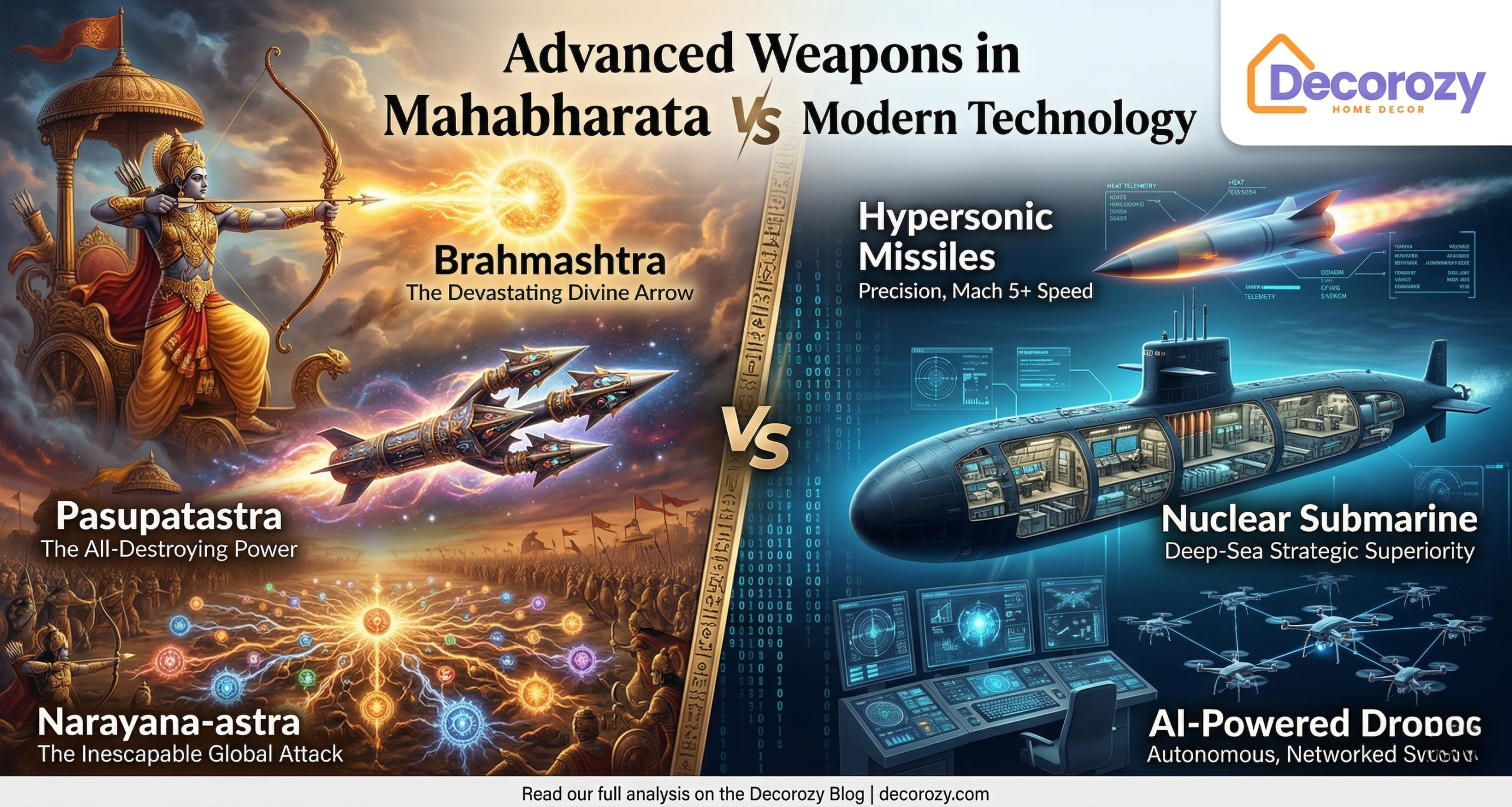
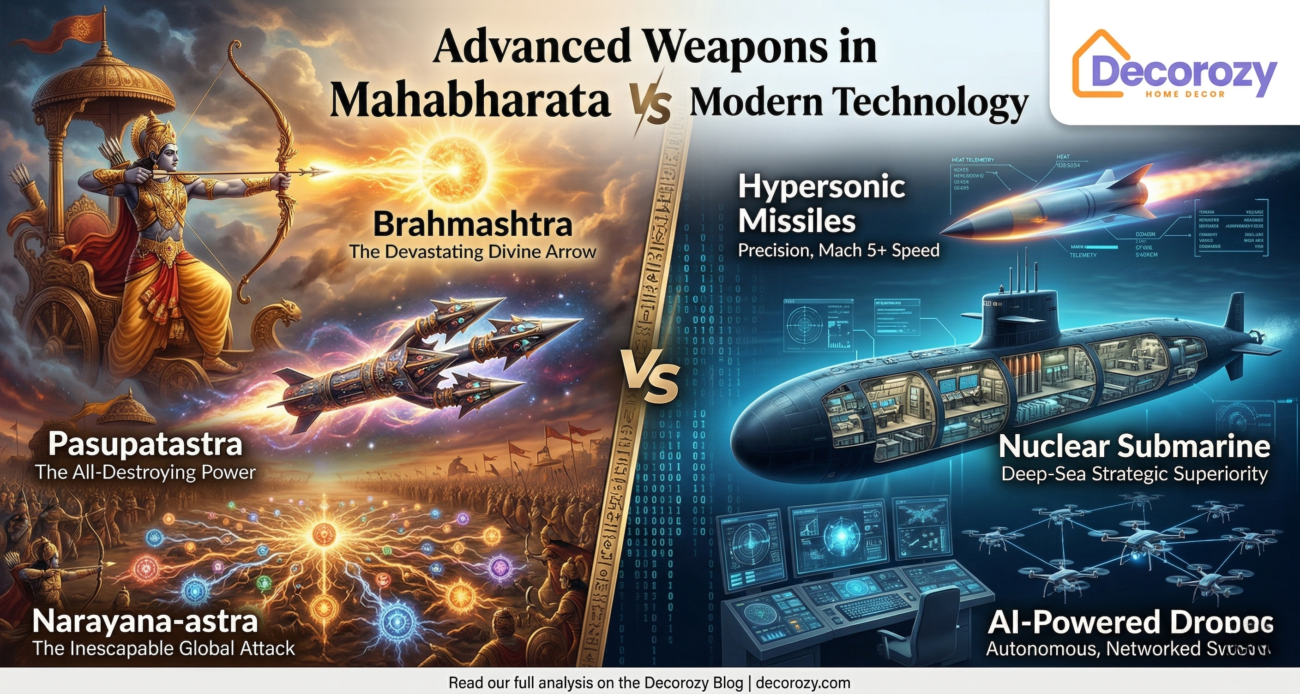
When we analyze the advanced weapons in Mahabharata vs modern technology, fascinating parallels emerge that brilliantly bridge the gap between ancient mythology and modern science.
Quick Answer: The comparison of advanced weapons in Mahabharata vs modern technology reveals striking similarities. Ancient “Astras” like the Brahmastra mirror modern nuclear bombs with their mass destruction and radioactive fallout. Similarly, guided arrows resemble heat-seeking missiles, and Vimanas parallel contemporary aerospace engineering and fighter jets.
The Core Concept of Advanced Weapons in Mahabharata Vs Modern Technology
To truly grasp this topic, we must look at the ancient Sanskrit texts through an analytical, modern lens.
The Mahabharata frequently describes “Astras,” which were highly destructive, celestial weapons invoked by specific mantras.
Unlike physical, hand-to-hand weapons known as Shastras, Astras functioned on esoteric, invisible energy principles.
Today, we see a distinct parallel in how modern warfare heavily relies on invisible energy manipulation.
From advanced radar systems to directed-energy weapons and lasers, the conceptual leap is surprisingly short.
Comparing advanced weapons in Mahabharata vs modern technology isn’t just about validating mythology; it’s about recognizing how human imagination accurately predicted future military capabilities.
Striking Parallels: Advanced Weapons in Mahabharata Vs Modern Technology
One of the most profound and frequently debated comparisons involves the dreaded Brahmastra weapon.
Ancient texts describe its deployment as a single, devastating projectile charged with the total power of the universe.
The immediate aftermath—blinding light brighter than a thousand suns, boiling waters, and instantly barren lands—perfectly mirrors the catastrophic effects of a modern nuclear explosion.
Furthermore, the post-war radiation sickness, described in the texts as hair and nails falling out, is eerily similar to modern atomic fallout accounts.
This specific parallel makes the study of advanced weapons in Mahabharata vs modern technology a chilling reflection on the concept of mutually assured destruction.
Additionally, ancient weapons like the Narayanastra, which autonomously targeted actively hostile, moving enemies, share foundational concepts with today’s precision-guided smart missiles.
Detailed Analysis: Specific Astras and Their Modern Equivalents
Let us break down several specific mythological armaments and their highly technical contemporary counterparts.
The Pashupatastra was said to be capable of destroying all creation, acting much like an anti-matter weapon or a global thermonuclear strike mechanism.
We also read detailed accounts of the Varunastra, a water-generating weapon, which conceptually resembles modern weather warfare or advanced hydro-technologies.
Meanwhile, the Agneyastra, which relentlessly rained fire upon enemy combatants, acts much like modern incendiary bombs, napalm, or thermobaric weapons.
Even the concept of “Vimanas,” or highly maneuverable flying chariots, aligns perfectly with modern drone technology and supersonic stealth aircraft.
By understanding these ancient narratives, we gain a unique, historical perspective on the inevitable evolution of global military technology.
The intersection of ancient lore and contemporary science offers a captivating intellectual journey for modern readers.
While skeptics appropriately view these ancient texts as purely allegorical, the immense imaginative scope of ancient Indian authors remains totally undeniable.
Keep exploring the fascinating crossroads of history, home design, and modern innovation with us at Decorozy.com.
FAQ Schema
- Question 1: What is the modern equivalent of the ancient Brahmastra?
- Answer: The Brahmastra is most commonly compared to a modern nuclear weapon. Ancient descriptions of its blinding light, massive heat, environmental devastation, and subsequent radiation sickness closely match the catastrophic effects of an atomic bomb explosion.
- Question 2: Did ancient Indian texts like the Mahabharata describe flying machines?
- Answer: Yes, the Mahabharata and other ancient texts describe “Vimanas,” which were flying palaces or chariots used in warfare and rapid travel. Today, aerospace experts often compare these conceptual vehicles to modern airplanes, stealth fighter jets, and advanced drone technology.
- Question 3: Are the advanced weapons in the Mahabharata considered real or mythological?
- Answer: Mainstream historians and scientists classify the weapons in the Mahabharata as mythological elements of an epic poem. However, their incredibly detailed descriptions showcase an advanced, prescient understanding of conceptual physics, warfare, and human imagination.