Jainism vs Buddhism Explained: Cultivating Mindful Spaces Through Ancient Philosophies
Creating a sanctuary within your home requires more than just selecting beautiful furniture; it requires an understanding of energy, intention, and the philosophical foundations of peace. At Decorozy, we believe that premium interior design transcends mere aesthetics, reaching into the profound realms of mindful living and spiritual harmony.
To truly master the art of serene living spaces, one must often look to the ancient wisdom of the East. The profound spiritual traditions of ancient India offer unparalleled insights into minimalism, balance, and intentional living. Today, we embark on a deep exploration of two of the world’s most influential spiritual paths, discovering how their timeless teachings can transform your home.
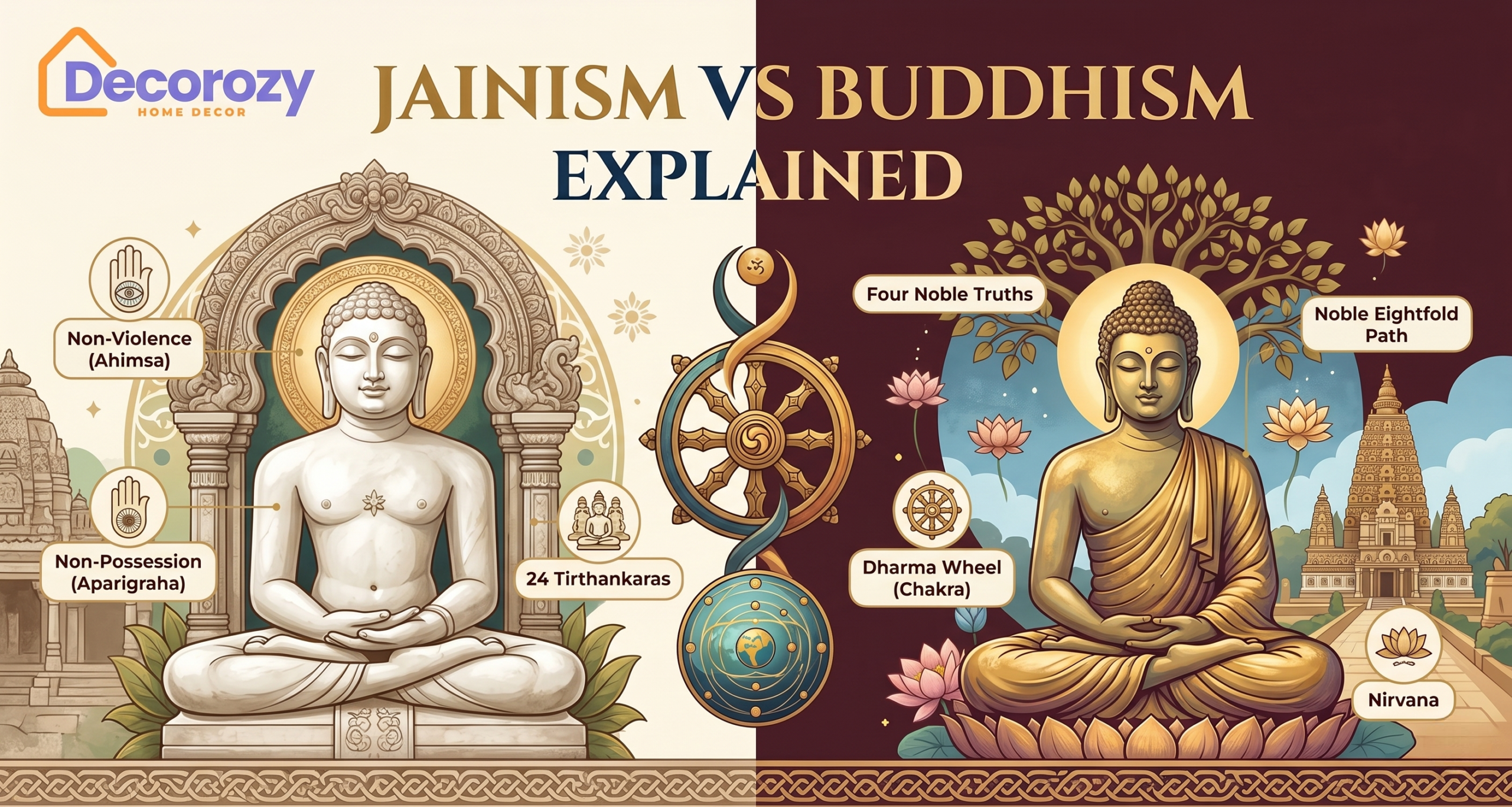
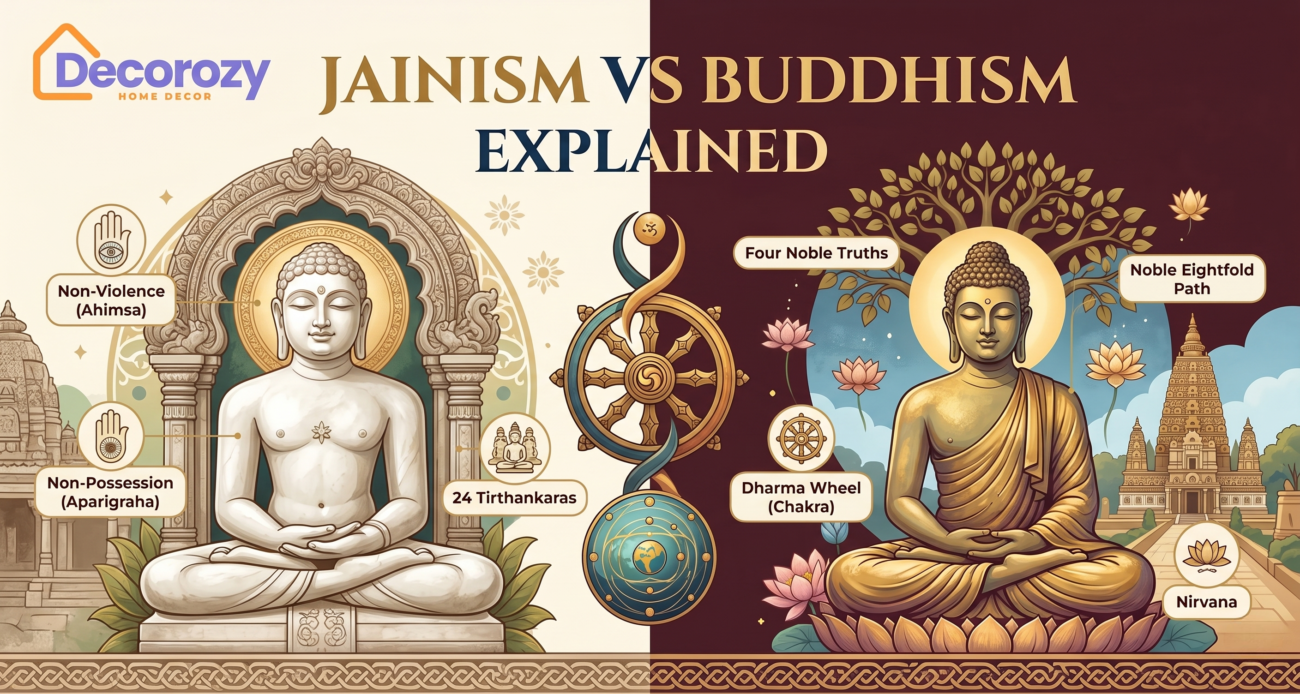
Quick Answer: Jainism and Buddhism both originated in ancient India, emphasizing liberation from the cycle of rebirth. While Jainism advocates for extreme asceticism and absolute non-violence (Ahimsa), translating to highly sustainable, cruelty-free living, Buddhism teaches the “Middle Path” of mindful moderation, inspiring balanced, uncluttered, Zen-like environments.
Key Takeaways
Philosophical Foundations: Both traditions reject the authority of the Vedas, focusing instead on personal spiritual effort, karma, and liberation, yet they diverge significantly in their approach to asceticism and the concept of the soul.
Jainist Design Influence: The Jain principle of Ahimsa (non-violence) and Aparigraha (non-attachment) inspires ultra-minimalist, eco-conscious, and 100% cruelty-free interior design choices.
Buddhist Design Influence: The Buddhist “Middle Path” and focus on mindfulness give rise to Zen interiors, meditation sanctuaries, and balanced spatial arrangements that avoid both extreme opulence and extreme austerity.
The Foundations: Jainism vs Buddhism Explained
To understand how these ancient philosophies influence modern luxury and mindful living, we must first dive deep into their historical and spiritual roots. Both Jainism and Buddhism emerged in the 6th century BCE in the Ganges basin of India. This was a time of immense intellectual and spiritual awakening, characterized by a shifting focus from ritualistic practices to internal, meditative quests for truth.
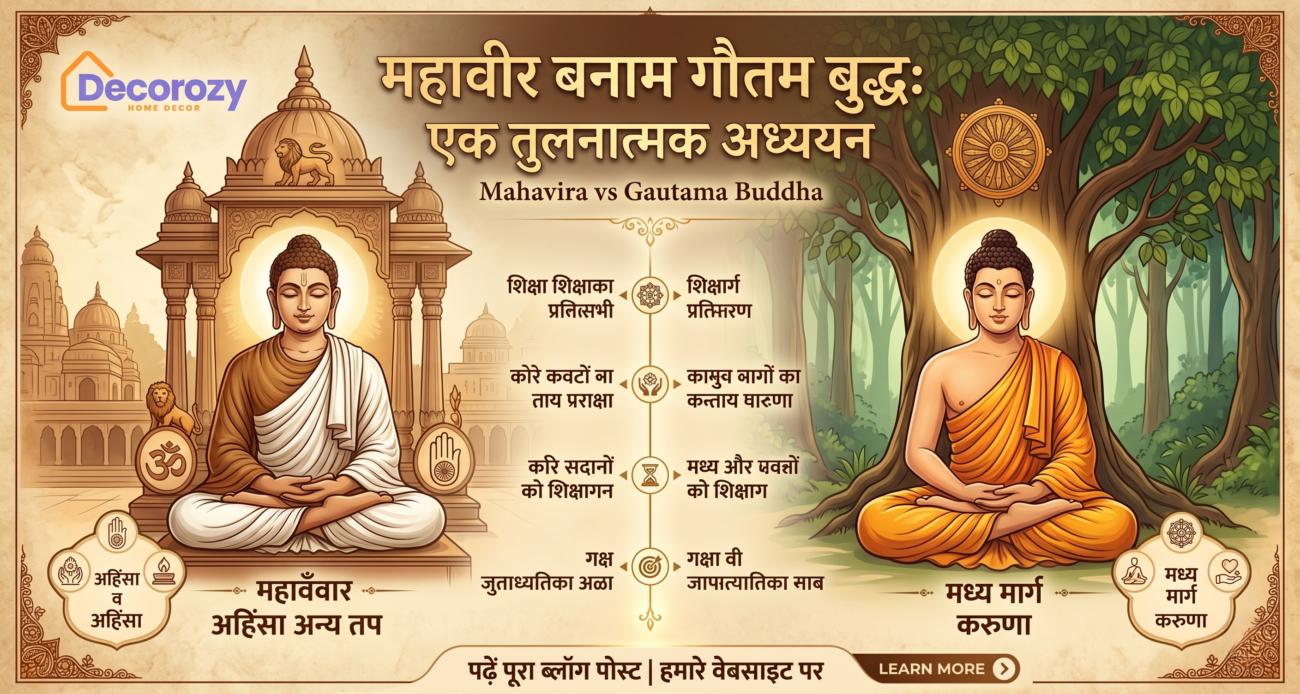
Both Mahavira (the 24th Tirthankara of Jainism) and Siddhartha Gautama (the Buddha) were born into royal families. Both renounced their wealth, palaces, and lavish surroundings in search of ultimate truth. This act of renunciation itself is a powerful lesson in intentional living—the realization that true peace is not found in the endless accumulation of material goods, a core ethos we celebrate in Decorozy’s curated collections.
Despite their shared origins and mutual belief in karma (the law of cause and effect) and samsara (the cycle of rebirth), their paths to moksha or nirvana (liberation) took distinct forms. Understanding these distinctions allows us to bring their specific energies into our architectural and design choices.
The Core of Jainism: Ahimsa and Absolute Purity
Jainism is one of the world’s oldest continuous religious traditions. Its teachings are centered around self-control, rigorous asceticism, and an absolute, unyielding commitment to non-violence. The philosophy dictates that every living being—from humans to microscopic organisms—has a soul (Jiva) of equal value.
The three guiding principles of Jainism, often referred to as the “Three Jewels” (Ratnatraya), are Right Faith, Right Knowledge, and Right Conduct. Right Conduct is heavily defined by the Five Great Vows (Mahavratas), with Ahimsa (non-violence) being the supreme directive.
In the realm of lifestyle and environment, this translates to a profound respect for nature. Followers practice strict vegetarianism and avoid any profession or practice that harms living beings. Furthermore, the principle of Aparigraha (non-possessiveness) teaches detachment from material wealth.
The Core of Buddhism: The Middle Path and Mindfulness
Buddhism, founded by Siddhartha Gautama after his enlightenment beneath the Bodhi tree, advocates for the “Middle Path.” After experimenting with both extreme royal indulgence and severe ascetic starvation, the Buddha realized that neither extreme led to spiritual awakening.
The foundation of Buddhist philosophy rests upon the Four Noble Truths: the reality of suffering (Dukkha), the cause of suffering (attachment/desire), the end of suffering, and the path that leads to the end of suffering (The Eightfold Path). Unlike Jainism, Buddhism teaches the concept of Anatman or non-self, suggesting that there is no eternal, unchanging soul.
For the modern homeowner, Buddhism’s Middle Path is the ultimate guide to balanced interior design. It teaches us to create spaces that are comfortable and nurturing, yet free from the clutter and over-indulgence that cause mental distraction and stress.
Comparative Analysis: Jainism vs Buddhism in Philosophy and Design
To master the nuances of these two profound paths, we have broken down their core differences and how they directly translate to interior curation and spatial energy.
Feature / Concept
Jainism
Buddhism
Interior Design Translation (Decorozy)
Founder / Key Figure
Lord Mahavira (24th Tirthankara)
Siddhartha Gautama (The Buddha)
Incorporating subtle iconography; Tirthankara art vs. Buddha statues.
Core Philosophy
Extreme Asceticism & Absolute Non-violence
The Middle Path & Moderation
Ultra-minimalism (Jain) vs. Balanced, comfortable serenity (Buddhist).
View on the Soul
Jiva: Every entity (even plants/water) has an eternal soul.
Anatman: No permanent, unchanging self or soul.
Hyper-eco-conscious material sourcing (Jain) vs. Fluid, adaptable living spaces (Buddhist).
Approach to Karma
Karma is a physical substance binding the soul; requires rigorous penance to shed.
Karma is intentional action (mental/physical); requires mindfulness to overcome.
Intentional placement of objects; creating spaces that require high-effort maintenance vs. easy-flow living.
Material Attachment
Aparigraha: Complete renunciation of earthly possessions for monks.
Reduction of craving and attachment to avoid suffering.
Intricate, geometric light fixtures (Jain) vs. Organic, flowing shapes and indoor greenery (Buddhist).
Expert Implementation & Tips: Infusing Ancient Wisdom into Decorozy Interiors
Understanding “Jainism vs Buddhism explained” is only the first step. As a premium design brand, Decorozy’s mission is to help you operationalize these concepts, transforming historical theology into tangible, breathtaking home aesthetics.
By applying the specific energies of these traditions, you can elevate your home from a mere dwelling to a sophisticated sanctuary of peace. Here is our expert guide to integrating these profound spiritual principles into your interior spaces.
The Jain Aesthetic: Cruelty-Free and Intentionally Minimalist
The Jain aesthetic is driven by a deep reverence for life and a rejection of unnecessary accumulation. Creating a Jain-inspired space means making highly conscious, ethical choices about every item you bring into your home.
Mastering Cruelty-Free Materiality
The principle of Ahimsa strictly forbids the use of materials derived from the suffering of animals. When curating a Jain-inspired living room or bedroom with Decorozy products, the focus must be entirely on cruelty-free luxury.
Avoid leather, silk, bone inlay, and certain types of wool. Instead, elevate your space with high-end vegan alternatives. Opt for premium faux leathers, organic cottons, linen, and hemp. Innovations in sustainable materials, such as Piñatex (pineapple leather) or mushroom-based textiles, offer opulent textures without compromising ethical boundaries.
Embracing Aparigraha Through Space
Aparigraha, the vow of non-possessiveness, is the ultimate ancient guide to decluttering. In interior design, this translates to keeping only what is absolutely necessary and spiritually uplifting.
Implement seamless, built-in storage solutions to hide daily necessities. Choose furniture with clean, unornamented lines. The visual emptiness of a room is just as important as the items within it. By leaving substantial negative space in your living areas, you allow the energy (prana) to flow freely, creating a visually restful environment that calms the mind instantly.
The Buddhist Aesthetic: Zen and the Balanced Middle Path
Buddhism’s design influence is deeply intertwined with Zen philosophy, which emphasizes naturalness, simplicity, and the beauty of the present moment. It is less about strict deprivation and more about harmonious balance.
Designing for Mindfulness and Meditation
The core of Buddhist practice is meditation. To reflect this in your home, dedicate a specific corner or an entire room to mindfulness. This space does not need to be austere; it should be inviting and grounded.
A Decorozy meditation space should feature low seating, such as plush floor cushions or a traditional zafu and zabuton. Incorporate a low altar table to display elements of nature—a simple bamboo plant, a water feature, or incense. The lighting should be soft and diffuse, utilizing paper lanterns or warm, dimmable LEDs to mimic the gentle light of dawn or dusk.
Wabi-Sabi and the Acceptance of Impermanence
The Buddhist concept of impermanence (Anicca) gave rise to the Japanese aesthetic of Wabi-Sabi—finding beauty in imperfection and the natural cycle of growth and decay.
Instead of striving for flawless, mass-produced symmetry, choose decor that tells a story. Select Decorozy ceramics with natural glazes, asymmetrical edges, or visible repairs (like Kintsugi). Incorporate reclaimed wood furniture where the grain, knots, and weathering are proudly displayed. This philosophy creates a deeply comforting environment that forgives the wear and tear of daily life.
Strategic Lighting and Color Psychology
Both Jain and Buddhist architectures utilize light and color to elevate the human spirit, albeit in slightly different ways.
Illuminating the Spirit
In Jain temples, such as the famous Dilwara temples, natural light is often filtered through intricately carved marble, creating a mesmerizing, uplifting geometry. You can replicate this by using intricately cut metal or wooden screens (jalis) in your home, allowing sunlight to cast intricate, meditative shadows across your floors.
Buddhist spaces often favor soft, diffused, and ambient lighting. The goal is to eliminate harsh glare and create a gentle glow that encourages introspection. Utilize Decorozy’s frosted glass lamps, rice paper shades, and strategically placed floor uplighting to wash walls in a calming luminescence.
The Color Palette of Peace
Jain Palettes: Lean heavily into pure whites, creams, and soft golds. White represents absolute purity and the shedding of karmic dust, creating spaces that feel expansive and immaculate.
Buddhist Palettes: Draw directly from nature and the monastic tradition. Earth tones, deep ochres, muted greens, and the iconic saffron/maroon of monk robes provide a grounded, earthy warmth that makes a room feel incredibly secure and serene.
Selecting Spiritual Art and Sculptures
The artwork you choose acts as the focal point for your home’s energy. Decorozy offers a curated selection of spiritual statuary and wall art that respects the profound heritage of these traditions.
When selecting a Buddha statue, consider the mudra (hand gesture). A Buddha with hands resting in the lap (Dhyana mudra) is perfect for a meditation room, symbolizing absolute focus and peace. A Buddha with the right hand raised (Abhaya mudra) represents protection and fearlessness, ideal for an entryway or living room facing the main door.
If you prefer Jain-inspired art, look for representations of the Tirthankaras in seated lotus positions, or geometric mandalas that represent the Jain cosmological universe. Keep the framing minimalist and ensure the artwork is placed at a respectful height, never on the floor.
Achieving Serenity with Decorozy’s Expert Curation
The debate of Jainism vs Buddhism explained through the lens of history reveals two distinct but equally powerful paths to enlightenment. By understanding their differences—the rigorous purity and non-violence of Jainism versus the mindful moderation and Zen balance of Buddhism—you can make deeply intentional choices about your living space.
Your home should be your sanctuary. It should be a physical manifestation of your inner peace. Whether you lean towards the ultra-minimalist, cruelty-free elegance inspired by Mahavira, or the balanced, earthy warmth inspired by the Buddha, Decorozy provides the premium tools, textiles, and expert guidance to bring your spiritual vision to life.
Explore Decorozy.com today to discover our exclusive collections of sustainable, mindful decor. Elevate your space, elevate your spirit, and let every room in your home become a testament to intentional, beautiful living.
Frequently Asked Questions (FAQs)
Q1: What is the main difference between Jainism and Buddhism? A: While both originated in ancient India and seek liberation from rebirth, Jainism focuses on extreme asceticism and absolute non-violence (Ahimsa) in all actions. Buddhism advocates for the “Middle Path,” promoting moderation, mindfulness, and the avoidance of extremes.
Q2: How can I apply Jain principles to my home decor? A: You can apply Jain principles by adopting a completely cruelty-free, sustainable approach to materials. Avoid leather or silk, embrace extreme minimalism (Aparigraha) to reduce clutter, and utilize a pure, light color palette to represent spiritual clarity.
Q3: What is a Buddhist “Zen” interior? A: A Zen interior is deeply influenced by Buddhist principles of mindfulness and impermanence. It features uncluttered spaces, natural materials like bamboo and unfinished wood, earthy color palettes, and dedicated zones for meditation and quiet reflection.
Q4: Do Buddhists and Jains believe in the same concept of the soul? A: No. Jainism believes every living entity possesses an eternal soul (Jiva) that carries karma. Buddhism teaches the concept of Anatman (non-self), meaning there is no permanent, unchanging soul, but rather a flowing stream of consciousness.
Q5: How do I choose the right spiritual artwork for my home? A: Choose artwork that aligns with the energy you want to cultivate. For deep meditation and protection, a Decorozy Buddha statue in the Abhaya or Dhyana mudra is ideal. For a focus on absolute purity and focus, minimalist Jain geometric art or Tirthankara figures are perfect.