The history of India’s independence is heavily shaped by monumental ideological debates between its greatest leaders. Among the most profound are the B.R. Ambedkar vs Mahatma Gandhi key differences regarding social reform and political structure. Their contrasting visions continue to deeply influence modern political discourse and social justice movements.
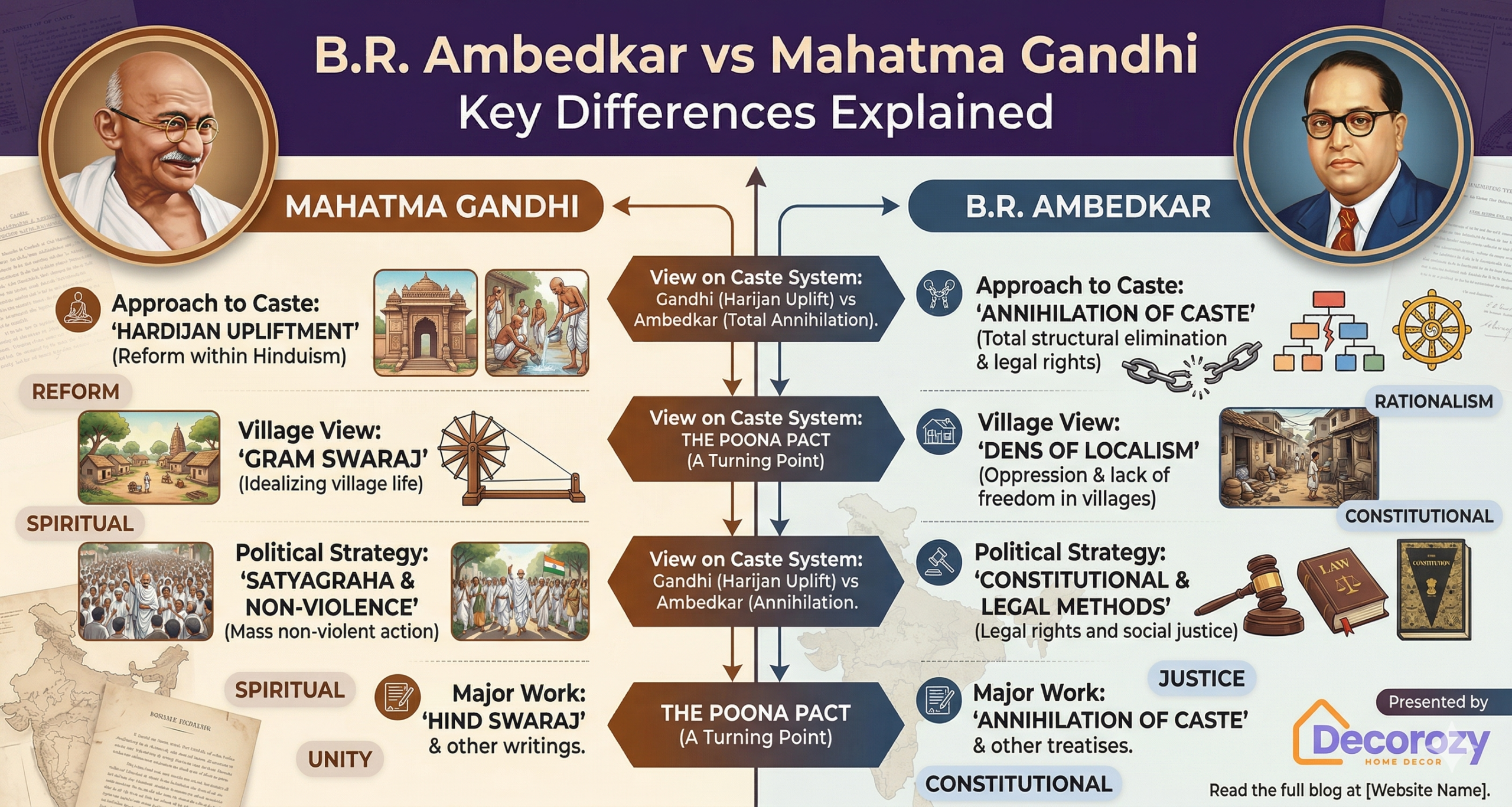
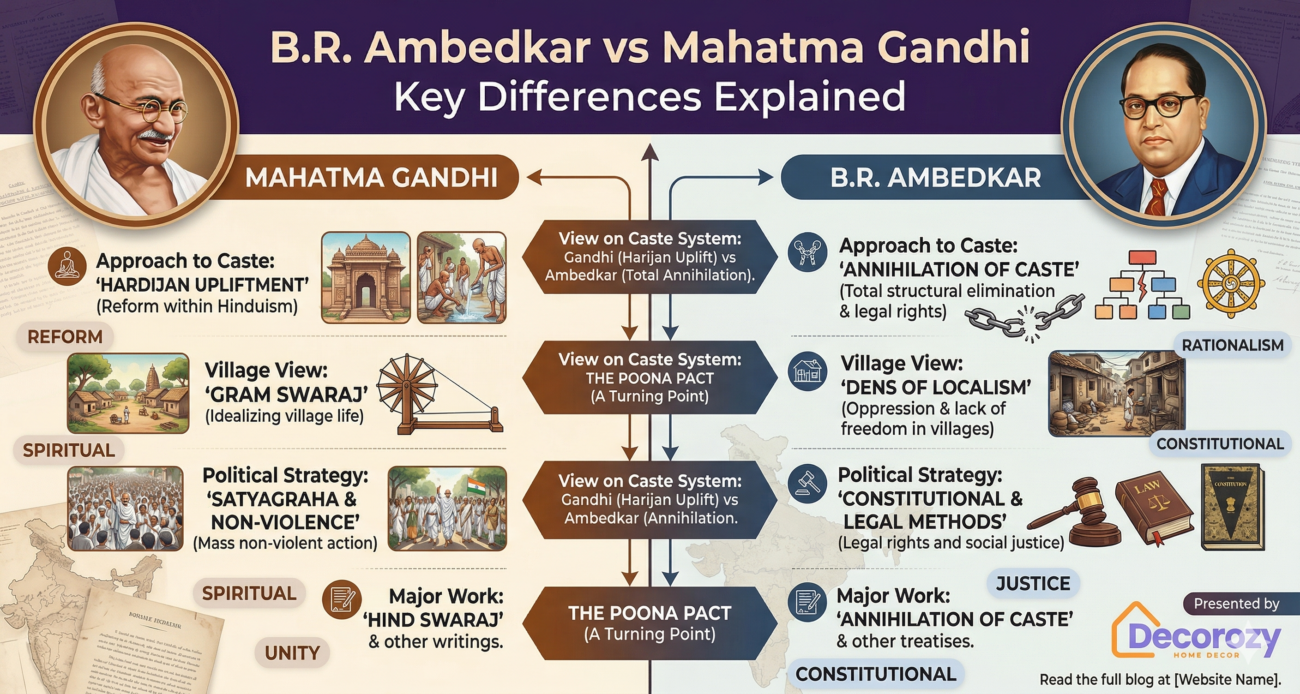
Quick Answer: The main B.R. Ambedkar vs Mahatma Gandhi key differences center on the caste system. Gandhi believed in reforming the Varna framework to remove untouchability through moral persuasion. Conversely, Ambedkar demanded the complete annihilation of the caste system, viewing it as inherently oppressive and irredeemable.
Exploring the Core B.R. Ambedkar vs Mahatma Gandhi Key Differences
Ambedkar and Gandhi held fundamentally opposing views on India’s traditional social structure. Gandhi romanticized the Indian village as the spiritual and economic heart of the nation.
He believed that self-sustaining, autonomous villages could foster a moral and egalitarian society. For Gandhi, village life represented purity and simplicity.
Conversely, Ambedkar viewed the traditional Indian village with deep skepticism. He famously described the village as a “den of ignorance” and a stronghold of rigid caste-based oppression.
Another major area of divergence was their approach to political representation. Ambedkar championed separate electorates for marginalized classes to ensure they had a true political voice.
Gandhi strongly opposed this idea, initiating a fast unto death in protest. He feared that separate electorates would permanently divide the Hindu community, leading to the historic compromise known as the Poona Pact of 1932.
Why Understanding B.R. Ambedkar vs Mahatma Gandhi Key Differences Matters Today
Grasping the B.R. Ambedkar vs Mahatma Gandhi key differences is absolutely essential for understanding contemporary Indian politics. Their intense debates laid the vital groundwork for India’s constitution.
Ambedkar’s insistence on legal frameworks and constitutional safeguards shaped the affirmative action policies we see today. He believed rights must be guaranteed by law, not left to the goodwill of the privileged.
Gandhi’s emphasis on moral persuasion and spiritual upliftment also left a lasting legacy. He believed that true societal change required a change of heart among the oppressor classes.
However, modern social justice movements increasingly lean toward Ambedkar’s demand for radical structural and legal changes. Studying both perspectives provides a balanced view of India’s ongoing struggle for true social equality.
A Detailed Analysis of Their Economic and Social Ideologies
Economically, Gandhi advocated for a highly decentralized, agrarian economy based heavily on cottage industries. He famously promoted Khadi and hand-spinning as tools for self-reliance.
He was highly skeptical of modern machinery and rapid industrialization. Gandhi argued that heavy industrialization would inevitably lead to capitalist exploitation and massive rural unemployment.
Ambedkar, a highly trained economist, strongly disagreed with this pastoral economic vision. He saw rapid industrialization and urbanization as essential tools for national economic growth.
More importantly, Ambedkar argued that modern industries would help break the rigid, hereditary occupational structures enforced by the caste system. He viewed the city as a space for social mobility.
Furthermore, their views on the state’s role were drastically different. Ambedkar advocated for a strong, centralized government equipped to strictly enforce and protect minority rights.
Gandhi, leaning towards philosophical anarchism, preferred a highly decentralized system based on Gram Swaraj (village self-rule). These contrasting visions remain highly relevant in current debates about governance and state power.
The debate between these two towering historical figures ultimately shaped the democratic framework of modern India. While Gandhi focused on moral awakening, Ambedkar demanded undeniable, legally binding rights. To dive deeper into India’s historical milestones and ongoing political evolution, continue exploring our expert historical guides right here on Decorozy.com.
FAQ Schema
- Question 1: What was the main conflict between Gandhi and Ambedkar?
- Answer: The primary conflict revolved around the caste system and political representation. Ambedkar demanded the total destruction of the caste system and separate electorates for marginalized groups. Gandhi sought to reform the existing Varna system and opposed separate electorates, fearing they would permanently divide society.
- Question 2: Who won the Poona Pact debate?
- Answer: The Poona Pact of 1932 was a political compromise. Ambedkar agreed to abandon the demand for separate electorates to save Gandhi’s life during his fast unto death. In exchange, Gandhi agreed to a significantly higher number of reserved seats for the Depressed Classes within the general electorate.
- Question 3: What were their different views on village economies?
- Answer: Gandhi viewed traditional villages as the ideal foundation for a self-sufficient, moral Indian society, promoting cottage industries. Ambedkar heavily criticized Indian villages as centers of rigid caste prejudice and oppression, advocating instead for urbanization and heavy industrialization to break traditional social barriers.