



Blog

Top Scientific Facts Mentioned in the Rigveda Explained
Welcome to Decorozy.com, where we explore the fascinating intersection of ancient wisdom and modern understanding. Have you ever wondered about the scientific facts mentioned in the Rigveda? This ancient text holds surprising insights that align closely with modern scientific discoveries.
Quick Answer: The Rigveda contains remarkable observations that align with modern science. These include early concepts of a heliocentric solar system, the spherical shape of the Earth, the hydrological cycle, and advanced astronomical principles recorded long before the invention of modern scientific instruments.
Understanding the Scientific Facts Mentioned in the Rigveda
The Rigveda stands as one of the oldest known texts in human history. Beyond its profound spiritual significance, it serves as a rich repository of ancient Indian science.
Scholars and historians continually uncover surprising scientific facts mentioned in the Rigveda. These ancient hymns use allegorical language to describe complex natural phenomena.
When carefully decoded, they reveal advanced knowledge of physics, astronomy, and environmental science. This highlights the brilliant, data-driven observational skills of ancient Vedic seers.
The Importance of Exploring Scientific Facts Mentioned in the Rigveda
Studying the scientific facts mentioned in the Rigveda provides a vital historical perspective. It proves that early human civilizations possessed a highly sophisticated understanding of the cosmos.
This knowledge highlights the rapid evolution of human thought and scientific inquiry. Recognizing these ancient scientific milestones fosters a greater appreciation for global heritage.
Furthermore, it encourages modern researchers to revisit ancient texts with a new lens. Finding parallels between Vedic cosmology and quantum physics can inspire innovative ways of thinking about our universe.
Detailed Analysis: Astronomy and Physics in the Vedic Era
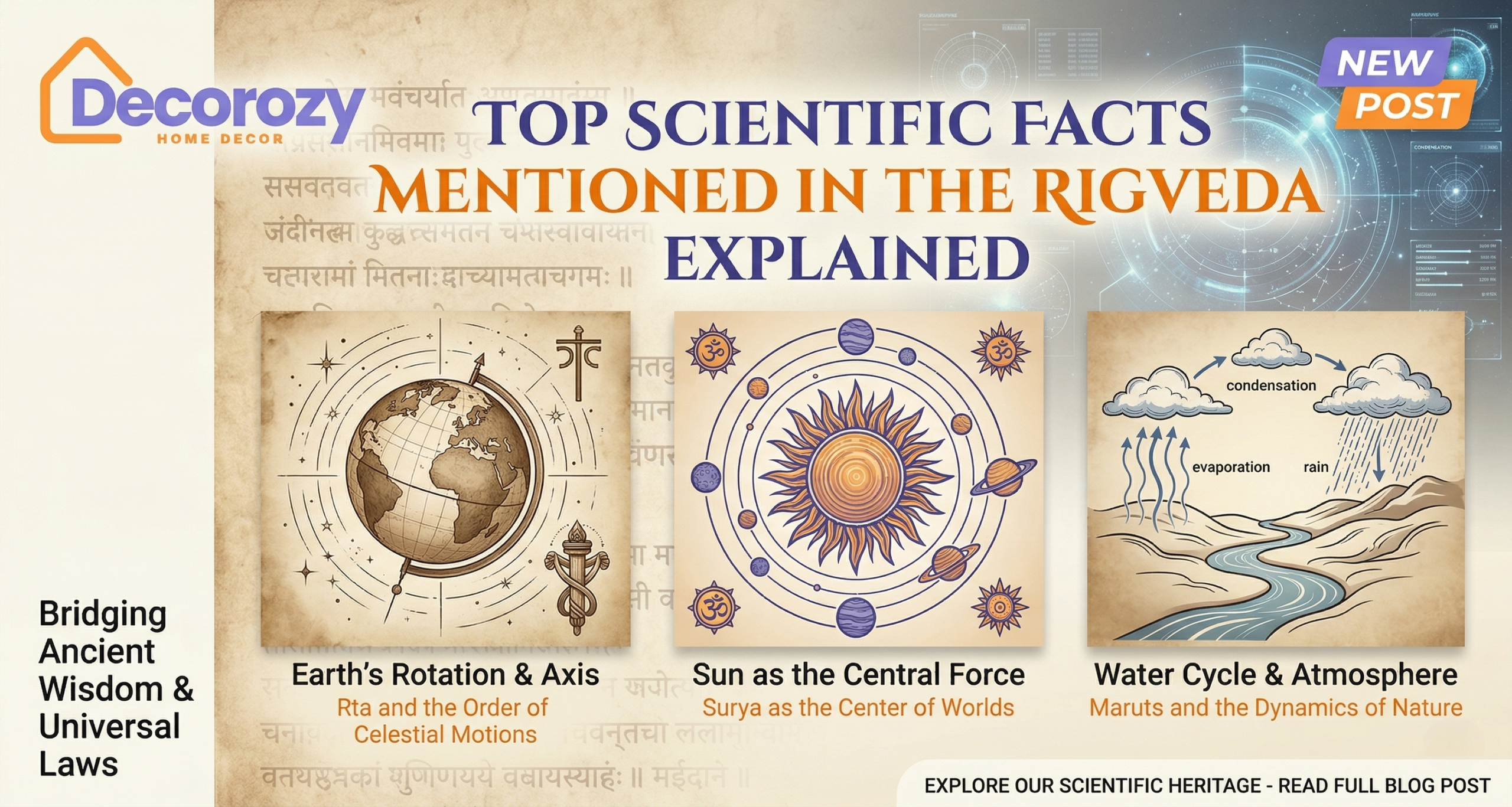
One of the most striking areas of Vedic science is ancient astronomy. Rigvedic hymns describe the sun as the powerful center of the solar system.
They accurately depict planetary orbits and the fundamental concept of gravity holding celestial bodies together. The text also contains clear descriptions of the Earth’s hydrological cycle.
Verses detail how the sun’s heat evaporates water, forms dense clouds, and returns as nourishing rain. Additionally, the Rigveda hints at complex physical concepts, laying the groundwork for later scholars to calculate metrics like the speed of light.
In conclusion, the Rigveda is much more than a collection of religious hymns; it is a testament to early scientific curiosity.
Are you fascinated by the hidden wisdom of ancient texts and how they shape our world? Explore more deep dives into history and science right here at Decorozy.com. Share this article and join the conversation today!
FAQ Schema
- Question 1: Does the Rigveda mention the solar system?
- Answer: Yes, the Rigveda contains verses that suggest a heliocentric model. It describes the sun as the central driving force that holds the earth and other celestial bodies in their respective paths through gravitational-like forces.
- Question 2: Are there references to the water cycle in the Vedas?
- Answer: Absolutely. The Rigveda clearly explains the evaporation of water by the sun, the formation of clouds in the atmosphere, and the subsequent rainfall, demonstrating an accurate understanding of the Earth’s hydrological cycle.
- Question 3: What does the Rigveda say about the shape of the Earth?
- Answer: The hymns in the Rigveda refer to the Earth as a sphere. They describe the planet as a rounded globe suspended in space, contradicting the common historical misconception that all ancient peoples believed in a flat earth.