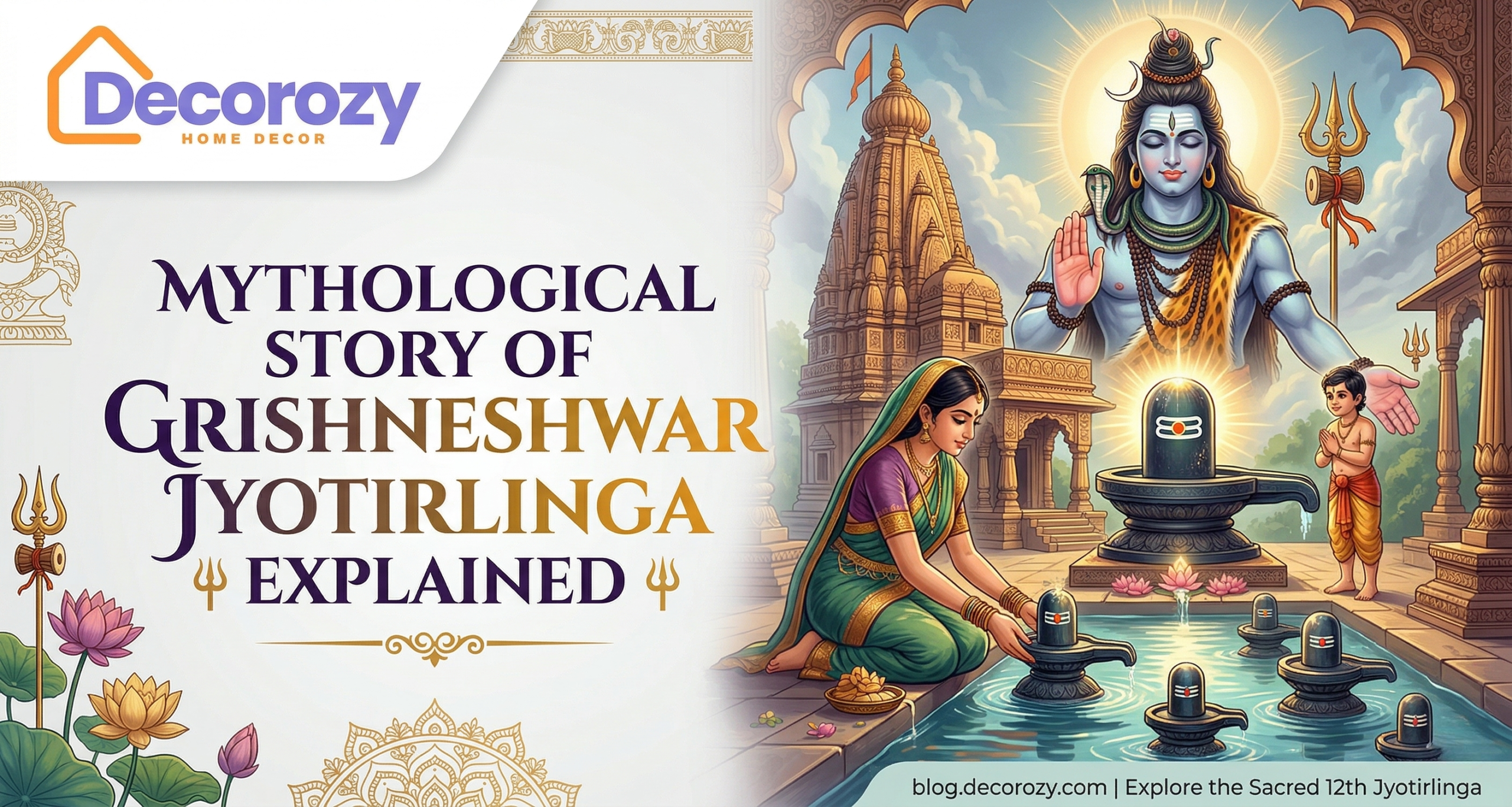
India is home to countless ancient shrines, but the twelfth and final Jyotirlinga holds a unique spiritual weight. Understanding the mythological story of Grishneshwar Jyotirlinga reveals profound insights into faith and divine intervention.
This ancient temple, located in Maharashtra near the famous Ellora Caves, draws millions of pilgrims annually. Its origins are deeply rooted in the revered texts of the Shiva Purana, showcasing the ultimate power of devotion.
Quick Answer: The mythological story of Grishneshwar Jyotirlinga centers on a woman named Ghushma. When her jealous sister murdered her son, Ghushma maintained unwavering faith. Lord Shiva, moved by her profound devotion, resurrected her son and manifested eternally as the Grishneshwar Jyotirlinga.
The Core Mythological Story of Grishneshwar Jyotirlinga
According to ancient scriptures, a learned Brahmin named Sudharma lived in the Devagiri mountains with his wife, Sudeha. Despite their righteous lifestyle, the couple suffered great sorrow because they were unable to conceive a child.
Desperate for an heir, Sudeha convinced her husband to marry her younger sister, Ghushma. She believed that a child born to her own bloodline would bring peace and continuation to their family’s legacy.
Ghushma was an incredibly devout woman who worshipped Lord Shiva daily with unmatched discipline. Every day, she meticulously crafted 101 lingams out of clay, worshipped them, and immersed them in a nearby lake.
The Tragedy Within the Mythological Story of Grishneshwar Jyotirlinga
Lord Shiva blessed Ghushma’s devotion, and she soon gave birth to a healthy, beautiful son. As the boy grew, he brought immense joy to Sudharma, but the situation slowly began to poison Sudeha’s mind.
Consumed by severe jealousy and feelings of inadequacy, Sudeha’s love for her sister morphed into bitter hatred. She could not bear to watch Ghushma receive all the praise, attention, and maternal joy within the household.
One dark night, Sudeha’s jealousy drove her to commit an unthinkable and horrific crime against her own family. She brutally murdered Ghushma’s young son while he was sleeping, severing the family’s happiness in an instant.
To hide her sinister deed, Sudeha dragged the boy’s lifeless body out into the dark. She threw him into the very same lake where Ghushma daily immersed her sacred clay Shiva lingams.
Lord Shiva’s Divine Intervention
The next morning, the household awoke to immense grief and chaos upon discovering the boy’s blood-stained bed. Sudharma and Sudeha wept loudly, but Ghushma remained entirely stoic, continuing her daily rituals without missing a step.
Ghushma’s faith was so unshakable that she believed the Lord who gave her the child would protect him. She calmly finished her prayers, gathered her clay lingams, and walked toward the lake for the daily immersion.
As she stepped near the water, a miraculous event unfolded right before the eyes of the grieving family. Her son emerged from the depths of the lake, entirely unharmed, praising the divine grace of Lord Shiva.
The Power of Supreme Forgiveness
Following the boy’s miraculous return, Lord Shiva himself appeared before Ghushma, radiating immense divine light. He was furious with Sudeha’s wicked actions and declared his intention to strike her down with his trident.
In a stunning display of compassion, Ghushma fell to her knees and pleaded for her sister’s life. She asked Lord Shiva to forgive Sudeha, arguing that ultimate divine grace should conquer human ignorance and sin.
Pleased by Ghushma’s pure heart and profound capacity for forgiveness, Shiva granted her a divine boon. He agreed to spare her sister’s life and offered to fulfill any wish that Ghushma desired in that moment.
Ghushma requested that Lord Shiva reside eternally in that exact location to protect and bless future devotees. Granting her wish, Shiva manifested himself as a pillar of light, forever known as the Grishneshwar (or Ghushmeshwar) Jyotirlinga.
Architectural and Historical Significance
Today, the Grishneshwar temple stands proudly in the village of Verul, serving as a testament to this incredible legend. The current architectural marvel was heavily restored in the 18th century by the great Queen Ahilyabai Holkar of Indore.
The temple boasts intricate carvings, stunning red volcanic rock construction, and a towering five-tier shikhara. It remains an essential pilgrimage site, perfectly blending India’s rich mythological heritage with stunning historical preservation.
Visiting this temple offers a powerful spiritual experience, reminding devotees of the protective power of sincere faith. The energy of the shrine continues to resonate with the ancient prayers of the devout Ghushma.
The profound lessons of forgiveness, devotion, and divine protection make this site a beacon for spiritual seekers worldwide. It is a story that transcends time, proving that genuine faith can literally bring life from the depths of despair.
To explore more fascinating historical insights, architectural wonders, and ways to bring spiritual harmony into your living spaces, explore the rest of our expert guides at Decorozy.com.
FAQ Schema
- Question 1: Where is the Grishneshwar Jyotirlinga located?
- Answer: Grishneshwar Jyotirlinga is located in the village of Verul in Maharashtra, India. It is situated less than a kilometer away from the UNESCO World Heritage site, the Ellora Caves.
- Question 2: Who built the current structure of the Grishneshwar temple?
- Answer: The current Grishneshwar temple was completely rebuilt and restored in the 18th century. The project was commissioned by the devoted Maratha queen, Ahilyabai Holkar of Indore.
- Question 3: What does the name “Grishneshwar” mean?
- Answer: The name Grishneshwar (also historically known as Ghushmeshwar) translates to the “Lord of Compassion.” It directly honors Ghushma, the devout woman whose faith compelled Lord Shiva to manifest there.