Varanasi is widely considered one of the oldest living cities on Earth, radiating an unparalleled spiritual energy. At its core lies a profound story of devotion, destruction, and monumental resilience. Understanding the history of Kashi Vishwanath Jyotirlinga is essential for anyone seeking to explore the depths of Hindu heritage.
Quick Answer: The Kashi Vishwanath Jyotirlinga has a history spanning millennia, marked by repeated cycles of destruction and resurrection. Originally established in antiquity, the temple was repeatedly demolished by invaders like Aurangzeb, before being permanently rebuilt by Maratha Queen Ahilyabai Holkar in 1780.
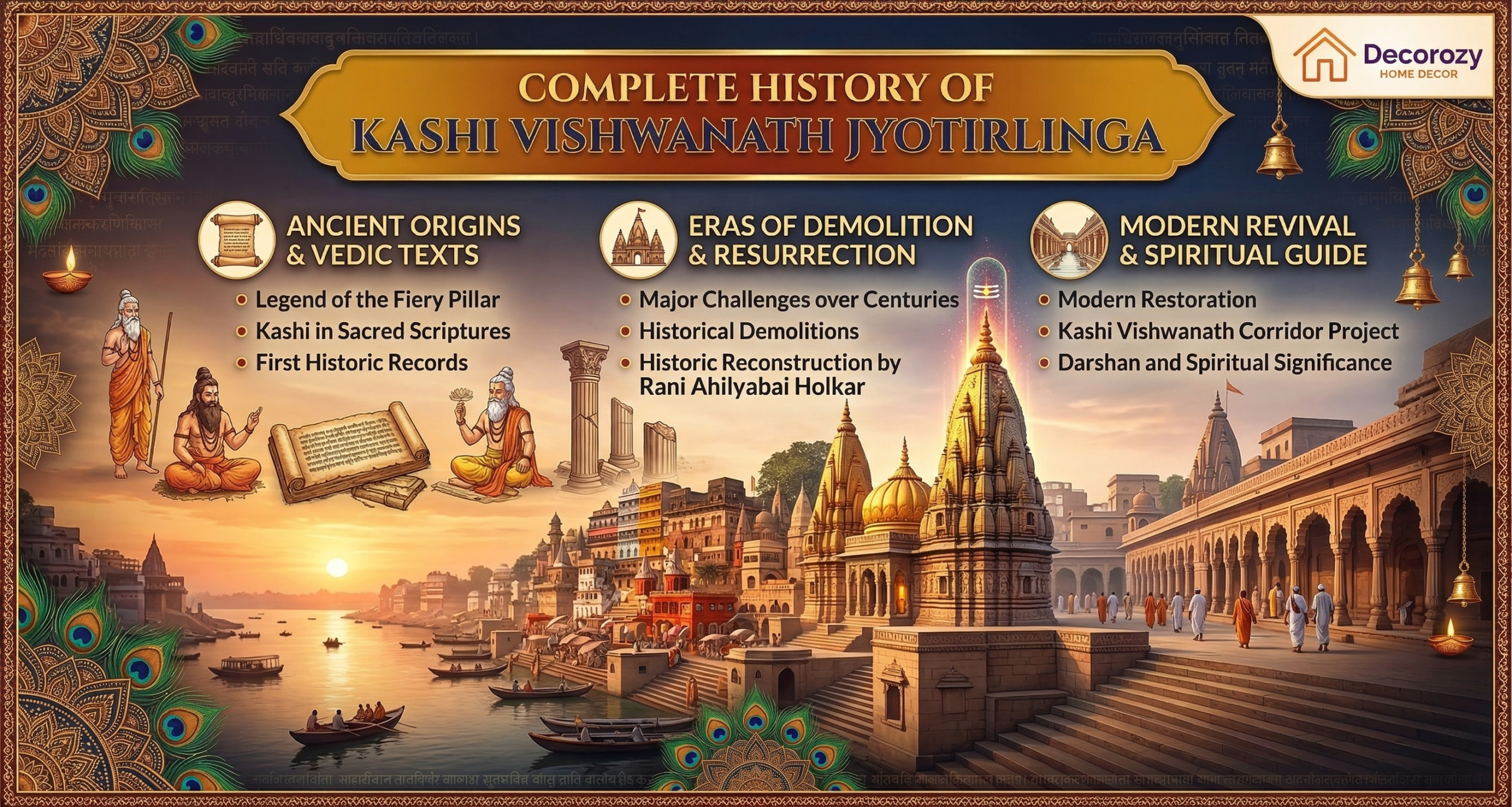
Early Origins and the Ancient History of Kashi Vishwanath Jyotirlinga
According to the Skanda Purana, the sacred city of Kashi is the original center of the universe. Hindu scriptures state that Lord Shiva manifested here as an endless, fiery column of light to assert his supremacy.
This divine manifestation is known as a Jyotirlinga, representing the infinite and formless nature of the cosmos. Consequently, Kashi holds the most supreme position among the twelve sacred Jyotirlingas scattered across India.
The original temple structure stood for centuries as a formidable beacon of Vedic learning and devotion. It consistently attracted sages, scholars, and millions of pilgrims from every corner of the Indian subcontinent.
Eras of Destruction: The Tumultuous History of Kashi Vishwanath Jyotirlinga
The medieval period brought immense, unprecedented challenges to the spiritual landscape of Varanasi. The temple faced its first major recorded destruction in 1194 CE at the hands of foreign invaders.
Qutb-ud-din Aibak’s army ruthlessly tore down the sacred structure, marking the beginning of a violent era. However, devoted local Hindus soon rebuilt the shrine under the patronage of a wealthy Gujarati merchant.
This devastating cycle continued over the centuries, with rulers repeatedly targeting the sacred site. The most severe and crippling blow to the temple’s legacy came during the 17th century.
In 1669, Mughal Emperor Aurangzeb ordered the complete and total demolition of the temple complex. He constructed the Gyanvapi Mosque over its ancient ruins, leaving only the sacred well, the Gyan Vapi, intact.
The Maratha Revival: Rebuilding the Sacred Shrine
Despite centuries of severe persecution, the faith of the local populace remained completely unshaken. Priests reportedly hid the original Jyotirlinga inside the Gyan Vapi well to protect it from desecration.
In 1780, the visionary Maratha Queen Ahilyabai Holkar of Indore championed a massive Hindu revival. She decisively constructed the current Kashi Vishwanath Temple immediately adjacent to the mosque’s site.
Her monumental architectural effort successfully restored Varanasi as the undisputed spiritual capital of India. The project reinvigorated the city’s economy, drawing artisans and pilgrims back to the sacred riverbanks.
Decades later, in 1835, Maharaja Ranjit Singh of the Sikh Empire donated a massive ton of pure gold. This gold was used to plate the temple’s prominent domes, earning it the famous moniker, the “Golden Temple of Varanasi.”
Modern Evolution and the Kashi Vishwanath Corridor
Today, the temple stands not just as an ancient relic, but as a thriving, dynamic center of active worship. Millions visit the adjacent Ganges riverbanks annually, seeking spiritual liberation, or Moksha.
In 2021, the Indian government inaugurated the monumental Kashi Vishwanath Corridor project. This massive infrastructural upgrade completely transformed the modern pilgrim experience in Varanasi.
It directly connected the sacred Ganges river to the temple complex, systematically removing highly congested alleys. This modern engineering marvel honors the site’s glorious past while securing its accessibility for future generations.
The enduring legacy of this sacred shrine is a powerful testament to unwavering human faith. From ancient scriptures to modern restorations, its spiritual journey is truly awe-inspiring. Explore more about integrating sacred Indian architecture and serene home sanctuaries right here on Decorozy.com!
FAQ Schema
- Question 1: Who built the present Kashi Vishwanath Temple?
- Answer: The current structure of the Kashi Vishwanath Temple was built in 1780 by the Maratha Queen, Maharani Ahilyabai Holkar of Indore, after the original temple was repeatedly destroyed.
- Question 2: How many times was the Kashi Vishwanath Temple destroyed?
- Answer: The temple was destroyed and rebuilt multiple times throughout history. The most notable destructions were by Qutb-ud-din Aibak in 1194 CE, the Sharqi kings in the 15th century, and Mughal Emperor Aurangzeb in 1669 CE.
- Question 3: Why is Kashi Vishwanath Jyotirlinga so spiritually important?
- Answer: It is revered as the first and most powerful of the twelve Jyotirlingas. Hindus believe that dying in Varanasi and receiving the Darshan of Kashi Vishwanath guarantees Moksha, or liberation from the cycle of rebirth.