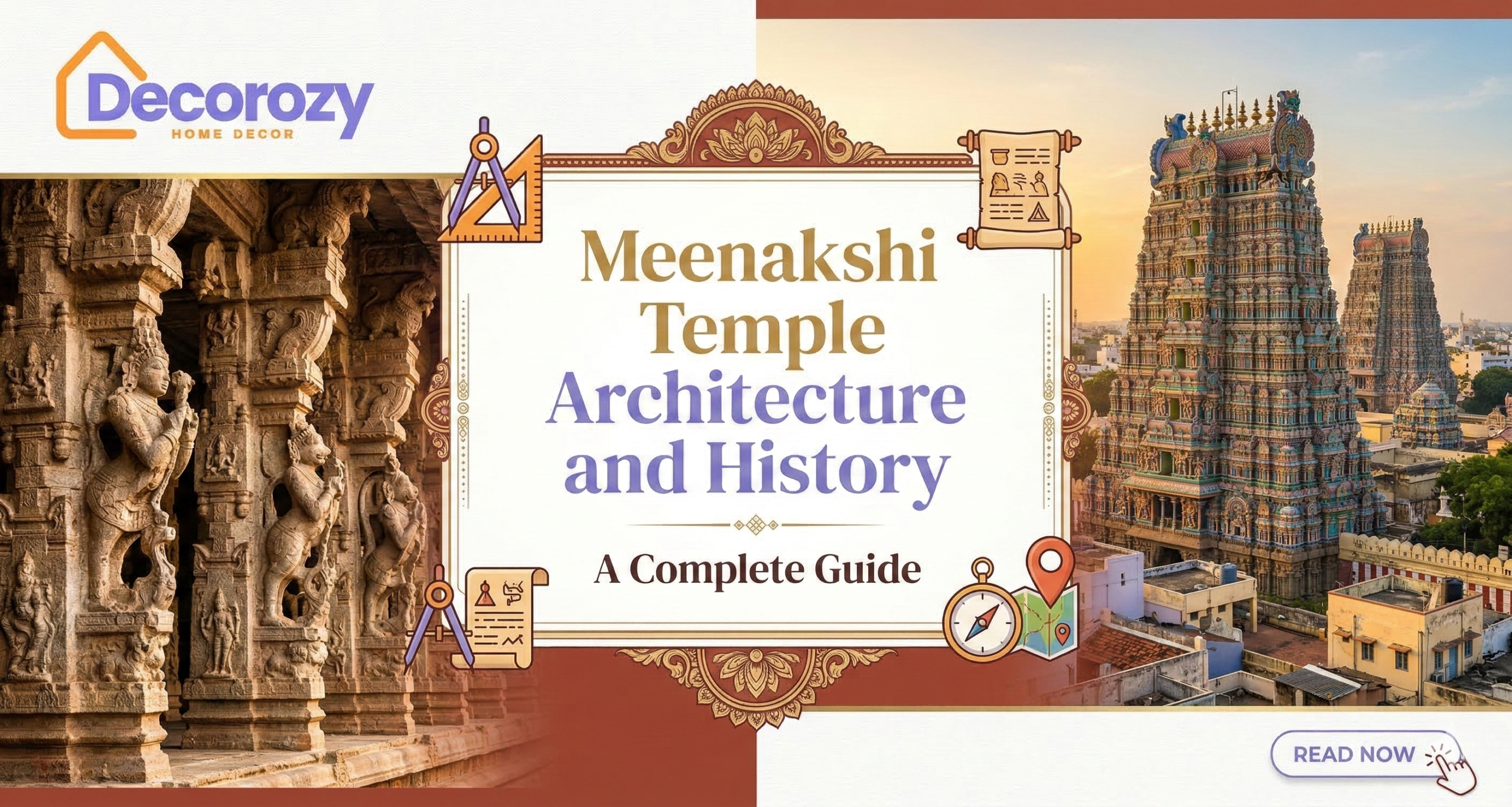
Standing proudly in the heart of Madurai, Tamil Nadu, lies a true marvel of ancient engineering. For centuries, pilgrims and historians alike have been captivated by the Meenakshi Temple architecture and history. This 14-acre complex is not just a place of worship; it is a living museum of India’s glorious past.
Quick Answer: The Meenakshi Temple is a prime example of Dravidian architecture, characterized by its 14 towering gopurams and concentric mandalas. Its history spans over 2,500 years, originally built by the Pandyas and extensively rebuilt in the 16th century by the Madurai Nayaks following its destruction by invaders.
A Masterpiece of Dravidian Design
The core concept behind the temple’s layout is deeply rooted in the ancient Shilpa Shastras. These traditional Hindu texts dictate the sacred geometry and spatial arrangements of structural construction. The entire ancient city of Madurai was historically built radiating outward from this very temple complex.
Viewed from above, the temple layout resembles a perfect cosmic mandala. It features multiple concentric enclosures, known as prakarams, fortified by massive stone walls. These thick masonry walls were originally constructed to protect the sacred inner shrines from foreign military invasions.
Every structure within the complex boasts breathtaking symmetry and precision. The layout perfectly aligns with the cardinal directions, showcasing the advanced town-planning skills of ancient Indian builders. The temple serves as a flawless, enduring representation of the classical Dravidian style.
The Cultural Importance of Meenakshi Temple Architecture and History
Understanding the Meenakshi Temple architecture and history is crucial for appreciating South India’s cultural evolution. The temple is uniquely dedicated to Goddess Meenakshi, a fierce manifestation of Parvati. She shares the central altar equally with her consort, Lord Sundareswarar (an incarnation of Shiva).
For over two millennia, this site has acted as the spiritual and economic epicenter of Madurai. It was a famous gathering place for scholars of the Tamil Sangam (literary assemblies) to debate philosophy, science, and art. Today, it continues to draw millions of devotees and tourists annually.
Beyond religion, the temple is an active preservation site for ancient structural and artistic techniques. The vibrant colors on the temple’s sculptures are still refreshed every 12 years using traditional mineral pigments. This ongoing, rigorous dedication keeps the temple’s rich heritage alive for future generations.
Detailed Analysis: Meenakshi Temple Architecture and History
The Early Origins and Pandyan Era
The origins of the temple stretch back to the 1st century CE. Early Tamil Sangam literature frequently mentions a majestic central shrine located in Madurai. However, the earliest surviving masonry that we can see today was built by the Pandya king Sadayavarman Kulasekaran I in the 13th century.
During this era, the foundational layout was permanently established. The Pandyas constructed the earliest central shrines for Goddess Meenakshi and Lord Shiva. They also built the oldest surviving gateway, the beautiful Eastern Gopuram.
Destruction and the Vijayanagara Rebirth
The 14th century brought immense tragedy to the region. Malik Kafur, a notorious commander of the Delhi Sultanate, invaded Madurai. His armies ruthlessly looted the temple’s vast wealth and left the sacred structures in complete ruins.
The turning point for the site came decades later with the rise of the Vijayanagara Empire. Led by Kumara Kampana, they defeated the invading forces and reclaimed the city. They initiated the earliest phases of rebuilding, reopening the sanctuary for daily worship.
The Great Nayak Restoration
The Meenakshi Temple architecture and history experienced its most dramatic expansion in the 16th century. Rulers of the Madurai Nayak dynasty, particularly Viswanatha Nayak and Thirumalai Nayak, spearheaded a massive, city-wide reconstruction effort.
They expanded the temple to its current, sprawling 14-acre footprint. The Nayaks closely followed the Vastu Shastra rules to expand the existing plans. They erected hundreds of new pillars, reconfigured layouts, and transformed the site into an architectural wonder.
The Towering Architectural Gopurams
The most iconic and photographed elements of the temple are its 14 gopurams, or monumental gateway towers. These stepped pyramids are constructed from brick and lime mortar resting upon massive granite foundations. They diminish elegantly in size as they rise toward the sky.
The Southern Gopuram is the tallest of them all, soaring to an impressive 170 feet (52 meters). Built in 1559 AD, it acts as a visual anchor for the city. Every single inch of these towers is covered in vibrant stucco art.
The Intricate Stucco Sculptures
The sheer volume of art on these towers is staggering. There are more than 33,000 brightly painted stucco figures spread across the complex. These carvings depict complex Hindu mythology, celestial beings, legendary animals, and divine battles.
The vibrant colors are achieved exclusively through traditional organic methods. Reds are derived from powdered bricks, yellows from turmeric, and blues from indigo. This ancient preservation system protects the underlying brick structure from moisture damage.
The Hall of a Thousand Pillars
Another undisputed architectural marvel is the Ayiramkaal Mandapam, famously known as the Hall of a Thousand Pillars. Despite its poetic name, it actually houses 985 intricately carved, solid granite columns. This hall was entirely commissioned by the Nayak dynasty.
From any viewing angle, the massive pillars appear to align in a perfectly straight, unbroken line. The hall also features legendary “musical pillars” carved from single blocks of stone. These pillars produce distinct musical notes (Sa-Re-Ga-Ma-Pa) when gently tapped.
The Sacred Golden Lotus Pond
Deep within the temple complex lies the sacred Porthamarai Kulam, translating directly to the Golden Lotus Pond. This ancient, serene water reservoir measures 165 by 120 feet. Devotees believe the pond was initially created by a blow from Lord Shiva’s trident.
The pond features an advanced ancient filtration system using thick layers of sand and charcoal. Historically, it was also used to judge the worth of new literature. Legendary poetic texts that successfully floated on the pond’s water were deemed ultimate masterpieces.
Advanced Astronomy and Vedic Geometry
The brilliance of the temple’s construction extends heavily into advanced astronomy. The main sanctum is perfectly aligned so that sunlight falls directly onto the primary deity only during specific solar festivals in April.
The entire complex strictly follows the perfect 4:5:6 mathematical ratio mandated by Vedic architectural texts. Furthermore, specific acoustic chambers are designed to amplify sound at exactly 136.1 Hz. This frequency is traditionally associated with the sacred “Om” chant.
Modern Restoration and Legacy
While the temple suffered minor structural degradation during the British Raj, modern efforts have restored its former glory. Following Indian independence, massive community-funded restorations took place in 1974, 1995, and 2009. Engineers and traditional artisans worked side-by-side.
Today, the temple stands as a flawless blend of artistic expression and scientific precision. It continues to heavily influence modern temple architecture across South India. The Meenakshi Temple is not a static monument, but a thriving, living ecosystem of faith and design.
The grand legacy of this site is a profound testament to India’s artistic and engineering genius. From its resilient survival through centuries of invasions to its awe-inspiring mandapams, the temple is a true world wonder. Keep exploring Decorozy.com for more deep dives into extraordinary historical architecture!
FAQ Schema
- Question 1: Who originally built the Meenakshi Temple?
- Answer: The earliest structural foundations were built by the Pandya kings in the 13th century. However, the massive 14-acre complex seen today was extensively rebuilt and expanded by the Madurai Nayak dynasty in the 16th and 17th centuries after historical invasions.
- Question 2: Why does the Meenakshi Temple have 14 gopurams?
- Answer: The 14 gopurams act as monumental, highly decorated gateways leading into the concentric enclosures of the temple. They represent the classical Dravidian architectural style, designed to visually guide pilgrims inward toward the sacred core while physically protecting the main shrines.
- Question 3: What is special about the Hall of a Thousand Pillars?
- Answer: The Hall of a Thousand Pillars features 985 meticulously carved granite columns that align perfectly in straight lines from any viewing angle. It also contains highly engineered musical pillars that produce different classical musical notes when gently struck.