The life of Lord Rama, the seventh avatar of Lord Vishnu, is a cornerstone of Hindu dharma. While the Ramayana beautifully details his birth, exile, and victory over Ravana, many devotees often wonder about the final chapter: how did Ram die?
Quick Answer: The Mahaprasthana of Lord Rama
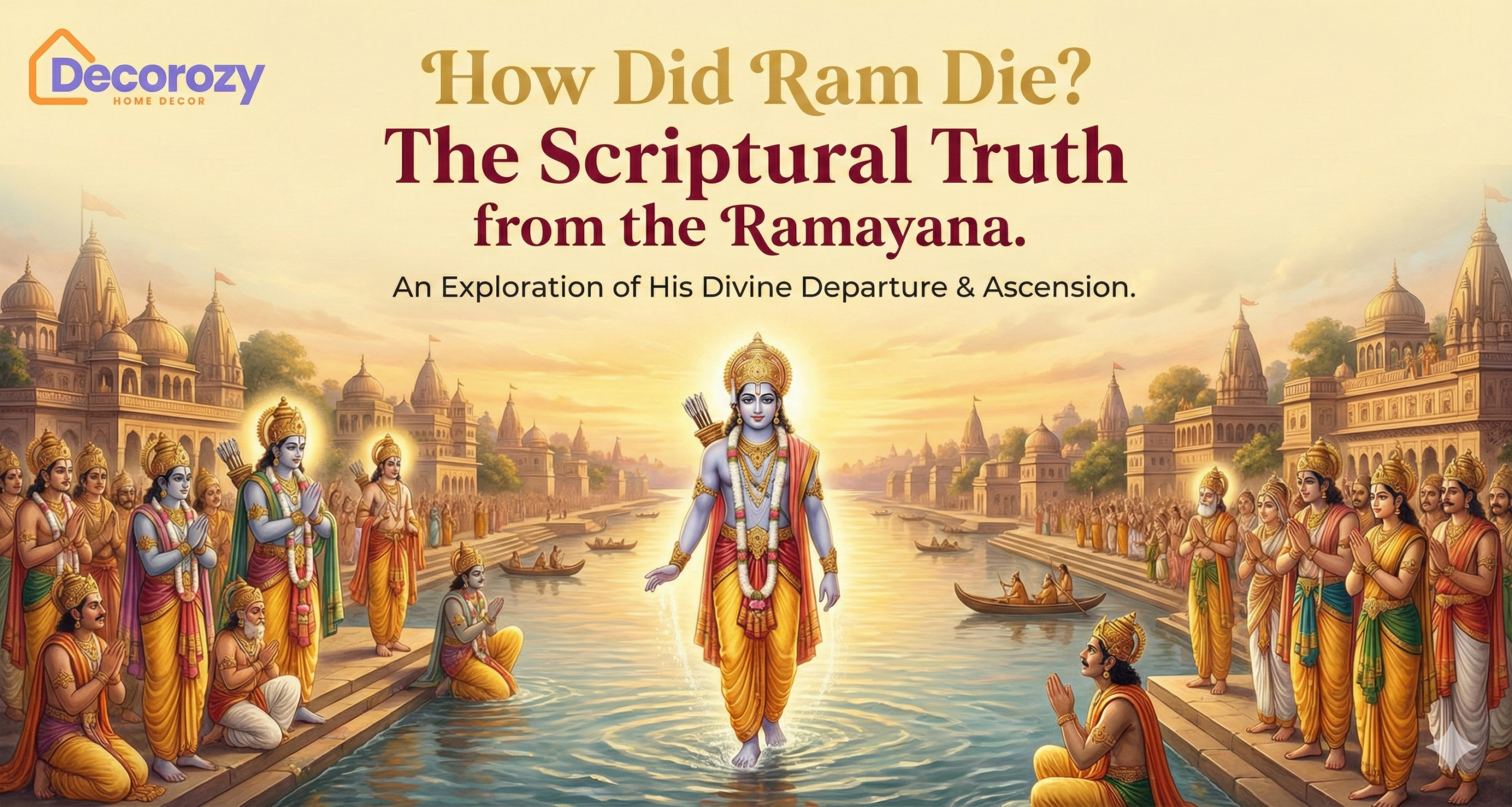
According to the Uttara Kanda and the Padma Purana, Lord Rama did not die a biological death. Instead, he took Jal Samadhi in the Sarayu River. After fulfilling his earthly mission and establishing Ram Rajya, he abandoned his mortal coil to return to his eternal abode, Vaikuntha.
The Visit of Kala Deva and the Vow of Silence
In the final stages of his earthly journey, a mysterious saint visited the court of Ayodhya. This visitor was actually Kala Deva (the personification of Time). He requested a private meeting with Lord Rama to discuss the end of his incarnation.
To ensure total privacy, Rama appointed his brother Lakshmana as the guard. He issued a stern decree: anyone who interrupted the meeting would face the death penalty. This high-stakes promise set the stage for a tragic series of events rooted in divine destiny.
The Wrath of Sage Durvasa and Lakshmana’s Sacrifice
While the secret meeting was underway, the short-tempered Sage Durvasa arrived, demanding an immediate audience with the King. True to his duty, Lakshmana refused entry. Infuriated, Durvasa threatened to curse the entire kingdom of Ayodhya if he were made to wait.
Facing a “How did Ram die” dilemma or the destruction of his people, Lakshmana chose self-sacrifice. He interrupted the meeting to save the kingdom from the curse. Knowing the penalty for his interruption was death, and unable to bear the thought of Rama executing him, Lakshmana chose to enter the Sarayu River first, performing Jal Samadhi to return to his form as Shesha Naag.
How Did Ram Die? The Final Journey to the Sarayu River
With Lakshmana gone and his mission as an avatar complete, Lord Rama realized it was time to leave the mortal world. He did not view this as an end, but as a Mahaprasthana (Great Journey). He walked toward the banks of the sacred Sarayu River, followed by the grieving citizens of Ayodhya.
As he stepped into the deepest part of the water, he meditated on his divine essence. The scriptures describe him transforming into his four-armed form of Lord Vishnu, ascending to Vaikuntha. This act of spiritual immersion explains exactly how did Ram die—it was a conscious transition from the physical realm to the eternal.
Conclusion: The Legacy of the Seventh Avatar
The story of Lord Rama’s departure is as profound as his life. It teaches us about the impermanence of the physical body and the unwavering nature of Dharma. Although the original Valmiki Ramayana focuses on his victory, the later texts provide the spiritual closure many seek. Lord Rama’s legacy lives on not in his “death,” but in the righteous path he paved for humanity.
Section 3: FAQ Schema
Q: Is the death of Lord Rama mentioned in the original Valmiki Ramayana? A: No, the core narrative of the Valmiki Ramayana typically concludes with Rama’s return to Ayodhya and his coronation. The details regarding his departure and Jal Samadhi are found in the Uttara Kanda and other Puranic texts like the Padma Purana.
Q: Why did Lord Rama have to leave Earth? A: As an avatar of Vishnu, Rama took human form to defeat Ravana and establish righteousness. Once Ram Rajya (the ideal kingdom) was established and his earthly duties were fulfilled, Kala Deva reminded him it was time to return to his divine form in Vaikuntha.
Q: What is Jal Samadhi? A: Jal Samadhi is a sacred practice in Hindu tradition where a divine being or a high-realized soul consciously leaves their physical body by immersing themselves in a holy river. In the context of Lord Rama, it signifies his transition from mortality back to his eternal state as Lord Vishnu.











One thought on “How Did Ram Die? The Scriptural Truth from the Ramayana”
According to my knowledge/understanding Durwasa Rikhi was the cause of distruction of Lord Krishna’s dynisty. There is huge time difference between Duaper &Treta, Durwasa Rikhi must be greater than Rama &Krishna. May he still be around us?