The Mystery of the Ekadanta: A Sacred Sacrifice
Lord Ganesha, the elephant-headed deity of wisdom, is universally adored for his role as the remover of obstacles. However, one of his most striking physical features often sparks curiosity: his singular, broken tusk. Known as Ekadanta, this iconic imagery holds deep spiritual significance. If you have ever wondered who broke the tooth of Lord Ganesha, the answers lie within ancient Puranic legends that blend divine duty with selfless sacrifice.
Quick Answer: Who Broke the Tooth of Lord Ganesha?
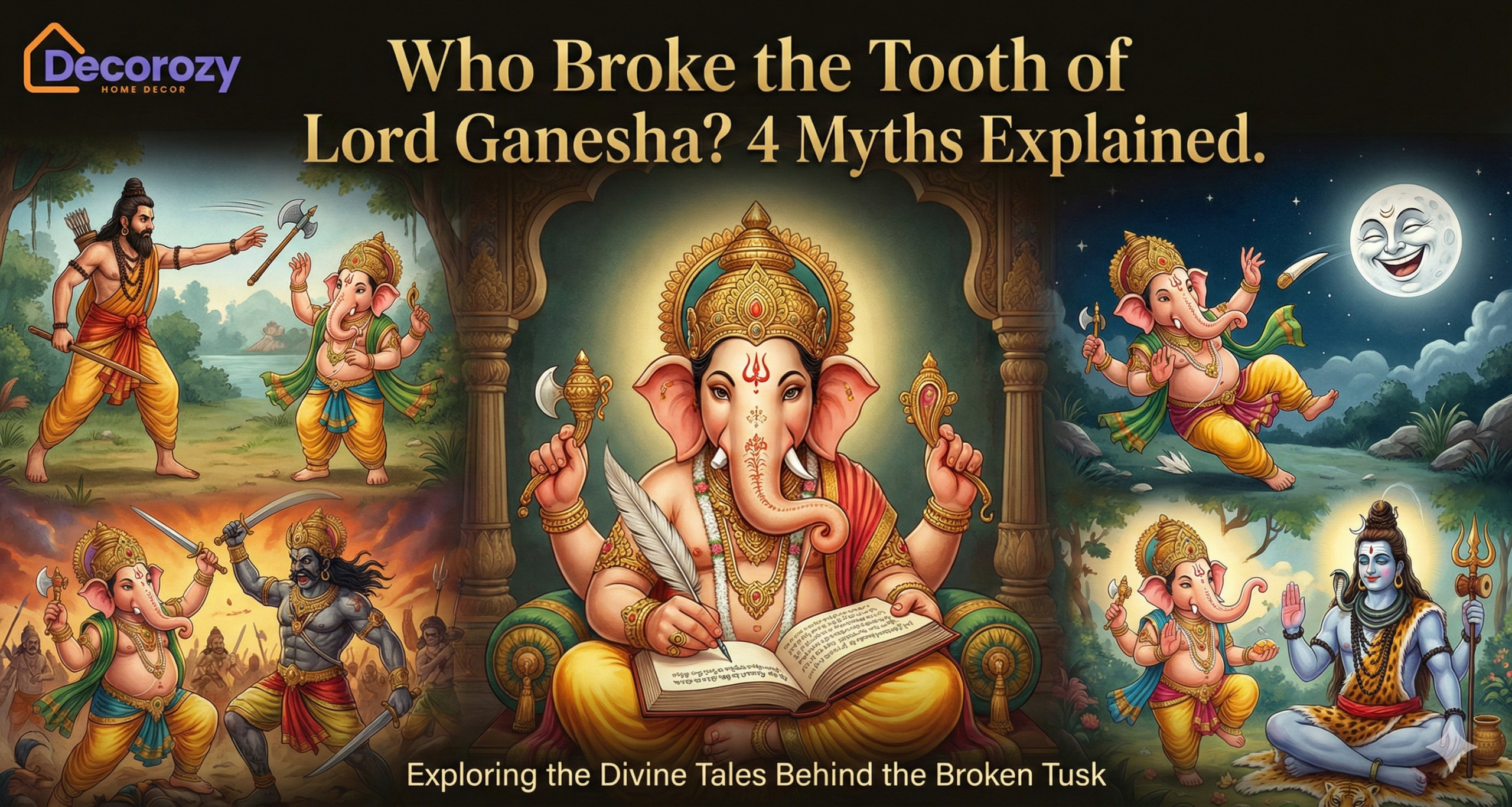
The most widely accepted legend states that Parashurama broke Lord Ganesha’s tooth with a divine axe after Ganesha blocked his entry to see Lord Shiva. Other traditions suggest Ganesha broke it himself to write the Mahabharata or to defeat the demon Gajmukhasur.
The Epic Duel: How Parashurama Broke the Tooth of Lord Ganesha
According to the Brahmanda Purana, the sixth avatar of Vishnu, Parashurama, visited Mount Kailash to thank Lord Shiva after a great military victory. However, Ganesha stood guard while his father meditated and refused entry to the vengeful warrior.
Enraged by the obstruction, Parashurama hurled his divine axe—a gift from Shiva himself—at the young deity. Recognizing the weapon as his father’s power, Ganesha chose to receive the blow rather than disrespect it. The impact severed his left tusk, forever earning him the title of the “One-Toothed Lord.”
Scribal Sacrifice: The Writing of the Mahabharata
Another profound narrative regarding who broke the tooth of Lord Ganesha centers on the creation of the world’s longest epic poem. When Sage Ved Vyasa needed a scribe for the Mahabharata, Ganesha agreed under the condition that the narration must never pause.
During the intense recitation, Ganesha’s pen suddenly snapped. To uphold his vow and ensure the flow of knowledge remained uninterrupted, he broke off his own tusk to use as a stylus. This act symbolizes that no sacrifice is too great for the pursuit of wisdom and dharma.
Divine Battles and Celestial Curses
Beyond these two famous accounts, Hindu mythology offers additional perspectives on Ganesha’s missing tusk:
- The Moon’s Hubris: One legend tells of the Moon God laughing at Ganesha’s appearance. In a flash of divine anger, Ganesha snapped off his tusk and hurled it at the Moon, cursing it to lose its constant glow.
- Gajmukhasur’s Defeat: In a battle against the invincible demon Gajmukhasur, Ganesha realized conventional weapons were useless. He sacrificed his tusk, turning it into a powerful projectile to subdue the demon and transform him into his vahana (mount), the mouse.
- The Brotherly Spat: The Bhavishya Purana mentions a conflict with his brother, Lord Kartikeya, who reportedly broke the tooth in a fit of rage during a disagreement over a scholarly text.
Conclusion: Embracing Perfection in Imperfection
Whether it was an act of humility toward his father’s weapon or a dedication to literature, the story of who broke the tooth of Lord Ganesha teaches us about the beauty of sacrifice. His broken tusk serves as a reminder that true perfection lies in fulfilling one’s duty, regardless of physical costs.
Would you like to explore our collection of handcrafted Ganesha idols to bring the energy of Ekadanta into your home?
Section 3: FAQ Schema
Q: Why is Ganesha called Ekadanta? A: Ganesha is called Ekadanta because the word translates to “the one with a single tusk.” This name honors the sacrifice he made, whether it was defending his father’s privacy or completing the sacred text of the Mahabharata.
Q: Which side of Ganesha’s tusk is broken? A: While depictions can vary by region and artistic style, most traditional Puranic accounts and idols show that Ganesha’s right tusk is the one that is broken or held in his hand, though some stories specifically mention the left.
Q: What is the spiritual meaning of the broken tusk? A: The broken tusk symbolizes the transcendence of duality. It teaches devotees that to achieve great goals or preserve knowledge, one must be willing to sacrifice personal ego and physical completeness for a higher purpose.