The Incredible Panchmukhi Hanuman Story: Origins and Spiritual Significance
The Ramayana remains one of the greatest epics ever told, teeming with divine figures who embody courage and righteousness. Among these, Lord Hanuman stands as the ultimate symbol of “Bhakti” and “Shakti.” While many recognize his monkey-faced form, the Panchmukhi Hanuman story reveals a deeper, more formidable avatar.
Quick Answer: What is the Panchmukhi Hanuman Story?
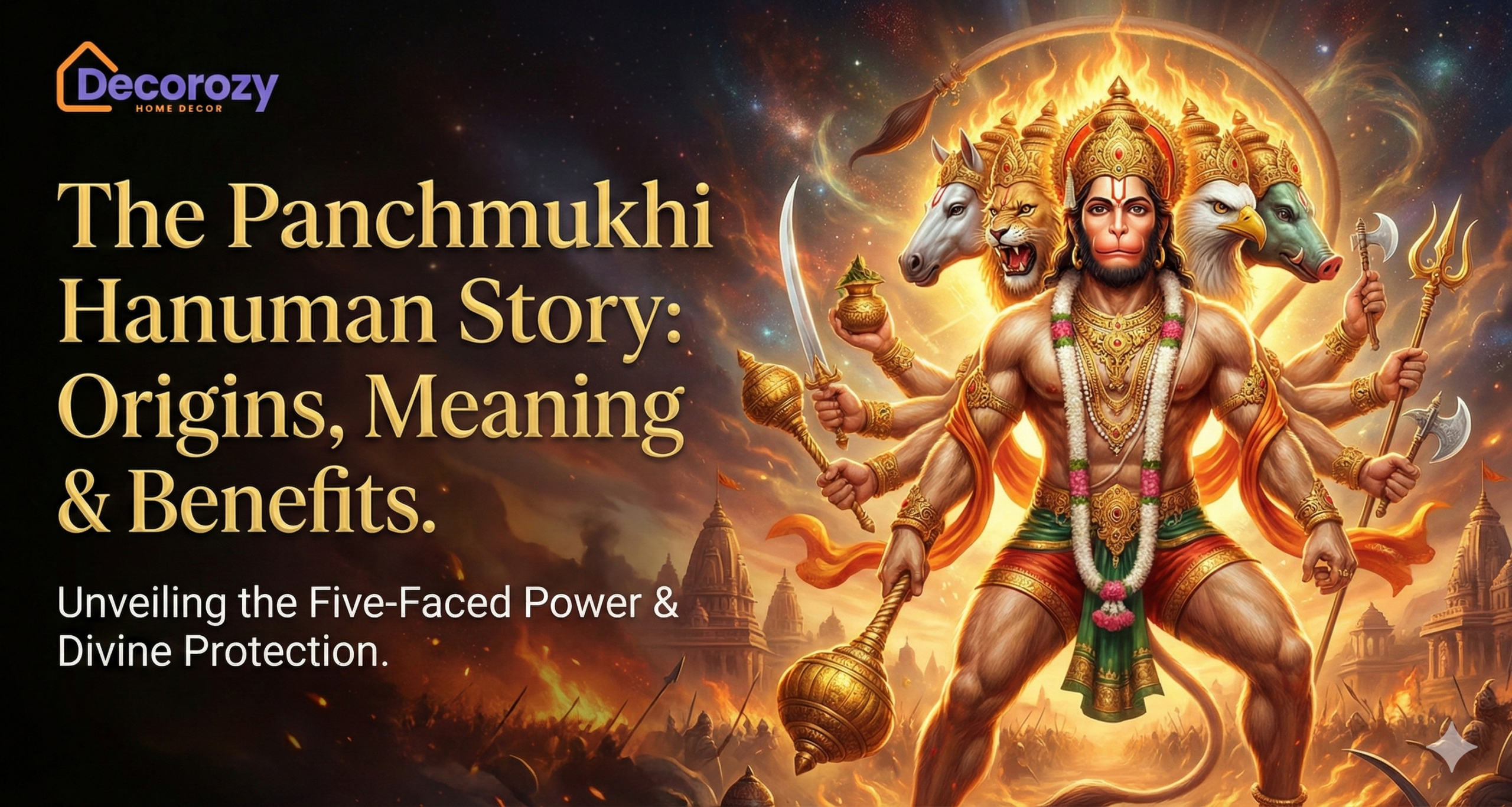
The Panchmukhi Hanuman story describes how Lord Hanuman assumed a five-faced form to rescue Lord Rama and Lakshmana from the underworld (Patala). To kill the demon Ahiravana, Hanuman had to extinguish five lamps hidden in different directions simultaneously, leading him to manifest as Panchmukhi.
The roots of the Panchmukhi Hanuman story lie in a critical moment during the battle of Lanka. After the fall of Indrajit, Ravana sought help from his brother Ahiravana, a powerful practitioner of dark arts and king of the underworld.
Despite Hanuman’s vigilant guard, Ahiravana used illusion to disguise himself as Vibhishana and abducted Rama and Lakshmana. Hanuman journeyed to Patala Loka to rescue them, where he encountered the secret to the demon’s life: five lamps lit in five cardinal directions.
To snuff out these flames all at once and bypass Ahiravana’s immortality, Hanuman manifested his divine five-faced form. This miraculous transformation allowed him to protect his Lord and restore balance to the universe.
Benefits of Worshipping the Five Faces
Understanding the Panchmukhi Hanuman story is incomplete without recognizing what each face represents. Every direction offers a unique spiritual shield for the devotee:
- East (Hanuman): Grants purity of mind and removes the stains of sin.
- South (Narasimha): The lion-man avatar who removes fear and ensures victory over enemies.
- West (Garuda): The celestial bird that wards off negative energy, black magic, and evil spells.
- North (Varaha): The boar incarnation providing stability, prosperity, and cosmic balance.
- Upward (Hayagriva): The horse-faced deity bestowing supreme wisdom, knowledge, and progeny.
Detailed Analysis: Symbolism and Placement
Beyond the legend, this avatar is deeply rooted in the five elements: Earth, Water, Fire, Air, and Ether. It serves as a reminder that Hanuman’s protection is omnipresent.
For those looking to bring this energy into their space, Vastu experts suggest placing a Panchmukhi Hanuman image or brass idol facing the main entrance or in the Southwest corner. This placement is believed to act as a spiritual firewall against negative influences.
Devotees often practice the five-fold path of worship—Naman, Smaran, Keerthanam, Yachnam, and Arpanam—to connect with this powerful energy. By chanting the Panchmukhi Hanuman Kavach, believers invoke a divine shield that guards against life’s obstacles.
Conclusion
The Panchmukhi Hanuman story is a testament to the lengths a devotee will go to protect the divine. This five-faced avatar offers a comprehensive shield, covering every direction of a seeker’s life. Whether you seek wisdom, protection, or inner peace, the grace of Panchamukha Anjaneya is absolute.
Ready to bring divine protection to your household? Browse our collection of handcrafted Panchmukhi Hanuman brass idols and invite positivity today.
Section 3: FAQ Schema (People Also Ask)
1. Can Panchmukhi Hanuman be kept at home? Yes, you can keep a Panchmukhi Hanuman portrait or idol at home. It is best placed in the puja room or near the entrance facing outwards to ward off evil spirits. According to Vastu, the Southwest direction is ideal for attracting stability and strength.
2. Why did Hanuman take the five-faced form? Hanuman took this form specifically to kill the demon Ahiravana. The demon’s life was tied to five lamps kept in five different directions. To kill him, all lamps had to be extinguished at once, which Hanuman achieved by manifesting five faces.
3. What weapons does Panchmukhi Hanuman hold? In this form, Hanuman is often depicted with ten arms holding various divine weapons. These include his iconic Gada (mace), a sword (Khanda), a trident (Trishul), a disc (Chakra), and a bow, each symbolizing his power to destroy different facets of evil.