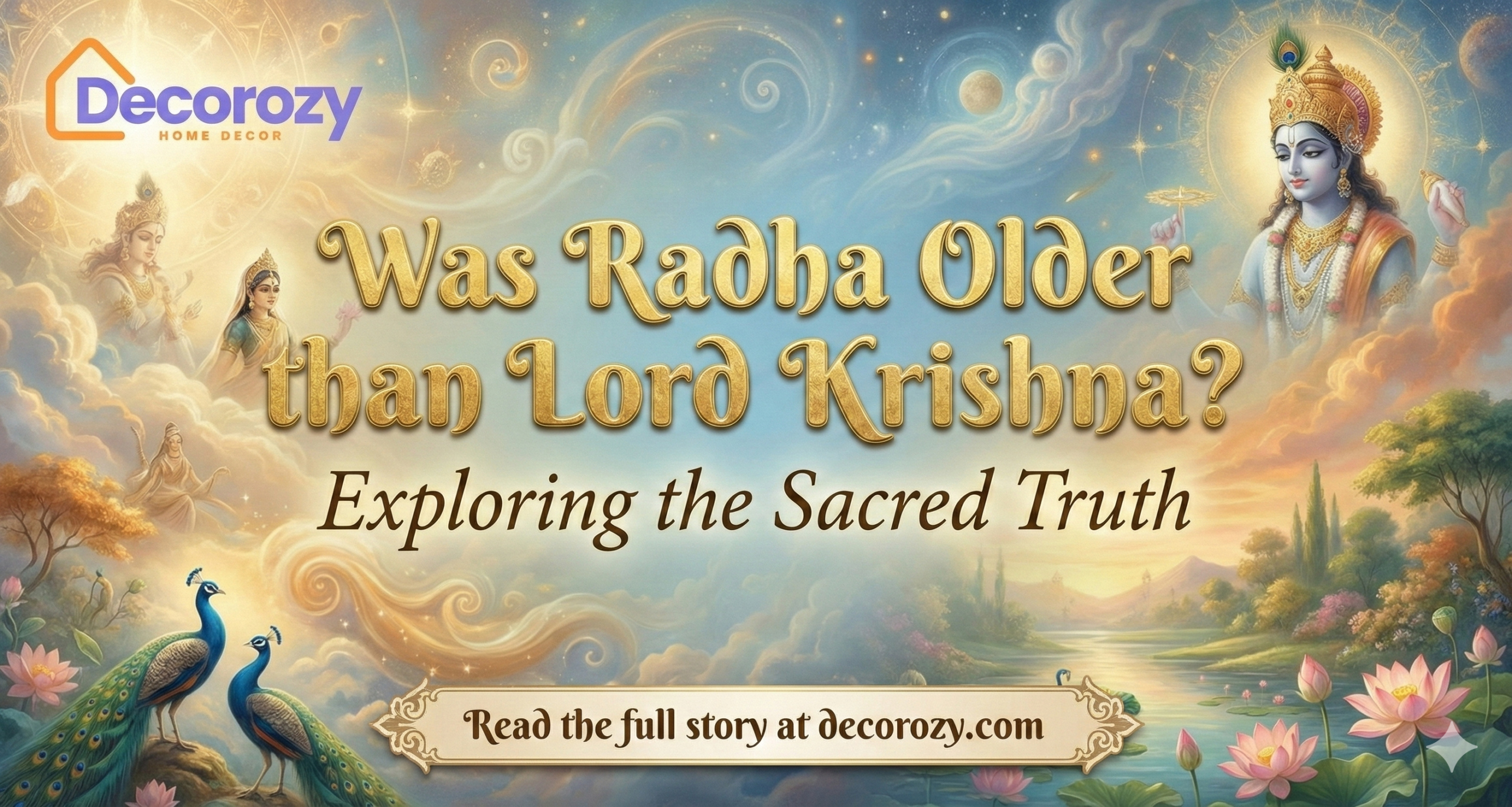
The love story of Radha and Lord Krishna is perhaps the most treasured narrative of pure, unconditional devotion in Hindu history. Their celestial union is not merely a tale of romantic affection but a profound symbol of the human soul’s eternal bond with the Divine. As devotees across the globe celebrate their connection through art, music, and dance, one intriguing question frequently arises among seekers: Was Radha older than Lord Krishna?
Quick Answer: Was Radha Older than Lord Krishna?
According to various mythological accounts and local traditions, Radha was indeed older than Lord Krishna, with many sources suggesting an age gap of approximately five to ten years. However, in Vedic philosophy, their relationship transcends physical age, symbolizing the timeless union of the individual soul (Atma) with the Supreme Consciousness (Paramatma).
The Mystical Nature of Radha and Krishna’s Bond
To truly grasp the dynamics of their relationship, one must look beyond the earthly lens of linear time. In the spiritual realm, the question of whether Radha was older than Lord Krishna shifts from chronological years to spiritual maturity. Radha is often viewed as the Hladini Shakti—the pleasure potency of the Divine.
Philosophically, if Krishna is the Sun, Radha is the sunlight; they are inseparable and co-eternal. Many scholars suggest that Radha’s “seniority” in the stories symbolizes her role as the embodiment of Mahabhava, the highest state of devotional ecstasy, which serves as a guide for all other seekers.
Historical and Mythological Accounts of the Age Gap
Traditional folklore in the Braj region provides specific narratives regarding their first meeting. One popular account describes a scene where Yashoda tied a mischievous young Krishna to a grinding stone. During this time, a twelve-year-old Radha is said to have encountered the young Krishna, feeling an immediate, divine attraction to his celestial charm.
- The 10-Year Gap: Many oral traditions and later Puranic interpretations suggest Radha was born roughly 10 to 12 years before Krishna.
- Spiritual Authority: Because she was older, Radha often took on a protective, mentoring role among the Gopis, leading the Ras Leela with a sense of maturity and spiritual grace.
- The Secret Marriage: Some texts, such as the Brahma Vaivarta Purana, mention that Lord Brahma performed a secret wedding ceremony for them in the Bhandirvan forest, acknowledging their eternal status regardless of earthly age.
Why the Age of Radha Matters in Hindu Philosophy
When discussing was Radha older than Lord Krishna, we uncover a deeper layer of “Parakiya Bhava”—a love that exists outside the conventional boundaries of social contracts like marriage. This “older” status reinforces the idea that Radha’s love was entirely selfless and devoid of worldly expectations.
In many traditions, Radha is considered the spiritual mentor of Krishna. Her wisdom and unwavering devotion light the way for his earthly journey. This age difference serves as a literary and spiritual device to show that true devotion (Bhakti) is not restricted by the physical laws of growth or time. It highlights that the soul’s maturity is far more significant than the body’s age.
Reconciling Different Scriptural Interpretations
Interestingly, the name “Radha” does not appear in the earliest Sanskrit texts like the Mahabharata or the Srimad Bhagavatam. Instead, these texts refer to a “special Gopi” who was Krishna’s favorite. It wasn’t until the medieval Bhakti movement and works like Jayadeva’s Gita Govinda that Radha’s persona was fully flourished in literature.
Some schools of thought argue that Radha and Rukmini are the same soul. Since Rukmini is the incarnation of Goddess Lakshmi and the formal Queen of Dwarka, her “Radha” manifestation in Vrindavan represents the more esoteric, emotional side of the same divine energy. Whether she was older in years or simply “senior” in her level of devotion, her position as the “Queen of Vrindavan” remains undisputed.
Conclusion: A Love Beyond Time
Ultimately, the question of whether Radha was older than Lord Krishna serves to remind us that divine love is not bound by material constraints. Their relationship is a timeless truth that continues to inspire spiritual growth and deep devotion. Whether she was his elder by ten years or his eternal counterpart from the beginning of time, Radha remains the ultimate symbol of the soul’s surrender to God.
Would you like me to create a detailed comparison table between the different depictions of Radha in the Puranas versus the Bhakti poetry?
FAQ: Common Questions About Radha and Krishna
1. Why is Radha’s name taken before Krishna’s? Krishna himself granted a boon that Radha’s name would always be recited first. This signifies that one can only reach the Divine (Krishna) through the path of pure devotion (Radha). Hence, the world says “Radhe Krishna.”
2. Did Radha and Krishna ever get married? While they did not have a conventional social marriage in the material world, many scriptures like the Garga Samhita describe a celestial wedding performed by Lord Brahma in the forest of Vrindavan, signifying their eternal spiritual union.
3. Is Radha mentioned in the original Vedas? The specific name “Radha” is not prominent in the four original Vedas or the early Puranas. She emerged as a central figure during the medieval period through the works of various saints and poets who emphasized the Rasa (emotional) aspect of spirituality.