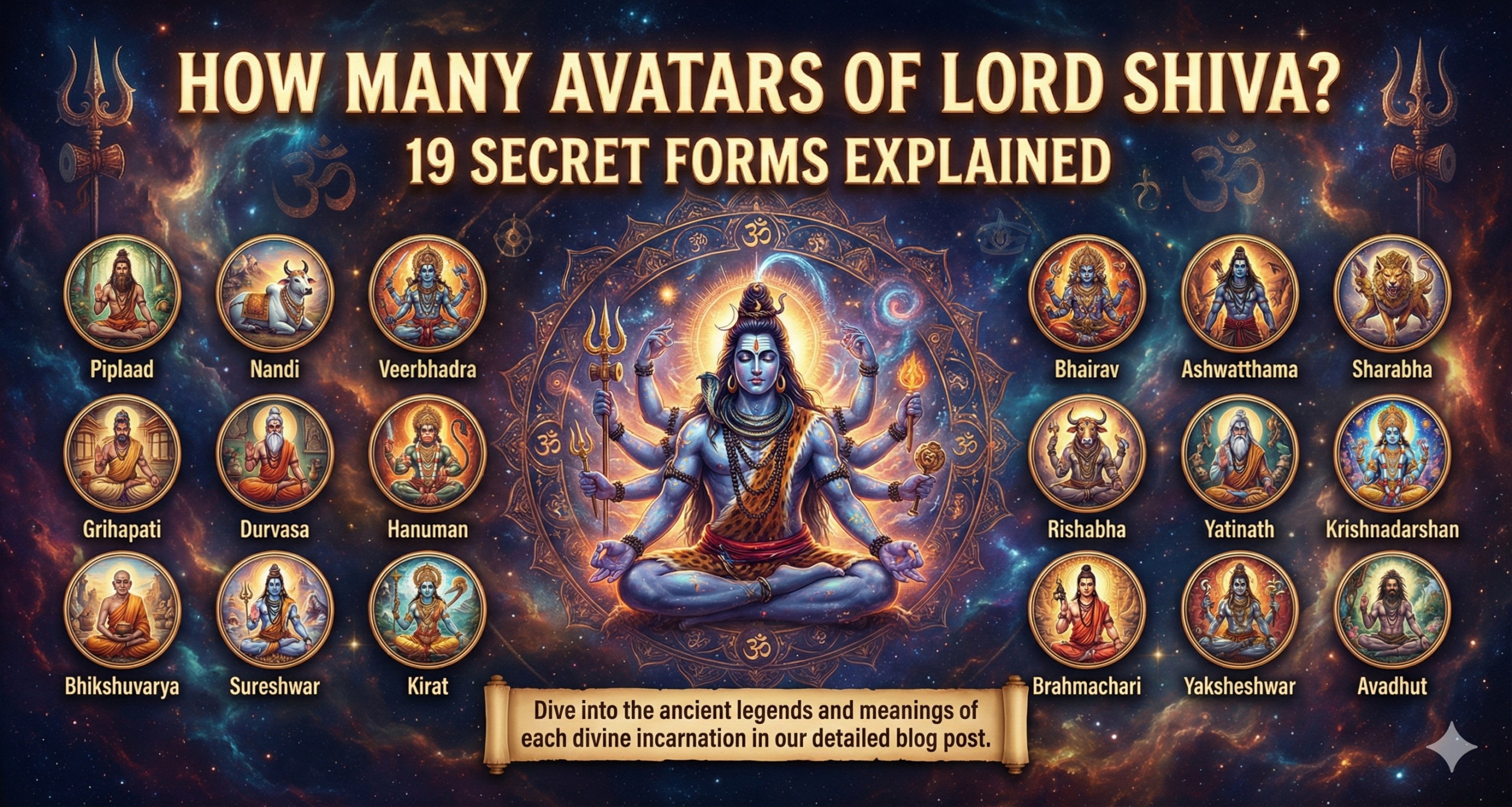

How Many Avatars of Lord Shiva? Unlocking the Mystical Secrets
Lord Shiva, the Adiyogi and the destroyer within the Hindu holy trinity, is often perceived as an ascetic dwelling on Mount Kailash. However, his divine presence is far more dynamic. To maintain cosmic balance, Mahadev manifests in various forms, leading many seekers to ask: how many avatars of Lord Shiva actually exist?
Quick Answer: How Many Avatars of Lord Shiva?
While Lord Shiva is essentially formless (Brahman), the Shiva Purana identifies 19 principal avatars. Unlike the full reincarnations of Vishnu, Shiva’s avatars are often Anshavtars (partial incarnations) or Rudras (fierce manifestations) appearing instantly to destroy ego, protect devotees, or restore Dharma across different Yugas.
Understanding the Concept: How Many Avatars of Lord Shiva?
In Hinduism, the concept of an “avatar” for Shiva differs slightly from the Dashavatara of Lord Vishnu. While Vishnu descends to Earth for a full lifespan, Shiva’s manifestations are often spontaneous bursts of cosmic energy.
Whether it is the fierce Veerabhadra born from a strand of hair or the loyal Hanuman born as an Ansh (part), these forms serve specific divine purposes. Understanding how many avatars of Lord Shiva are recognized helps devotees connect with the specific energy needed for their spiritual journey, ranging from protection to profound wisdom.
The 19 Principal Avatars of Lord Shiva
The Shiva Purana provides the most authoritative list regarding how many avatars of Lord Shiva are primary to his mythology. Each form represents a unique virtue or cosmic lesson.
- Piplaad: The son of Rishi Dadhichi who famously disciplined Shani Dev to protect devotees.
- Nandi: The divine bull representing unwavering devotion and the gatekeeper of Kailash.
- Veerabhadra: A terrifying warrior created to avenge Sati, symbolizing righteous anger.
- Bhairava: The “terrible” protector who destroyed Brahma’s ego and guards sacred sites.
- Ashwatthama: The immortal warrior from the Mahabharata, born of Shiva’s power.
- Sharabha: A bird-lion hybrid that appeared to calm the fierce Narasimha avatar.
- Grihapati: A form that emphasizes the divinity found within domestic life and household harmony.
- Durvasa: The short-tempered sage who maintains cosmic discipline through his trials.
- Rishabha (Vrishabha): The bull form that restored order during conflicts between gods and demons.
- Yatinath: A peaceful traveler who tested the hospitality and devotion of a tribal couple.
- Hanuman: The most famous avatar, representing the pinnacle of strength and selfless service.
- Krishna Darshan: A manifestation highlighting the importance of Yagna (sacrifice) and rituals.
- Bhikshuvarya: The mendicant who protects orphans and teaches the value of detachment.
- Sureshwar: A form that disguised itself as Indra to test the purity of his followers’ faith.
- Keerat (Kirateshwar): A hunter who challenged Arjuna’s skill to grant him the Pasupata weapon.
- Sunatnartak: The wandering dancer who asked King Himalaya for Parvati’s hand in marriage.
- Brahmachari: The celibate student form used to test Parvati’s resolve during her penance.
- Yaksheshwar: A form that humbled the Devas after they became arrogant following a victory.
- Avadhut: The ultimate liberated soul who shattered the pride of Indra.
Benefits of Worshipping Shiva’s Diverse Forms
Worshipping different manifestations of Mahadev allows devotees to tap into specific frequencies of divine energy. For instance, the Bhairava form is sought for protection against negative energies, while the Hanuman avatar is invoked for courage and mental strength.
By knowing how many avatars of Lord Shiva there are, you can tailor your spiritual practice. These forms teach us that the Divine is not a static concept but a living, breathing force that adapts to the needs of the universe, whether through the serenity of a meditator or the fury of a warrior.
Detailed Analysis: The 11 Rudras and 64 Manifestations
Beyond the 19 primary forms, the Shatarudra-samhita mentions the 11 Rudras (Ekadasha Rudras). These are fierce celestial beings—Kapali, Pingal, Bheem, and others—who assist in cosmic destruction and the management of the universe.
Furthermore, Tamil traditions like the Thiruvilayadal Puranam describe 64 divine interventions of Shiva. When we look at the 12 Jyotirlingas, such as Kashi Vishwanath or Kedarnath, we see that Shiva’s presence is also anchored to the Earth through pillars of light, proving that his forms are truly infinite.
Conclusion
Lord Shiva remains the ultimate paradox—the formless Adiyogi who manifests in 19 primary ways to guide humanity. From the fierce Veerabhadra to the compassionate Bhikshuvarya, each avatar offers a path to liberation and a way to conquer the ego.
Would you like me to create a detailed guide on how to worship a specific Shiva avatar for protection or spiritual growth?

Pure Brass Shiv Parivar Idol with Nandi | Shiva Family Murti for Home Mandir
Experience divine balance and family harmony with this
Pure Brass Shiv Parivar Idol,
featuring Lord Shiva, Maa Parvati, Lord Ganesha, Kartikeya, and sacred Nandi,
perfect for home mandir, office, and spiritual décor.
- Material: This idol is made of brass
- Dimensions (L × W × H): 8 × 5.2 × 6.5 cm
- Weight: 160 grams
83 in stock
Section 3: FAQ Schema (People Also Ask)
Q1: Who is the most powerful avatar of Lord Shiva? A1: While all avatars carry the essence of Mahadev, Veerabhadra and Bhairava are considered his most powerful fierce forms, while Hanuman is regarded as the most powerful in terms of devotion and physical strength.
Q2: Is Hanuman an avatar of Shiva? A2: Yes, according to various scriptures including the Shiva Purana, Lord Hanuman is considered an Anshavtar (partial incarnation) of Lord Shiva, specifically the 11th Rudra manifestation.
Q3: Why did Shiva take 19 avatars? A3: Lord Shiva took 19 primary avatars to perform specific tasks such as testing the devotion of his followers, destroying the ego of other gods (like Indra and Brahma), and restoring cosmic balance during various Yugas.