
Who Was Lord Hanuman’s Father? Unraveling the Mysteries of the Vayuputra
Lord Hanuman, the legendary Vanara hero of the Ramayana, remains one of the most revered figures in Hindu dharma. Known for his unwavering devotion to Lord Rama and his incomparable strength, his origins are as fascinating as his feats. Many devotees often find themselves asking: Who is Lord Hanuman’s father?
To understand the lineage of the “Monkey God,” one must look beyond a single name. The answer involves a beautiful blend of earthly royalty, celestial intervention, and the supreme grace of Lord Shiva.
Quick Answer: Who is Lord Hanuman’s Father?
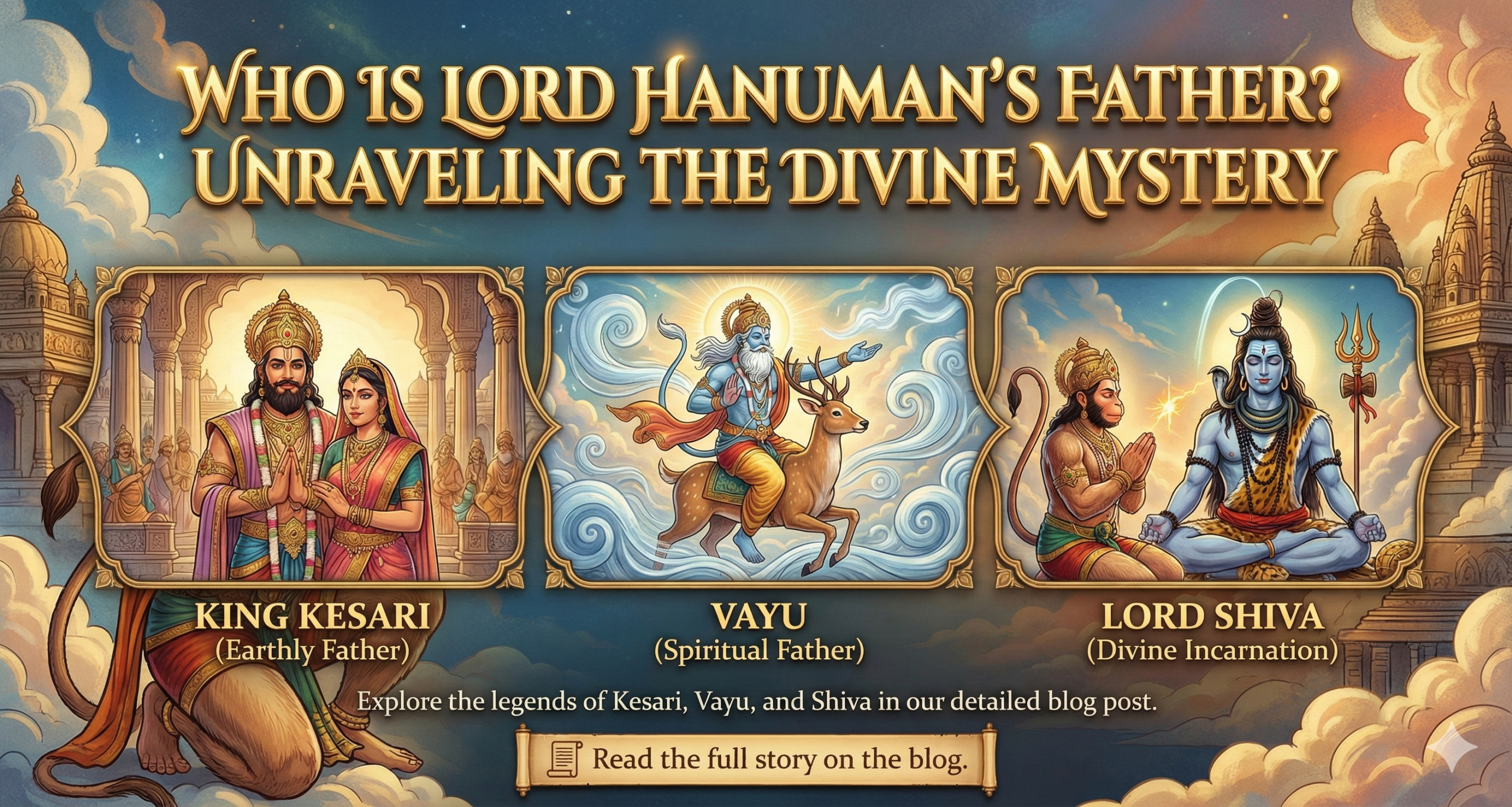
Lord Hanuman’s father is traditionally recognized in two forms: his earthly, biological father Kesari, the Vanara King of Sumeru, and his spiritual father Vayu, the Wind God. Additionally, Hanuman is considered an Ansh Avatar (partial incarnation) of Lord Shiva, born through divine intervention.
The Earthly Lineage: King Kesari and Anjana
The primary name associated with Lord Hanuman’s father in physical form is Kesari. A powerful and righteous Vanara chief, Kesari ruled over the region of Sumeru. Alongside his wife, Anjana, a celestial nymph (Apsara) who lived on Earth due to a curse, he performed intense penance to seek a child of extraordinary caliber.
Because of this lineage, Hanuman is frequently addressed by the title Kesari Nandan (son of Kesari). This connection grounds Hanuman in the physical world, representing the virtues of courage, discipline, and the fruit of human perseverance.
The Divine Connection to Vayu Deva
While Kesari was his earthly father, Hanuman is most famously known as Vayuputra or Pavanputra, meaning “Son of the Wind.” The role of Lord Hanuman’s father is attributed to the Wind God, Vayu, due to his pivotal role in Hanuman’s birth.
According to the Bhavartha Ramayana, Vayu carried the divine payasam (sacred pudding) from King Dasharatha’s ritual to the hands of Anjana as she prayed. This celestial energy, combined with the blessings of Lord Shiva, resulted in the birth of a child with the power of the wind—capable of flying at immense speeds and possessing limitless vitality.
The Symbolism of Dual Parentage
The duality of having both a Vanara king and a Vedic deity as a father serves a profound symbolic purpose. It represents the perfect union of Earthly Valor and Divine Grace.
- Kesari provided the physical form and the warrior spirit.
- Vayu provided the spiritual essence, speed, and superhuman abilities.
- Anjana provided the vessel of devotion and motherhood.
This unique heritage is why Hanuman is celebrated as Anjaneya (son of Anjana) and Maruti (son of Maruta/Vayu) simultaneously. His life proves that when human effort (Kesari) meets divine blessing (Vayu), the result is a force that can move mountains.
Conclusion: Honoring the Son of Kesari and Vayu
Whether you revere him as Kesari Nandan or Vayuputra, the essence of Lord Hanuman’s father lies in the strength and spirit passed down through these legends. Hanuman remains a bridge between the human and the divine, reminding us that we all carry a spark of the celestial within our earthly lives.
Would you like to learn more about the specific mantras used to honor Hanuman’s divine lineage?

Pure Brass Ram Darbar Idol | Lord Ram Sita Lakshman Hanuman Murti
Experience the beauty of devotion with this
Pure Brass Ram Darbar Idol,
featuring Lord Ram, Maa Sita, Lakshman ji, and Hanuman ji, ideal for
home mandir, office, and spiritual spaces.
- Material: This idol is made of pure brass
- Dimensions (L × W × H): 7 × 4.2 × 7.5 cm
- Weight: 145 grams
83 in stock
Section 3: FAQ Schema
Q: Why is Hanuman called Vayuputra if Kesari is his father? A: Hanuman is called Vayuputra because the Wind God, Vayu, acted as the spiritual father by delivering the divine energy (Prana) to Anjana’s womb. Kesari is his biological/earthly father who raised him, while Vayu provided his supernatural powers.
Q: Is Lord Hanuman an incarnation of Lord Shiva? A: Yes, many scriptures describe Hanuman as the Rudra Avatar or the 11th manifestation of Lord Shiva. His birth was the result of Anjana’s prayers to Shiva, which were fulfilled through the medium of Vayu.
Q: What are the different names of Hanuman related to his parents? A: Hanuman has several names reflecting his lineage: Anjaneya and Anjaniputra (Son of Anjana), Kesari Nandan (Son of Kesari), and Pavanputra, Maruti, or Vayuputra (Son of the Wind/Vayu)