The Divine Legend of the Dashavatara
Lord Vishnu, the supreme preserver within the Hindu Trimurti, serves as the ultimate guardian of cosmic order. Whenever the world teeters on the brink of chaos, he descends to Earth in various forms to restore balance. These divine incarnations, known as the 10 Avatars of Vishnu, represent a spiritual evolution that spans millions of years across four distinct cosmic ages.
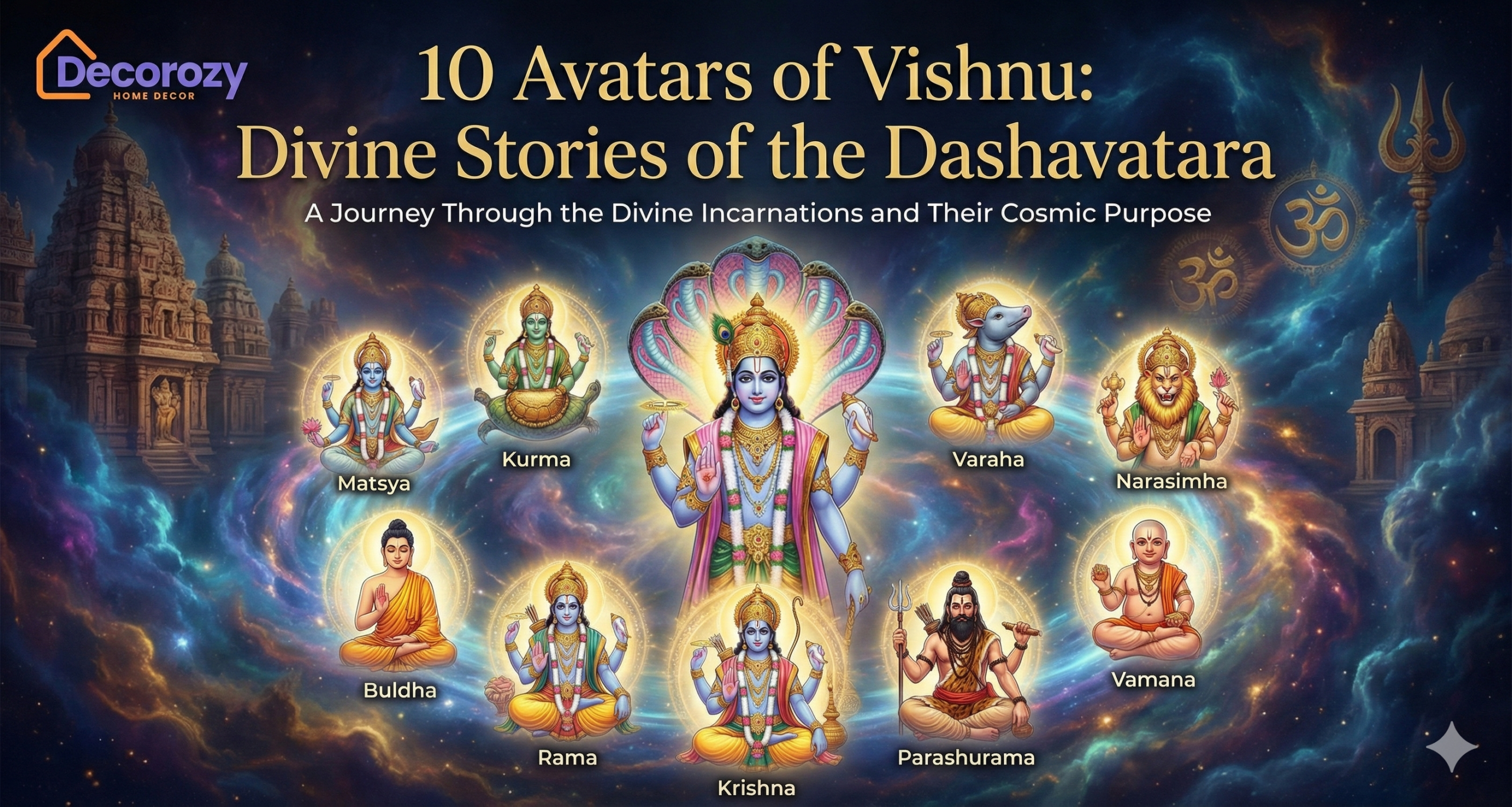
Quick Answer: The 10 Avatars of Vishnu, or Dashavatara, are Matsya (Fish), Kurma (Tortoise), Varaha (Boar), Narasimha (Half-man/Lion), Vamana (Dwarf), Parashurama (Warrior), Rama (King), Balarama/Krishna (Philosopher), Buddha (Sage), and the future warrior Kalki. They appear across the Yugas to destroy evil and protect Dharma (righteousness).
The Purpose and Roles of the 10 Avatars of Vishnu
Why does the supreme deity take physical form? According to Vedic tradition, Vishnu’s incarnations are necessitated by both divine duty and ancient karmic cycles. One primary reason is the curse of Sage Bhrigu, who condemned Vishnu to endure the sufferings of human birth after the deity accidentally killed the sage’s wife while battling Asuras.
Beyond ancient curses, the 10 Avatars of Vishnu manifest to eliminate tyrannical forces and shield the Earth, personified as the Goddess Bhudevi. By taking these forms, Vishnu ensures that the cycle of time (Yugas) progresses according to divine law, moving from the purity of Satya Yuga to the current spiritual challenges of Kali Yuga.
Detailed Analysis: The Journey Through the Yugas
The Dashavatara is not merely a list of stories; it is a chronological map of spiritual and physical evolution. Each avatar corresponds to a specific era of time, addressing the unique darkness of that age.
The Satya Yuga (Golden Age)
- Matsya: The fish who saved King Manu and the sacred Vedas from a Great Flood.
- Kurma: The tortoise who supported Mount Mandara during the churning of the ocean (Samudra Manthan).
- Varaha: The boar who defeated the demon Hiranyaksha to lift the Earth from the primordial depths.
- Narasimha: The fierce half-man, half-lion who destroyed the “unkillable” demon Hiranyakashipu to protect the boy-devotee Prahlada.
The Treta and Dvapara Yugas
- Vamana: The dwarf priest who reclaimed the three worlds from King Bali in just three steps.
- Parashurama: The warrior-sage with an axe who purged the Earth of corrupt and tyrannical kings.
- Rama: The ideal king of Ayodhya whose life, chronicled in the Ramayana, established the standards of morality and sacrifice.
- Balarama/Krishna: The divine brothers who guided humanity through the Great War of Mahabharata, offering the timeless wisdom of the Bhagavad Gita.
The Kali Yuga and the Future
- Buddha: Often cited as the ninth avatar, he taught non-violence and the path to enlightenment to counter rigid dogmatism.
- Kalki: The final avatar, predicted to appear in approximately 432,000 years. Mounted on a white horse with a flaming sword, he will end the darkness of Kali Yuga and herald a new Golden Age.
Conclusion: Embracing the Lessons of the 10 Avatars of Vishnu
The stories of the Dashavatara remind us that the struggle between good and evil is eternal, but righteousness always prevails. From the aquatic depths of Matsya to the enlightened teachings of Buddha, these incarnations offer a blueprint for courage, humility, and devotion.
Would you like me to create a detailed table comparing the specific weapons and powers associated with each of these ten avatars?
Section 3: FAQ Schema (People Also Ask)
Q: Who is the final avatar of Lord Vishnu? A: The final incarnation is Kalki, the future warrior. He is prophesied to appear at the end of the Kali Yuga to cleanse the world of wickedness and restore the Satya Yuga (the Age of Truth).
Q: Why is Buddha sometimes included in the 10 Avatars of Vishnu? A: In many Puranic traditions, Gautama Buddha is included as the ninth avatar to symbolize the shift toward ahimsa (non-violence) and compassion. However, some regional traditions replace him with Balarama, the brother of Krishna.
Q: What is the meaning of “Dashavatara”? A: The term comes from the Sanskrit words “Dasha,” meaning ten, and “Avatara,” meaning incarnation or descent. Together, they refer to the ten primary forms Lord Vishnu takes to preserve the cosmic order.